
Updated October 2026 | The Bulldog Law | California DUI Defense
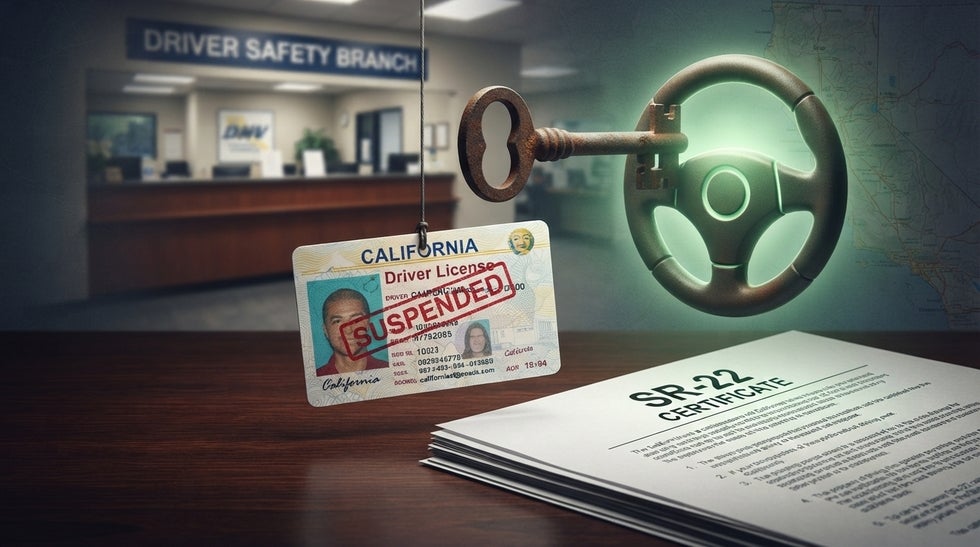
An SR-22 is not insurance. It is a certificate of financial responsibility that your insurer files electronically with the California DMV, proving you carry at least the state's minimum liability coverage, and promising to tell the DMV if that coverage lapses. The DMV requires it before it will reinstate or restrict a license after a DUI or wet reckless conviction, an administrative suspension from a DUI arrest, a chemical test refusal, a conviction for driving on a suspended license, an accident while uninsured, or a negligent operator suspension. The filing itself costs a few dollars; the premium increase that comes with it is the real expense, and it runs for three years from reinstatement, restarting from zero if the policy lapses for a single day.
The Bulldog Law's DUI attorneys get the SR-22 question at the end of nearly every case, when the client is ready to get the license back and discovers that the DMV wants a form their insurer has never heard of. The answer is simple, and the form is easy. The expensive part is decided earlier, in the case: a wet reckless instead of a DUI, a win at the administrative hearing, a restricted license sooner, each changes how long the SR-22 runs and how much the insurer charges while it does. What follows is what the SR-22 is, every situation that triggers it, how it interacts with restricted licenses and interlock devices, and how the resolution of the case affects it. Call (888) 928-1609 or message our team.
What an SR-22 actually is
California's financial responsibility law requires every driver to carry liability insurance, at minimum 30/60/15: $30,000 per person and $60,000 per accident for injury, and $15,000 for property damage, under the limits that took effect in 2025. The SR-22 is the DMV's way of verifying that a driver it does not trust is actually carrying it. The insurer files the certificate, the DMV records it against the license, and the insurer is obligated to file an SR-26, a notice of cancellation, if the policy ends. A driver with an SR-22 on file cannot quietly drop coverage; the DMV finds out within days and suspends the license. The DMV's financial responsibility page describes the forms; the practical rules are below.
Three things an SR-22 is not. It is not a separate policy; it attaches to whatever liability policy the driver buys. It is not proof of full coverage; the DMV requires only the minimums, though a lender may require more. And it is not a California-only concept with California-only insurers; most national carriers file SR-22s, some decline high-risk drivers entirely, and a set of carriers specializes in them. A driver who moves to California with an SR-22 obligation from another state generally has to maintain it here, and a California driver who moves away has to keep the California filing current through the three years.
When the DMV requires one
DUI and wet reckless convictions. A conviction under Vehicle Code 23152 or 23153, or a wet reckless plea under Vehicle Code 23103.5, triggers a license suspension and an SR-22 requirement for reinstatement or for a restricted license. This is the trigger in the large majority of SR-22 cases, and it applies to a wet reckless even though the wet reckless carries no mandatory suspension of its own; the DMV treats the conviction as alcohol-related for financial responsibility purposes.
The administrative suspension. Separately from any conviction, a DUI arrest with a blood alcohol level of 0.08 or more, or a refusal to submit to a chemical test, triggers an administrative per se suspension by the DMV, and reinstatement after that suspension requires an SR-22 whether or not the court case ends in a conviction. Winning the DMV hearing within the 10-day window after arrest, which our attorneys request in every DUI case, removes this trigger.
Driving on a suspended license. A conviction under Vehicle Code 14601 requires an SR-22 for reinstatement, and the underlying suspension, if it was DUI-related, carries its own. The related offense of driving without a license under Vehicle Code 12500 does not usually require one.
Accidents without insurance. A driver involved in an accident while uninsured faces a one-year suspension, and reinstatement requires proof of financial responsibility by SR-22 for three years, under Vehicle Code 16430 and the sections around it. A judgment for accident damages that goes unpaid produces the same requirement until the judgment is satisfied.
Negligent operator suspensions and other DMV actions. A driver suspended for accumulating too many points, or revoked for other reasons, is often required to file as a condition of reinstatement, at the DMV's discretion.
How long, and the lapse rule
The standard period is three years from the date the DMV reinstates or restricts the license. The requirement runs continuously, and the one rule every SR-22 driver has to understand is the lapse: if the policy cancels, expires, or is non-renewed at any point, the insurer files the cancellation notice, the DMV suspends the license, and the three-year period starts over when a new SR-22 is filed. A missed payment in month 34 produces a new three-year obligation. Our attorneys tell clients to set the policy to automatic payment and to call the insurer, not simply switch, if they want to change carriers, because a gap of even a day between policies is a lapse. Driving during a lapse suspension is a Vehicle Code 14601 offense with its own penalties.
The DMV does not send a notice when the three years end; the driver is responsible for knowing the date and asking the insurer to stop filing, which is when the premium comes back down. A driver who forgets continues paying the high-risk rate.
Restricted licenses, interlocks, and the SR-22
California DUI drivers get back on the road in stages, and the SR-22 is required at the first stage. After a first DUI conviction, a driver may obtain a restricted license, to drive to work and to the DUI program, after serving a short hard suspension, by enrolling in the DUI program, filing an SR-22, and paying the reinstatement fee. Since 2019, a driver who installs an ignition interlock device may obtain an IID-restricted license with no hard suspension at all, and the SR-22 is required for that too; the interlock does not replace the filing. The restricted period and the SR-22 period run concurrently, and both end on their own schedules. For a second or third DUI, the hard suspension is longer, the IID period is longer, and the SR-22 period remains three years from whenever reinstatement finally occurs, which is why the filing in a repeat case often starts well after the conviction. Probation conditions, including the zero-tolerance rule our attorneys explain on our Vehicle Code 23154 page, run on their own track.
Non-owner SR-22
A driver who no longer owns a car, who sold it to pay for the case, or whose car was impounded, still needs the SR-22 to get the license back, and insurers sell a non-owner policy for exactly that purpose: liability coverage for the driver when operating a vehicle they do not own, with the SR-22 filed against it. It is less expensive than an owner policy because there is no vehicle, it satisfies the DMV, and it keeps the three-year clock running so that the obligation is finished by the time the driver buys a car. A non-owner policy does not cover a vehicle the driver owns or regularly uses, and a driver who buys a car during the period has to convert to a standard policy without a gap.
What it costs, and how the case decides it
The filing fee is nominal, typically $15 to $50. The premium is the cost. An SR-22 marks the driver as high-risk, and California insurers price a DUI conviction accordingly: increases of two to three times the prior premium are common, for the full three years, and some carriers decline to write the policy at all, which pushes the driver to a specialty carrier at a higher rate. Over three years the difference can run into thousands of dollars, which is more than most DUI fines.
That is why the SR-22 is decided in the case, not at the DMV counter. A wet reckless still triggers the filing, but insurers treat a reckless driving conviction more favorably than a DUI at renewal, and some do not surcharge it at all. Winning the administrative hearing removes the APS trigger and, if the court case is dismissed or reduced to a non-alcohol offense, can remove the SR-22 requirement entirely. A plea to a non-alcohol reckless, where the facts allow it, avoids the filing. And a felony DUI or a repeat offense extends the suspension, the IID period, and the time before the three-year SR-22 clock even begins. Our DUI defense attorneys negotiate with the license and the insurance consequences on the table, and for non-citizens the plea is also chosen for its immigration effect, since a DUI and a wet reckless are treated differently there as well.
A short checklist
Request the DMV hearing within 10 days of the arrest; it is the first chance to avoid an SR-22. Ask the insurer before the conviction whether it files SR-22s and what the premium will be; shop if the answer is no or the number is large. File the SR-22 only when the DMV requires it for reinstatement, not earlier, since the three years run from reinstatement. Set the policy to auto-pay. Mark the end date three years out and ask the insurer to stop filing when it arrives. And if a bench warrant or an unresolved traffic matter is blocking reinstatement, clear it first, because the DMV will not reinstate over a hold.
Frequently asked questions
What is an SR-22 in California?
A form, not a policy. An SR-22 is a certificate of financial responsibility that your insurance company files electronically with the DMV, confirming that you carry at least the state minimum liability coverage. The DMV requires it to reinstate or restrict a license after certain suspensions, most often a DUI. The insurer files it, monitors it, and must notify the DMV if the policy lapses, which is the part that gives the SR-22 its teeth.
How long do you need an SR-22 after a DUI in California?
Three years, in almost every case. The requirement begins when the DMV reinstates or restricts the license and runs continuously; a lapse in coverage at any point restarts the clock and re-suspends the license. Some suspensions, such as a second or third DUI or a refusal, carry longer license consequences, but the SR-22 period itself is three years from reinstatement for a standard DUI.
How much does an SR-22 cost?
The filing is cheap, typically $15 to $50 charged once by the insurer. The expense is the premium: an SR-22 flags you as a high-risk driver, and California insurers raise DUI drivers' rates substantially, commonly doubling or tripling them, for the three years the filing is in place. Shopping among insurers that specialize in SR-22 filings is the only way to control that number, and a wet reckless resolution instead of a DUI reduces it further.
Can I get an SR-22 without a car?
Yes. A non-owner SR-22 policy covers you when driving a vehicle you do not own and satisfies the DMV's filing requirement. It is the route for people who sold or lost their car after the suspension but need the license back, and it is usually cheaper than a standard SR-22 policy because there is no vehicle to insure.
What happens if my SR-22 lapses?
The insurer is required to notify the DMV, which suspends the license again, and the three-year clock restarts from the date you refile. Driving during that suspension is driving on a suspended license under Vehicle Code 14601, a misdemeanor, and in a DUI-related suspension the minimum penalties are higher. Set the policy to auto-pay and never let it cancel, even for a day.
Related reading from our attorneys
- Wet reckless: the DUI plea bargain
- DUI program requirements and DMV compliance
- Chemical test refusals and implied consent suspensions
Facing a DUI? The SR-22 is one of the costs the case decides
The Bulldog Law's DUI attorneys handle the court case and the DMV hearing together in courts across California, with the license, the SR-22, and the immigration consequences all part of the resolution. Visit our criminal defense page, call (888) 928-1609, or reach us online.