
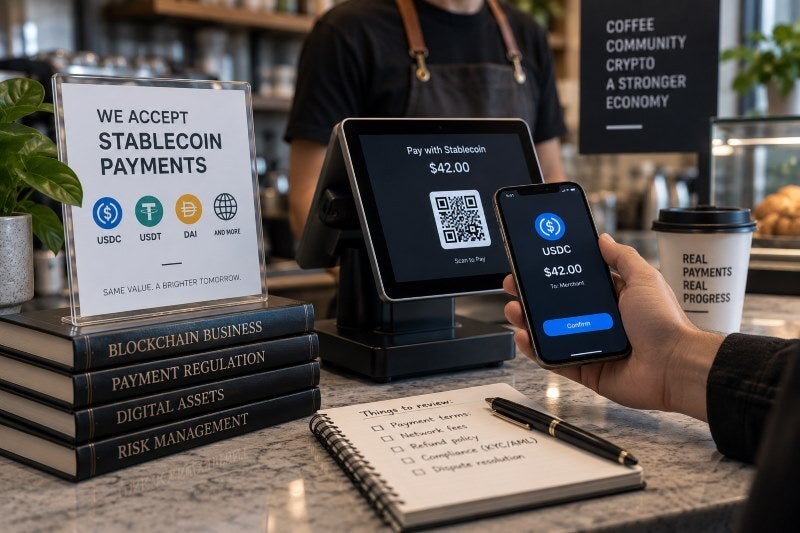
Stablecoin Payment Disputes can arise when a business accepts USDC, USDT, or another dollar-linked digital asset and later discovers that the payment was sent on the wrong network, frozen by an issuer, routed through a third-party processor, delayed by a compliance review, or worth less than expected. Accepting a token designed to track the U.S. dollar can reduce some volatility, but it does not make the transaction legally identical to receiving cash in a bank account.
California businesses should understand both the commercial agreement and the regulatory structure behind the token they accept. The state's rules governing approved stablecoins and covered digital-asset businesses are discussed further in the firm's analysis of California Financial Code section 3603 and stablecoin compliance.
Quick answer
Businesses accepting stablecoins should define when payment becomes final, which token and blockchain are permitted, who bears network and conversion fees, what happens after a depeg or freeze, and whether a payment processor may hold or reverse settlement. A merchant simply accepting digital assets for its own goods does not automatically become a regulated crypto intermediary, but custody, conversion, transmission, or payment-processing services can create additional licensing and compliance issues.
Why Stablecoin Payment Disputes Happen
Stablecoins are often marketed as digital dollars because they are designed to maintain a stable value relative to fiat currency. Legally and operationally, however, several different relationships may sit between the customer and merchant.
A customer may send tokens directly to the merchant's wallet, or a processor may receive the stablecoins, convert them, hold them temporarily, and later settle dollars or digital assets with the merchant.
Common disputes include:
- Payment being sent on the wrong blockchain network.
- The merchant receiving the wrong stablecoin.
- A processor freezing settlement for compliance review.
- A stablecoin temporarily losing its dollar peg.
- The issuer freezing particular wallet addresses.
- A customer claiming that payment was made when the merchant never received usable funds.
- Network fees reducing the amount actually received.
- A processor or custodian becoming insolvent before settlement.
Businesses that rely on intermediaries should understand which entities actually issue and support the asset. The regulatory distinctions among permitted payment stablecoin issuers can matter when a dispute involves redemption or reserve obligations.
When Is a Stablecoin Payment Legally Complete?
The parties should not assume that the appearance of a blockchain transaction automatically resolves whether an invoice has been paid.
A contract can specify that payment is complete after a particular number of network confirmations, when the designated wallet receives the correct asset, or only after a payment processor confirms settlement.
That distinction becomes important if a customer sends USDC to an unsupported network, sends a similarly named token, or transfers funds to an outdated wallet address. A blockchain transaction may be technically final while the contractual payment obligation remains disputed.
Businesses adopting these systems should address those rules as part of broader Web3 and cryptocurrency business compliance planning, rather than relying only on wallet instructions displayed at checkout.
What Happens if the Stablecoin Loses Its Peg?
A stablecoin designed to equal one dollar can temporarily trade below that amount. If a merchant accepts $50,000 in stablecoins shortly before a depeg, the contract may determine which party bears the difference.
Relevant questions include whether the invoice was denominated in U.S. dollars or tokens, whether the merchant agreed to accept a specific number of units, and whether immediate conversion was part of the payment arrangement.
Prior market events demonstrate that even major stablecoins can temporarily diverge from their expected value. The legal and operational problems created by those events are examined in stablecoin depeg and reserve disputes.
Can a Stablecoin Issuer Freeze a Payment?
Some centralized stablecoins contain technical mechanisms that can prevent particular addresses from transferring tokens. Issuers may exercise these capabilities in response to sanctions, law enforcement actions, security incidents, or other circumstances permitted by their terms and applicable law.
A business therefore should not assume that receipt of a stablecoin always gives it the same unrestricted ability to move funds as possession of physical cash.
If the merchant's assets are instead held through an exchange or wallet provider, ownership and access issues may resemble crypto custody disputes involving exchanges and wallet providers.
California Stablecoin Rules for Businesses
California's Digital Financial Assets Law became operative for many covered businesses on July 1, 2026. The law requires licensing or a timely application for many companies engaged in activities such as exchanging, transferring, storing, or issuing redeemable digital financial assets for or on behalf of California residents, subject to exemptions.
A retailer accepting stablecoin directly as payment for its own goods or services should not automatically be treated the same as a business that holds customer assets, exchanges tokens, or transmits funds for others. The actual payment flow matters.
Businesses providing stablecoin infrastructure should therefore determine whether they are merely accepting payment or performing a regulated intermediary function. Broader preparation for regulator review is addressed in crypto business regulatory-readiness planning.
Federal Stablecoin Regulation Is Also Changing
The federal GENIUS Act established a national framework for payment stablecoins, including rules concerning permitted issuers, reserves, redemption, and regulatory supervision. As of September 2026, agencies are still issuing implementing regulations, and the principal statutory restrictions are expected to become effective in 2027 unless the statutory timing rules result in an earlier effective date.
Businesses therefore should distinguish current obligations from rules that have been enacted but are not yet fully operative. The developing federal structure is part of the broader federal stablecoin and digital-asset regulatory landscape.
Bank-issued and bank-affiliated stablecoin models can raise additional questions because banking regulators may supervise the issuer or institution differently from a nonbank crypto company. The firm's discussion of federal regulation of bank-issued stablecoins provides additional context, while OCC-regulated stablecoin entities operating in California may face a different regulatory structure from state-licensed providers.
Payment Processors Can Create Another Layer of Risk
A merchant may never directly control the stablecoins paid by its customer. Instead, a processor may receive the tokens and promise to settle U.S. dollars into the merchant's bank account.
The processing agreement should address:
- When the customer's obligation to the merchant is considered satisfied.
- Who bears depeg risk before conversion.
- Settlement timing.
- Conversion and network fees.
- Compliance holds.
- Chargebacks or refund procedures.
- Custody of assets before settlement.
- Liability after hacks or service interruptions.
A disagreement involving these obligations may become a broader fintech and digital-asset payment dispute rather than simply a disagreement about cryptocurrency price.
Stablecoin Payments Can Still Have Tax Consequences
For current federal tax purposes, the IRS treats stablecoins as digital assets. Businesses receiving digital assets as payment for goods or services generally must account for the value received and maintain records supporting their tax reporting.
Federal regulators are continuing to consider whether payment stablecoins should receive different treatment in particular contexts, so businesses should avoid assuming that a token designed to maintain a one-dollar value is already treated exactly like cash for every tax purpose.
California businesses can review the broader recordkeeping and reporting issues in the firm's guide to cryptocurrency taxation in California.
What Should a Stablecoin Payment Agreement Say?
A business accepting meaningful transaction amounts should consider written terms addressing:
- The exact stablecoins accepted.
- Permitted blockchain networks.
- The wallet address or approved payment processor.
- The exchange rate used for dollar-denominated invoices.
- When payment becomes final.
- Responsibility for gas and conversion fees.
- Depeg and redemption risk.
- Refund procedures.
- Compliance freezes.
- Errors involving unsupported tokens or networks.
- Dispute-resolution procedures.
These provisions can prevent a technical mistake from becoming an expensive contract dispute.
What Evidence Should Businesses Preserve?
After a disputed stablecoin payment, merchants should preserve:
- The invoice and underlying sales contract.
- Wallet addresses and transaction hashes.
- The stablecoin and blockchain used.
- Payment processor records.
- Exchange-rate data at the relevant time.
- Customer communications.
- Refund requests.
- Compliance or freeze notices.
- Terms of service in effect on the payment date.
- Accounting and tax records.
If the dispute cannot be resolved directly, the merchant should also review whether its processor or exchange agreement requires private dispute resolution. Many digital-asset platforms use arbitration clauses in crypto and Web3 agreements that can affect where a claim must be filed.
Frequently Asked Questions About Stablecoin Payments
Is receiving USDC or USDT the same as receiving U.S. dollars?
No. Stablecoins may be designed to track the dollar, but they remain digital assets with separate issuer, redemption, custody, technical, and regulatory risks.
Can a business refuse a refund because the original stablecoin lost value?
The answer depends on the sales and refund terms. A contract should specify whether refunds are calculated in dollars or in the number of tokens originally paid.
Does accepting stablecoins require a California crypto license?
Not automatically. A business accepting payment for its own goods or services presents a different situation from an intermediary exchanging, storing, or transferring assets for customers. The actual business model should be reviewed under current California law.
Can stablecoin payments be reversed?
Blockchain transfers themselves may be technically irreversible, but issuers, custodians, processors, or courts may still affect access to assets depending on the circumstances.
Stablecoin Payment Disputes lawyers in California
Stablecoin Payment Disputes can combine ordinary sales contracts with digital-asset custody, blockchain settlement, issuer restrictions, tax reporting, and rapidly changing financial regulation. Businesses should define payment finality and risk allocation before a dispute occurs rather than assuming that a one-dollar peg answers every legal question.
Bulldog Law helps businesses evaluate stablecoin and cryptocurrency payment disputes involving merchants, payment processors, digital-asset companies, exchanges, and counterparties. Early review can help determine whether the problem is a contract issue, custody dispute, compliance hold, depeg event, or broader regulatory concern. No particular recovery or outcome can be guaranteed.