
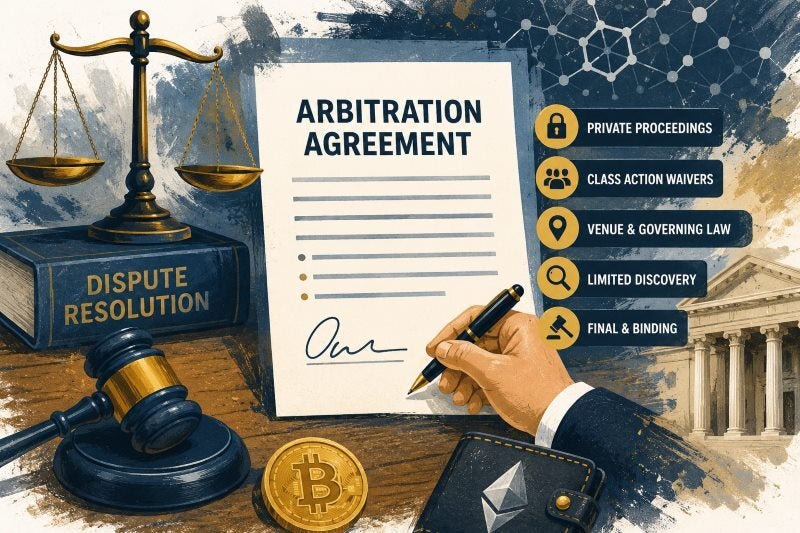
Crypto Arbitration Clauses can determine whether a dispute against an exchange, wallet provider, DeFi platform, NFT marketplace, token issuer, or Web3 startup is heard in court or in a private arbitration forum. For California users and businesses, the answer is usually fact-specific: an exchange or platform may be able to compel arbitration if the clause is enforceable, the user agreed to it, and the claim falls within its scope, but arbitration is not automatic in every crypto dispute.
The practical concern is serious. A user may lose access to funds, suffer a hack, challenge a token promotion, or dispute a frozen account, only to learn that the platform's terms require individual arbitration and waive class action rights. Before filing a lawsuit or responding to a demand for arbitration, the parties should review the exact terms, how consent was obtained, what claims are covered, and whether emergency court relief remains available.
Why Crypto Arbitration Clauses matter
Crypto Arbitration Clauses matter because many digital asset disputes involve online terms that users accept when opening an account, connecting a wallet, placing a trade, minting an NFT, joining a token sale, or using a protocol interface. These terms may require disputes to be handled through a private arbitration provider rather than a public court.
Common disputes affected by arbitration clauses include:
- Account freezes, withdrawal delays, or suspended exchange access.
- Stolen crypto recovery claims involving platform security or customer support.
- Token sale, airdrop, staking, or DeFi reward disputes.
- Consumer fraud claims involving fake promises or misleading promotions.
- Class claims after a platform outage, delisting, hack, or token collapse.
- Disputes over venue, governing law, filing fees, and emergency injunctions.
Arbitration can be faster in some cases, but it can also limit discovery, class procedures, public filings, and appeal rights. Those limits can affect leverage, cost, and strategy.
Crypto Arbitration Clauses and user consent
Crypto Arbitration Clauses are not enforceable simply because a company placed them somewhere on a website. The platform usually must show that the user agreed to the terms. In online cases, that may involve clickwrap terms, sign-up screens, updated terms, email notices, mobile app prompts, or account-access flows.
Consent disputes often focus on what the user actually saw. A clear checkbox next to a terms disclosure is different from a hidden link buried at the bottom of a page. A later update may create another issue if the platform added arbitration after the user already opened an account or held assets on the platform. The platform may argue that continued use accepted the new terms. The user may argue that the notice was inadequate, unclear, or unfair under the circumstances.
Users should preserve screenshots of sign-up pages, update notices, emails, account banners, and terms versions. Platforms should preserve records showing when terms were presented, what version applied, and how acceptance was captured.
Class action waivers and consumer crypto claims
Many crypto arbitration clauses include class action waivers. These provisions usually require users to bring claims individually, not as part of a class or representative proceeding. In practical terms, that can make smaller claims harder to pursue because the cost of individual arbitration may be high compared to the user's loss.
Class waiver enforceability depends on the clause, the claims, and applicable law. A platform may argue that federal arbitration law favors enforcement of individual arbitration agreements. A consumer may argue that the clause is unconscionable, was not properly accepted, conflicts with a public remedy, or cannot be applied to certain claims.
Consumer crypto claims may involve misleading marketing, failed withdrawals, trading losses, fake tokens, or denied rewards. When the dispute involves promotion of a risky token or social-media-driven asset, meme coin manipulation and securities risks may affect whether investors frame the case as consumer fraud, securities misconduct, market manipulation, or another claim.
Venue clauses, governing law, and arbitration providers
A crypto platform's terms may identify the arbitration provider, location, language, governing law, filing process, fee allocation, and whether hearings happen remotely. These details matter. A California user may face a clause requiring arbitration in another state or under rules that are unfamiliar, expensive, or difficult to navigate.
Some terms include small claims court carveouts, intellectual property carveouts, emergency injunctive relief provisions, or special rules for mass arbitrations. Others require informal notice and a waiting period before either side can file. Missing those steps may create delay or give the other side procedural arguments.
Platforms should draft dispute terms carefully because one-sided or confusing terms may invite challenges. Users should not assume that an arbitration clause ends the dispute. The clause may be enforceable, partially enforceable, or subject to court review before arbitration begins.
Emergency injunctions and court remedies
Even when arbitration applies, a party may still need court relief. Crypto assets can move quickly, and an arbitrator may not be able to stop an immediate transfer, preserve wallet records, freeze account access, or require a platform to maintain custody while the dispute proceeds.
Some arbitration clauses allow parties to seek provisional court remedies before or during arbitration. California courts may also be asked to address threshold issues such as whether arbitration applies, whether a party agreed to arbitrate, whether a class waiver is enforceable, and whether emergency relief is necessary.
Emergency relief may be important after theft, account takeover, or mistaken transfer. If a user sends assets to the wrong address, wrong wallet address transfer disputes may require fast preservation efforts and careful review of whether an exchange, custodian, or identifiable recipient can be reached. If assets were stolen, legal recovery options after stolen cryptocurrency may need to be coordinated with any arbitration requirement in the platform terms.
Fraud, rug pulls, and investor arbitration disputes
Crypto arbitration clauses may appear in token sale agreements, exchange terms, launchpad terms, staking agreements, NFT marketplace terms, and project websites. Investors may later argue that a token project misrepresented its roadmap, concealed insider allocations, manipulated trading activity, or abandoned the project after raising funds.
If the dispute involves a failed project or alleged exit scheme, rug pull claims against founders and promoters may overlap with arbitration, especially if the token sale documents contain a dispute-resolution clause. If the project distributed tokens through an airdrop, token airdrop tax and securities risks may affect the legal theory, damages, and records needed to prove the claim.
Arbitration does not eliminate the need for evidence. Investors should preserve purchase records, wallet addresses, marketing materials, Discord and Telegram messages, whitepapers, tokenomics documents, screenshots of claims, and records showing when they relied on the project's statements.
Criminal investigations and government seizure issues
An arbitration clause between a user and a platform generally does not stop law enforcement from investigating crimes, issuing subpoenas, or seeking seizure of assets. A private arbitration agreement is not a shield against criminal process, tax enforcement, sanctions investigations, or government forfeiture proceedings.
If the dispute involves fraud, laundering, stolen funds, or suspicious transfers, users and platforms may face parallel civil and criminal issues. federal crypto wire fraud investigations often depend on communications, wallet flows, exchange records, and intent evidence. When prosecutors view transactions as concealment, layering, or movement of illicit proceeds, crypto money laundering charge risks may become part of the broader legal strategy.
Government seizure creates another layer. A user may be arbitrating with an exchange while also dealing with a seizure warrant, restraining order, or forfeiture issue. law enforcement seizure of cryptocurrency can affect custody, access, and timing. If Bitcoin is already in government custody, Bitcoin seizure in a criminal case may require a different process than a private exchange dispute.
Tax, staking, and DeFi disputes in arbitration
Crypto arbitration disputes can also involve tax records. A user may claim that a platform's reporting was wrong, a staking program was misdescribed, DeFi transactions were not properly documented, or tax forms created mismatches with IRS records. Arbitration clauses may apply if the dispute arises from the platform's user agreement or service terms.
For complex trading activity, DeFi tax reporting for swaps and lending may help identify the transactions and records needed to support a claim or defense. If the dispute involves staking income, rewards, or validator payouts, staking rewards tax treatment may affect damages, reporting, and settlement structure.
If the IRS contacts the user after platform activity or tax reporting issues, crypto tax audit defense may require the same transaction exports, account records, and communications that are relevant in arbitration.
Where crypto arbitration disputes may be handled in California
A crypto arbitration dispute may begin with a demand letter, informal dispute notice, arbitration demand, court petition to compel arbitration, court petition to stay arbitration, emergency injunction request, or small claims filing if the contract permits it. California Superior Court may become involved when a party asks the court to decide whether arbitration applies, enforce or challenge an award, or grant provisional relief.
If federal claims are involved, federal court may also be available depending on jurisdiction, the parties, and the claims. Arbitration providers may have their own consumer, commercial, emergency, or mass-arbitration procedures. Courts, arbitrators, and arbitration providers are neutral institutions and are not affiliated with Bulldog Law.
Before filing, the parties should check the platform's notice requirement, deadline, provider rules, fee provisions, venue clause, governing law clause, small claims carveout, emergency relief language, and class action waiver.
Evidence to preserve before challenging or enforcing arbitration
Crypto arbitration disputes are document-heavy. The key records often show consent, asset movement, platform conduct, user reliance, and damages.
- Terms of service, arbitration clauses, privacy policies, and updated notices.
- Account registration records, clickwrap screens, emails, and app prompts.
- Wallet addresses, transaction hashes, account balances, withdrawals, deposits, and failed transfers.
- Support tickets, chatbot logs, emails, Discord messages, Telegram records, and platform announcements.
- Tax forms, staking reports, DeFi exports, trading history, and valuation records.
- Marketing materials, influencer posts, token sale documents, and investor communications.
Strong evidence can affect both the arbitration dispute and the underlying crypto claim. A party may need to prove that arbitration was accepted, that the clause applies, that a claim is excluded, or that emergency relief is necessary before assets move or records disappear.
Practical steps when a platform demands arbitration
When an exchange or Web3 platform demands arbitration, users and businesses should slow down and review the clause carefully. Practical steps may include:
- Save the current terms and any earlier versions that may have applied.
- Identify when and how the user allegedly accepted arbitration.
- Check whether the claim falls within the clause or a carveout.
- Review class waiver, venue, governing law, fee, and provider rules.
- Preserve transaction records, communications, support tickets, and screenshots.
- Evaluate whether court relief is needed before arbitration begins.
- Consider whether parallel tax, criminal, regulatory, or recovery issues exist.
The right response depends on the claim, the amount at issue, the urgency, and the enforceability of the clause. Arbitration may be the required forum in some cases, but the terms and facts should be reviewed before accepting that conclusion.
Crypto Arbitration Clauses lawyers in California
Crypto Arbitration Clauses can decide whether a digital asset dispute proceeds in court, arbitration, small claims court, or an emergency injunction proceeding. The analysis may involve online consent, class action waivers, platform terms, consumer claims, tax records, asset recovery, criminal investigations, and California enforcement rules.
Bulldog Law helps California clients evaluate crypto arbitration clauses involving exchanges, Web3 platforms, token projects, staking programs, DeFi activity, frozen accounts, stolen assets, investor claims, and consumer disputes. Early legal review may help preserve evidence, challenge or enforce arbitration terms, and identify practical options before filing deadlines or asset movement create additional problems.