
Updated November 2026 | The Bulldog Law | California Trial Attorneys
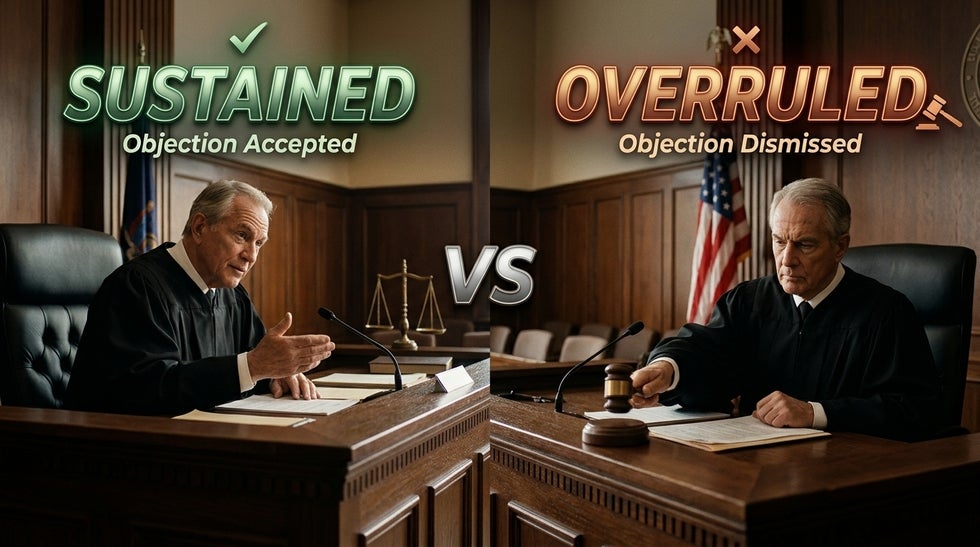
Sustained means the judge agrees with the objection: the question may not be answered or the evidence stays out. Overruled means the judge disagrees: the question stands and the witness must answer. Those two words decide, one question at a time, what a jury is allowed to hear, and whether a lawyer made the objection at all often decides what an appellate court is allowed to review later.
People sitting through a first hearing as a defendant, a witness, or a family member hear these rulings dozens of times without explanation. Our attorneys make and answer objections in California courtrooms every week; here is what is happening.
How an objection works
Trials run on rules of evidence. When one side believes a question, an answer, or an exhibit breaks a rule, the lawyer says "objection" and names the ground. The Legal Information Institute defines an objection as a formal protest raised during a trial or hearing to indicate that the other side's evidence or conduct violates the rules. The judge then rules, usually at once.
- Sustained.The objection is upheld. The witness does not answer. The questioning lawyer may rephrase to fix the problem, lay more foundation, or move on.
- Overruled.The objection is rejected. The witness answers and the testimony is evidence.
- Sustained. the answer is stricken."The witness answered before the ruling. The judge removes the answer and instructs the jury to disregard it.
- Rephrase. or "lay a foundation."The judge is sustaining the objection in substance and telling the lawyer how to cure it.
- Withdrawn. The questioning lawyer drops the question before the judge rules.
Some objections cannot be argued in front of the jury without revealing the very thing being objected to. The lawyers then approach the bench for a sidebar, or the jury is sent out, and the argument is made on the record outside the jurors' hearing.
Common objections in California courts
|
Objection |
What it means |
California rule |
|
Relevance |
The evidence does not tend to prove or disprove a disputed fact that matters |
Evidence Code 210, 350 |
|
Hearsay |
The witness is repeating an out-of-court statement offered for its truth, and no exception applies |
Evidence Code 1200 |
|
More prejudicial than probative |
The value of the evidence is substantially outweighed by the risk of unfair prejudice, confusion, or delay |
Evidence Code 352 |
|
Leading |
The question suggests the answer; generally improper on direct examination, allowed on cross |
Evidence Code 764, 767 |
|
Speculation or lack of personal knowledge |
The witness is guessing or did not perceive the matter |
Evidence Code 702 |
|
Lack of foundation |
The lawyer has not yet shown the facts that make the evidence admissible |
Evidence Code 403, 1401 |
|
Improper opinion |
A lay witness is giving an opinion that requires an expert, or an expert is outside the field |
Evidence Code 800, 801 |
|
Argumentative, asked and answered, compound, vague |
The form of the question is unfair or confusing, or it badgers the witness |
Evidence Code 765 |
|
Nonresponsive |
The witness answered something other than the question; paired with a motion to strike |
Evidence Code 766 |
|
Privilege |
The answer would reveal attorney-client, spousal, or other protected communications |
Evidence Code 900 and following |
Evidence Code 352 deserves special mention in criminal cases. It gives the judge discretion to exclude evidence that is technically admissible, and it is the ground for keeping out gang references, old convictions, and graphic photographs that add heat without adding proof.
Why objections matter after the trial
An objection does two jobs. It tries to keep the evidence out now, and it makes a record for later. Evidence Code 353 says a judgment will not be reversed for wrongly admitted evidence unless the record shows a timely objection or motion to strike that stated the specific ground. An objection on the wrong ground, or made after the damage is done, usually forfeits the issue.
The rule runs the other way too. When the judge sustains an objection and keeps out evidence a party needs, Evidence Code 354 requires that party to make an offer of proof: a statement on the record of what the evidence would have been. Without it, the appellate court cannot tell whether the ruling mattered.
Even a preserved error leads to reversal only if it was prejudicial. For most evidentiary rulings the appellate court reviews for abuse of discretion and asks whether a better result was reasonably probable without the error. That is why overruled is not the end of the matter and sustained is not always a victory, and why an erroneous ruling can become one of the grounds for a new trial.
If you are the witness or the defendant
- Stop speaking the moment a lawyer says "objection." Wait for the ruling.
- If the judge says "sustained," do not answer. Wait for the next question.
- If the judge says "overruled," answer the question that was asked. Ask to have it repeated if needed.
- Do not argue with the ruling or look to the judge for help. Your lawyer handles the law.
- A lawyer who objects often is not hiding something, and one who objects rarely is not asleep. Jurors are told that objections are not evidence and that they must not guess at what an answer would have been.
Objections outside the courtroom
The same words work differently in a deposition, where no judge is present. Lawyers state objections for the record and the witness usually answers anyway, with the ruling made later if the testimony is used at trial. Our page on deposition objections covers those rules.
The other meaning of overruled
Lawyers also say a case was overruled when a court declares that an earlier precedent is no longer the law. A decision of the California Supreme Court overruling one of its own earlier cases changes the rule for every court in the state. That is distinct from reversed, which describes what an appellate court does to the judgment in the case in front of it.
Frequently asked questions
What does sustained mean in court?
Sustained means the judge agrees with the objection. The question cannot be answered, or the evidence cannot come in, and the lawyer who asked must rephrase or move on. If the witness already answered, the judge may strike the answer and tell the jury to disregard it.
What does overruled mean in court?
Overruled means the judge disagrees with the objection. The question stands, the witness must answer, and the evidence is admitted. The objecting lawyer has still preserved the issue for appeal by making the objection.
What is the difference between sustained and overruled?
They are the two possible rulings on an objection. Sustained upholds the objection and keeps the evidence out. Overruled rejects the objection and lets the evidence in. A simple way to remember it: sustained stops the question, overruled lets it go on.
What does objection mean in court?
An objection is a lawyer's formal statement that a question, an answer, or an exhibit violates the rules of evidence or procedure. It asks the judge to rule immediately. In California the objection must be timely and must state the specific legal ground, such as hearsay or relevance.
What happens if a lawyer does not object?
The evidence comes in and the issue is usually lost for appeal. Under California Evidence Code 353, a verdict will not be reversed because evidence was wrongly admitted unless a timely and specific objection or motion to strike appears in the record. Failure to object can later be raised only indirectly, as a claim that the trial lawyer was ineffective.
Does the witness have to answer after an objection is overruled?
Yes. Once the judge overrules the objection, the witness must answer the question. A witness should stop talking when a lawyer says "objection" and wait for the ruling before answering.
What does it mean when a judge says the answer is stricken?
It means the answer is removed from the evidence the jury may consider. The jurors heard it, so the judge instructs them to disregard it, and they are presumed to follow that instruction. When the stricken material is too damaging for an instruction to cure, the remedy is a mistrial.
What does overruled mean for a court case or precedent?
Outside the trial setting, a case is overruled when a higher court, or the same court in a later decision, declares that an earlier precedent is no longer good law. That is different from reversed, which means an appellate court set aside the lower court's ruling in the same case.
Related reading from our attorneys
- Deposition objections on the record
- Nine grounds for a new trial in California criminal cases
- When jury instructions are given in California criminal trials
Trials are won on what the jury hears. That is decided one objection at a time
The Bulldog Law's criminal defense attorneys try cases across California and protect the record for appeal from the first witness. Call (888) 928-1609 or reach us online.