
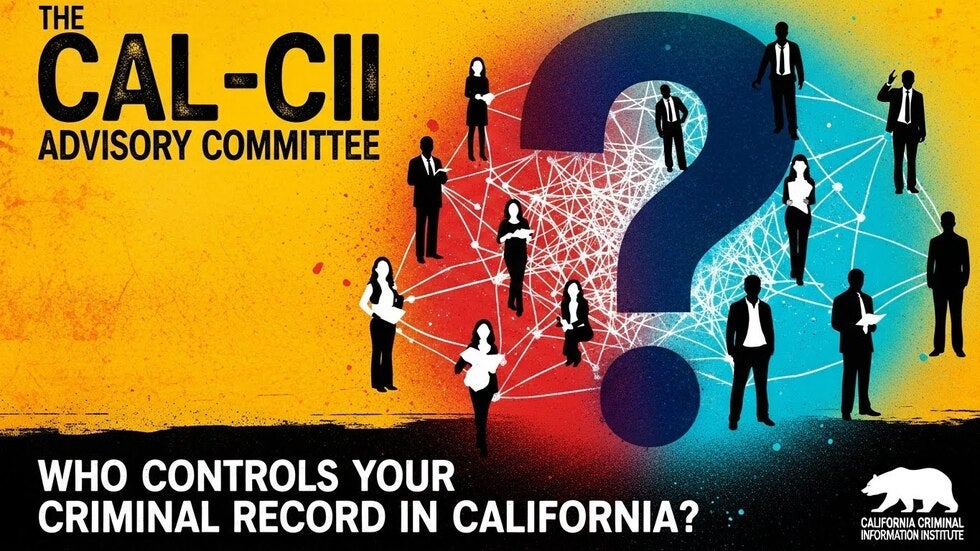
Understanding the Power Structure Behind California's Criminal Records System
Most Californians have no idea that a small advisory committee influences how their criminal records are managed, stored, and accessed throughout the state. California Penal Code Section 13100.1 establishes this committee, which oversees the California Criminal Index and Identification system, commonly known as Cal-CII. For anyone who has ever been arrested or convicted of a crime, understanding who sits on this committee and what they control is essential knowledge.
The Cal-CII database is the central repository for criminal records in California. Every arrest, prosecution, and conviction generates data that flows into this system. The advisory committee created under Section 13100.1 helps determine operating policies, what information gets included in criminal records, and how long those records are retained. These decisions have lasting consequences for millions of Californians.
The Composition Problem: Where Are the Defense Voices?
When you examine the makeup of the Cal-CII advisory committee, a troubling pattern emerges immediately. The committee consists of twelve members, and the overwhelming majority represent law enforcement and prosecutorial interests. From a defense perspective, this creates a fundamental imbalance in how California's criminal records system operates.
Law Enforcement Dominance on the Committee
The statute requires representation from the California Police Chiefs' Association, the California Peace Officers' Association, three representatives from the California State Sheriffs' Association, the California Highway Patrol, and the Office of Emergency Services. That's seven seats out of twelve dedicated exclusively to law enforcement agencies.
Add to that a representative from the California District Attorneys Association, and you have eight committee members whose professional interests align with prosecution and law enforcement. These are the voices making recommendations about what information gets collected about you, how long it stays in the system, and who can access it.
The Missing Perspectives
Conspicuously absent from this advisory committee is any representation from criminal defense attorneys, public defenders, or organizations that advocate for the rights of people with criminal records. There are no seats designated for the California Public Defenders Association, no representative from the California Attorneys for Criminal Justice, and no voice from organizations working on criminal justice reform or reentry services.
The two "public" members appointed by legislative leaders must be knowledgeable about background clearances, but the statute provides no requirement that these individuals have experience with the challenges faced by people trying to overcome criminal records or understanding the defense perspective on record accuracy and retention.
What the Advisory Committee Actually Controls
The scope of the advisory committee's influence extends to three critical areas: operating policies, criminal records content, and records retention. Each of these areas directly affects anyone who has had contact with California's criminal justice system.
Operating Policies and Access Controls
Operating policies determine who can access criminal records, under what circumstances, and for what purposes. These policies affect everything from employment background checks to housing applications, professional licensing decisions, and immigration proceedings.
When a committee dominated by law enforcement interests makes recommendations about access policies, the tendency is naturally toward broader access and longer retention. After all, from a law enforcement perspective, more information is almost always better. However, from a defense and civil liberties standpoint, broad access to criminal records creates numerous problems for people trying to rebuild their lives after arrests or convictions.
Criminal Records Content Decisions
What information gets included in your criminal record matters enormously. Does the system capture arrest information even when charges are never filed? How quickly do dismissals and acquittals get reflected in the database? Are expunged convictions truly removed or simply marked differently?
The advisory committee's recommendations on content issues shape how complete and accurate criminal records are throughout California. Unfortunately, when the majority of committee members come from law enforcement backgrounds, the incentive structure favors including more information rather than less, and prioritizing rapid data entry over careful verification of outcomes and dispositions.
Records Retention: How Long Is Too Long?
Perhaps most significantly, the advisory committee advises on records retention policies. California law provides various mechanisms for clearing criminal records, including expungement, sealing of juvenile records, and certificates of rehabilitation. However, even when records are legally cleared, questions remain about what happens to the underlying data in various criminal justice databases.
Retention policies determine how long arrest records, disposition information, and related data remain accessible in Cal-CII and connected systems. Longer retention serves law enforcement interests by maintaining comprehensive historical information. However, extended retention creates ongoing obstacles for people seeking employment, housing, education, and professional opportunities.
The Compensation Question and Committee Independence
Section 13100.1 specifies that committee members serve "without compensation, except for reimbursement of necessary expenses." While this might seem like a minor administrative detail, it has important implications for who can afford to serve and how independent the committee remains.
Who Can Afford to Serve?
Committee members representing law enforcement agencies, district attorneys' offices, and court systems serve in their professional capacities. Their employers support their participation as part of their regular duties. In contrast, true public interest representatives or defense oriented voices would likely need to volunteer their time without institutional support.
This structural reality makes it even less likely that the committee will include perspectives that challenge law enforcement priorities or advocate for limiting the scope and accessibility of criminal records.
The Attorney General's Ultimate Authority
The statute makes clear that the advisory committee serves "at the pleasure of the Attorney General." This means the Attorney General can dismiss committee members at will and is not bound by the committee's recommendations. While this preserves executive authority over the Cal-CII system, it also means the committee's influence depends heavily on the current Attorney General's priorities and philosophy.
For defendants and people with criminal records, this creates uncertainty. Depending on who holds the Attorney General's office, the advisory committee might have significant influence over policies that affect millions of Californians, or it might be largely ceremonial. The lack of formal requirements for the Attorney General to follow committee recommendations means there are few checks on executive discretion in this area.
Why Defense Attorneys Should Care About This Committee
Criminal defense lawyers need to understand the Cal-CII advisory committee structure because it affects nearly every client they represent. The policies this committee influences determine what prosecutors can access when making charging decisions, what judges see when considering bail and sentencing, and what obstacles clients face long after their cases conclude.
Practical Implications for Defense Work
When defense attorneys encounter problems with criminal records, such as arrests without dispositions, incorrect information, or failures to update expunged convictions, they're dealing with the results of policies shaped by this advisory committee. Understanding the committee's composition helps explain why certain problems persist despite legal requirements for accuracy and completeness.
The law enforcement heavy makeup of the committee also explains why fixes for these problems are often slow in coming. When the people advising on system improvements primarily represent agencies that benefit from broad information access and long retention periods, there's little institutional pressure to prioritize the accuracy and privacy concerns that matter most to defendants.
Advocacy and Reform Opportunities
The structural imbalance in the Cal-CII advisory committee isn't inevitable. The statute could be amended to include defense representation, public defender voices, and advocates for people with criminal records. Such reforms would create a more balanced approach to managing California's criminal records system.
What Would Balanced Representation Look Like?
A truly balanced advisory committee might include representatives from the California Public Defenders Association, California Attorneys for Criminal Justice, and organizations working on reentry and criminal justice reform. These voices would bring expertise on the real world consequences of records retention policies and could advocate for systems that balance legitimate law enforcement needs with fairness and accuracy.
Including people who have personally navigated the challenges of having a criminal record would provide invaluable perspective on how system policies affect actual lives. Currently, the committee structure ensures that the people making recommendations about criminal records rarely experience the consequences of those policies themselves.
The Broader Context of Criminal Justice Reform
California has made significant strides in criminal justice reform in recent years, from reducing certain felonies to misdemeanors through Proposition 47 to expanding expungement opportunities and limiting the use of criminal history in employment decisions. However, these legal reforms mean little if the underlying criminal records database continues to operate under policies designed primarily to serve law enforcement interests.
The Cal-CII advisory committee operates largely outside public view, making recommendations that shape how millions of criminal records are managed without meaningful input from defense perspectives or people directly affected by these policies. This lack of transparency and balance undermines broader reform efforts and perpetuates a system where criminal records follow people far longer and more comprehensively than justice requires.
Moving Forward: The Need for Transparency and Balance
For anyone concerned about fairness in California's criminal justice system, the composition and authority of the Cal-CII advisory committee deserves more attention. While Section 13100.1 establishes the committee's structure, there's nothing preventing legislative reform to create better balance and more meaningful oversight.
Defense attorneys, public defenders, and criminal justice reform advocates should push for amendments that would bring diverse perspectives to this important advisory body. Until that happens, decisions about criminal records management in California will continue to reflect primarily law enforcement priorities, with insufficient consideration for accuracy, privacy, and the long term consequences of maintaining comprehensive criminal databases.
Understanding who controls California's criminal records system is the first step toward ensuring it operates fairly for everyone—not just those with badges or prosecutorial authority. Meaningful accountability requires informed advocacy to correct errors, challenge misuse, and enforce the legal limits placed on record creation, access, and retention.
For experienced guidance on California criminal records, record correction, post-conviction rights, and defense advocacy, visit thebulldog.law or call (888) 928-1609 for a confidential consultation.