
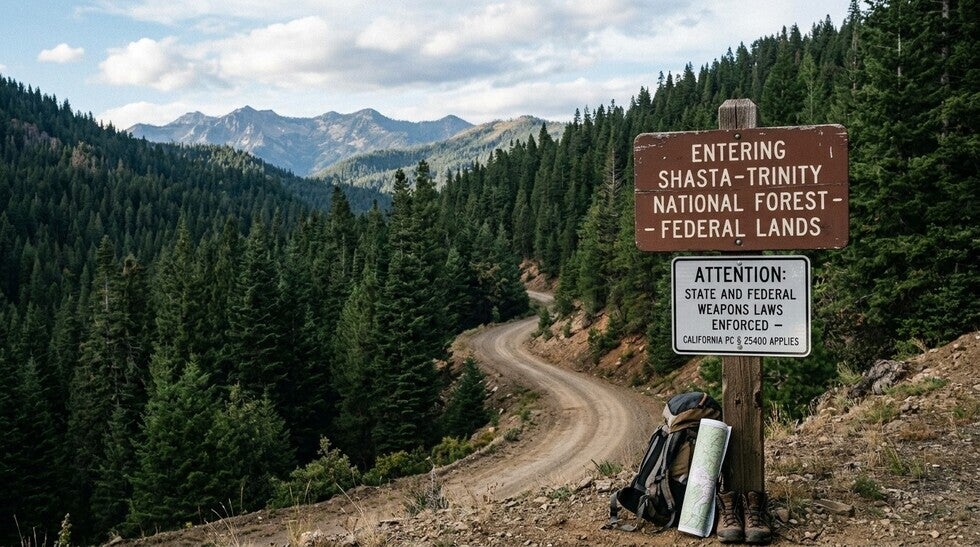
Weapons Charges in Trinity County often arise from facts that look different from urban firearms cases. A rifle in a truck during hunting season, a handgun on a remote homestead road, a firearm found during a Highway 299 stop, or a weapon discovered near Shasta-Trinity National Forest land can all trigger serious California or federal consequences.
California firearms law still applies in rural counties. Trinity County's mountain roads, isolated properties, wildlife concerns, timber work, cannabis history, and large areas of public land may shape the defense strategy, but they do not automatically excuse unlawful carry or transport. The facts that explain why a firearm was present are important, especially for negotiations and sentencing, but the first defense question is usually whether the stop, search, seizure, and charge can be challenged.
Weapons Charges in Trinity County under PC § 25400
California Penal Code § 25400 makes it a crime to carry a concealed firearm in certain ways, including concealed in a vehicle under a person's control, concealed on the person, or concealed in a vehicle where the person is an occupant. The statute focuses on concealment, knowledge, possession, and the specific location of the firearm.
A PC § 25400 case in Trinity County may begin during a traffic stop, a call for service, a hunting contact, a probation search, a cannabis-related investigation, or a domestic disturbance response. A handgun under a seat, in a backpack, inside a center console, or hidden within camping gear can create exposure even when the person says the firearm was for wildlife protection, remote property security, or travel between lawful locations.
Lawful transport matters. California generally requires a handgun transported in a motor vehicle to be unloaded and locked in the vehicle's trunk or in a locked container. A glove box or utility compartment is not treated the same as a locked container. Rifles and shotguns have different transport rules, but loaded firearm and prohibited-person issues can still create charges. Because California weapons statutes were reorganized through the deadly weapons recodification, understanding California deadly weapons recodification rules can help explain why older case language may still matter in a modern Trinity County prosecution.
Loaded firearm allegations under PC § 25850
California Penal Code § 25850 prohibits carrying a loaded firearm on the person or in a vehicle while in a public place or on a public street in an incorporated city, or in a public place or on a public street in a prohibited area of an unincorporated area. In a rural county, that location language can become important.
A loaded firearm case may turn on whether the firearm was actually loaded, whether the area was covered by the statute, whether the person knew the firearm was present, and whether any exception applies. Officers may also inspect a firearm under the statute to determine whether it is loaded in covered public locations.
Trinity County cases often involve hunters, ranchers, timber workers, remote property owners, and people who keep firearms in vehicles for perceived protection. The reason for possession may help explain the facts, but the prosecution will focus on the elements of the charged offense. A defense lawyer should evaluate the firearm's condition, ammunition location, vehicle location, officer reports, body camera footage, dispatch records, and whether the officer had a lawful basis for the original contact.
Remote rural necessity is not an automatic defense
Remote rural necessity is not a blanket statutory exemption from PC § 25400 or PC § 25850. It may still matter as factual context, mitigation, or part of a broader defense strategy depending on the stop, search, location, firearm status, and available statutory exceptions.
That distinction matters in Trinity County. A remote homestead owner with a clean record, documented wildlife issues, lawful firearm ownership, and no evidence of threats or criminal intent may be in a different posture from someone carrying a hidden weapon for intimidation or violence. Rural necessity may affect charging decisions, plea negotiations, diversion arguments where available, probation conditions, and the way the defense presents the client's intent.
The constitutional analysis remains central. If the firearm was discovered after a vehicle stop, the defense should examine whether the officer had reasonable suspicion for the stop and whether any later search was lawful. If the stop fails, the firearm evidence may be suppressed. Prior California weapons cases may still provide defense opportunities after statutory renumbering, and weapons case precedent after recodification can matter when challenging how older authority applies to current Penal Code sections.
Hunting season and Trinity Alps firearm transport
Trinity County hunting season can create weapons cases from misunderstandings, rushed departures, and poor transport habits. A hunter may lawfully possess a firearm while hunting, but that does not mean every vehicle transport choice is lawful before or after the hunt.
A common fact pattern involves a firearm loaded at or near a trailhead, placed back into a vehicle, and discovered on a public road. Another involves a handgun carried for campsite protection without a proper concealed carry permit or without complying with transport rules. The hunting license, tag, lawful destination, and absence of criminal intent may help the defense, but those facts do not automatically defeat every charge.
Preserve hunting documents immediately. Licenses, tags, maps, campground reservations, trailhead photos, GPS data, text messages, and witness statements may help show lawful purpose. The defense should also identify whether the contact occurred on private land, a county road, a state highway, or National Forest System land because jurisdiction and applicable rules may differ.
Federal land and Shasta-Trinity National Forest jurisdiction
Shasta-Trinity National Forest issues can complicate Trinity County weapons cases. National Forest System lands are subject to federal regulations, including rules that restrict certain firearm discharge near residences, buildings, campsites, developed recreation sites, occupied areas, National Forest System roads, bodies of water, and other places where people or property may be endangered. Specific forest orders may also prohibit or limit firearm discharge in defined areas, sometimes with exceptions for lawful hunting.
A contact on federal land does not always mean the same charge will be filed in the same court. State weapons charges may proceed in Trinity County Superior Court, while federal offenses arising on National Forest System land may proceed in the Eastern District of California. Location can therefore affect the forum, procedure, penalties, discovery, negotiation strategy, and sentencing exposure.
In forest cases, the defense should identify the exact location of the contact using maps, GPS data, incident reports, boundary records, and any applicable Forest Service orders. A general statement that the person was “in the forest” is not enough. The exact road, campsite, trailhead, wilderness area, closure order, hunting zone, and officer authority may all matter.
Timber, cannabis, and prohibited-person exposure
Trinity County weapons cases can become much more serious when the accused person has a prior conviction, restraining order, or other status that prohibits firearm possession. Timber workers, remote landowners, cannabis industry participants, and rural residents may view firearms as everyday safety tools, but federal and state prohibited-person rules can override local custom and practical need.
The Lautenberg Amendment, 18 U.S.C. § 922(g)(9), can create serious federal firearm exposure for people with qualifying misdemeanor domestic violence convictions. The analysis depends on the conviction record, relationship element, counsel and jury-trial rights, expungement, pardon, restoration of civil rights, and any applicable federal exceptions. A prior case that seemed minor at the time may still become a major issue when a firearm is later discovered.
A person with any prior domestic violence, felony, restraining order, or firearm-related conviction should not explain the firearm to officers without legal counsel. A statement that seems helpful in a state concealed carry case may create federal exposure. When a California firearm surrender, seizure, or return issue is also present, California weapons surrender requirements may become part of the broader defense and rights-restoration analysis.
Location-sensitive weapons charges
Some weapons cases depend heavily on where the firearm was found. Airports, schools, correctional facilities, courthouses, and government buildings can trigger specialized statutes, enhanced penalties, or separate charges. Trinity County may be rural, but location-specific rules still matter when a firearm is discovered near a restricted place or during travel.
For example, firearm possession in an airport terminal, on school grounds, or in a correctional setting can raise distinct defenses and risks. A person who lawfully owns a firearm may still violate a location-specific law by carrying or transporting it into the wrong place. When a case involves travel through restricted transportation areas, airport terminal weapons charge defenses can be relevant to how intent, notice, screening, and possession are evaluated.
School-related weapon allegations also require special care. A hunting rifle, pocketknife, or other object that might be lawful in one setting can become a criminal issue near a school campus or school activity. Trinity County families, students, and rural residents should understand how California school grounds weapons defenses may apply when location, knowledge, and lawful possession are disputed.
Correctional facility cases are different again. Bringing or possessing a weapon, controlled substance, or contraband in a jail or correctional facility can create severe exposure even if the person did not intend harm. If a Trinity County case involves booking, visiting, transportation, or jail-adjacent facts, weapons contraband in correctional facilities may affect the defense strategy.
Defense strategy after a Trinity County weapons arrest
A strong defense begins with silence and preservation. The accused person should not make statements about why the firearm was present, who owned it, whether it was loaded, when it was last used, or whether it was carried for protection until counsel has reviewed the facts. Those statements can affect both state and federal exposure.
The defense should document how the firearm was stored, whether the container was locked, where ammunition was located, whether the firearm was loaded, who had access to the vehicle, and whether there were lawful hunting, work, or property-related reasons for the firearm's presence. Photos, maps, licenses, tags, witness names, trailhead information, and body camera footage may become important.
The defense should also evaluate statutory continuity. California's weapons laws were reorganized, but some older terms, cases, and defenses remain relevant. In the right case, weapons law continuity protections may help connect older authority to current code sections and prevent the prosecution from treating recodification as a substantive expansion of liability.
Weapons Charges in Trinity County court process
State weapons charges in Trinity County generally proceed through Trinity County Superior Court in Weaverville. A case may involve arraignment, release conditions, discovery, motion practice, negotiations, trial readiness, and sentencing if there is a conviction or plea. Federal cases connected to National Forest System land or prohibited-person allegations may proceed separately in the Eastern District of California.
Early defense work can affect the entire case. Counsel should request body camera footage, patrol video, dispatch records, search reports, firearm testing records, criminal history materials, maps, and any federal agency reports. If there is a suppression issue, the defense may challenge the stop, detention, search, consent, inventory search, probation search, or warrant execution.
Disposition strategy may include dismissal, reduction, diversion where legally available, deferred entry options where available, misdemeanor treatment, plea to a non-firearm offense, return of property, limited probation terms, or trial. The right goal depends on the client's record, immigration concerns, firearm rights, employment, hunting needs, federal exposure, and the strength of the evidence.
Weapons Charges in Trinity County lawyers in California
Weapons Charges in Trinity County require a defense strategy that understands both California firearms law and the realities of rural life. PC § 25400, PC § 25850, federal land rules, hunting transport, remote property needs, prohibited-person laws, and location-specific restrictions can overlap in a single case.
Bulldog Law helps clients facing California weapons allegations, firearm transport issues, concealed carry charges, loaded firearm accusations, federal land concerns, and prohibited-person exposure. The firm does not promise outcomes, but it can evaluate the stop, search, statute, jurisdiction, and rural context to pursue practical defense strategies in Trinity County and throughout California.