
Updated October 2026 | The Bulldog Law | California Drug Crimes Defense
When you find a bottle of Xanax in a purse or a friend hands you a pill at a party, you might think it's harmless.
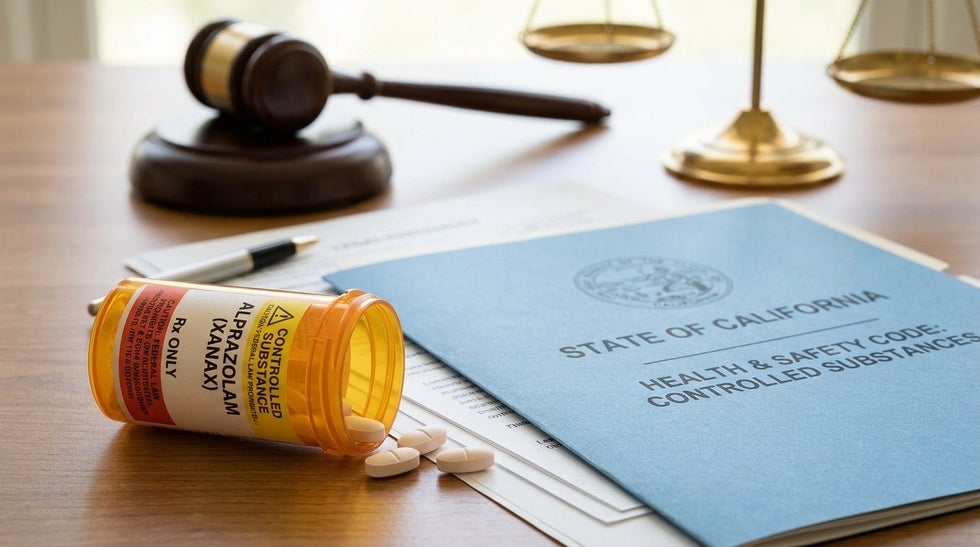
In California, that pill is a Schedule IV controlled substance, and possessing it without a prescription can land you in jail or on a criminal record.
Xanax Schedule IV Status and California Controlled Substance Laws
Every benzodiazepine, including alprazolam, diazepam, clonazepam, and lorazepam, is listed under Health and Safety Code 11057. The federal Controlled Substances Act classifies these drugs as Schedule IV, meaning they have accepted medical use but a low potential for abuse.
Because they are Schedule IV, California treats possession without a prescription under Health and Safety Code 11375 rather than the harsher statutes for opiates or stimulants. A first-time offense can be a misdemeanor, but repeat violations may trigger felony charges.
Federal Schedule IV Classification Under the Controlled Substances Act
The Controlled Substances Act places alprazolam and its cousins in Schedule IV, the lowest tier for prescription drugs. This classification acknowledges medical value while still imposing limits on distribution.
Under federal law, a Schedule IV drug may be prescribed, but it must be dispensed only by a licensed practitioner and tracked through the DEA's monitoring systems.
California Health and Safety Code 11057 and Benzodiazepine Regulations
California's Health and Safety Code 11057 lists all controlled substances, including benzodiazepines, and requires that they be prescribed by a licensed provider. The code also sets the system for penalties when these drugs are possessed illegally.
Because benzodiazepines are Schedule IV, possession without a prescription is a misdemeanor under Health and Safety Code 11375(b)(2), punishable by up to six months in county jail and a fine of up to $1,000.
California also enforces the Prescription Drug Monitoring Program, which tracks prescriptions and helps identify doctor shopping or forged prescriptions.
Prescription Refill Limits and CURES Database Monitoring
Patients may refill a benzodiazepine prescription up to five times within six months, a limit that helps prevent overuse. This rule is enforced through the California Prescription Drug Monitoring Program (CURES).
The CURES database records every prescription, allowing law enforcement to verify whether a patient's supply is legitimate and to spot suspicious patterns.
Penalties for Possessing Xanax Without a Prescription in California
In my experience defending California felony cases, I've seen how a single bottle of Xanax can trigger a misdemeanor or even a felony, depending on the circumstances and prior history.
When you possess a Schedule IV drug without a prescription, the law treats it as a misdemeanor under Health and Safety Code 11375(b)(2), with up to six months in county jail and a fine of up to $1,000. Business and Professions Code 4060 also addresses possession of controlled substances.
|
Statute |
Charge |
Penalty |
|---|---|---|
|
Health and Safety Code 11375(b)(2) |
Misdemeanor possession |
6 months jail, $1,000 fine |
|
Health and Safety Code 11375(b)(1) |
Wobbler possession for sale |
1 year jail or 16 months/2/3 years felony |
|
Health and Safety Code 11377 |
Stimulant possession |
Up to 1 year jail |
|
Health and Safety Code 11351 |
Possession for sale |
Same as 11375(b)(1) |
Misdemeanor Charges Under Health and Safety Code 11375(b)(2)
Under Health and Safety Code 11375(b)(2), possession of a controlled substance without a prescription is a misdemeanor. The maximum sentence is six months in county jail and a fine of up to $1,000.
Prosecutors must prove that the defendant had knowledge of the drug's presence, its nature, and that it was a usable amount. The defense hinges on whether the defendant had a valid prescription. If the defendant is a first offender, diversion programs may be available, potentially avoiding a criminal record.
Elements of Possession and the Valid Prescription Defense
To secure a conviction, the state must show possession, knowledge of the drug, and a usable quantity. The defendant must also lack a prescription written for them. Readers comparing related California statutes also review our guide on drug possession under Health and Safety Code 11350.
Even if the prescription exists, it must be in the defendant's name and for the specific drug. A prescription for a different medication does not shield the defendant.
Comparison of Schedule IV Possession vs. Stimulant Statutes
Schedule IV drugs are treated less harshly than Schedule II stimulants. Health and Safety Code 11377, which governs stimulants, allows up to one year in jail for possession.
Because benzodiazepines have a lower abuse potential, the law imposes a lighter penalty, but the consequences for a repeat offender can still be severe.
Criminal Liability for Selling, Furnishing, or Sharing Xanax
When a person gives away or sells a bottle of Xanax, the law steps up. The offense becomes a wobbler, meaning it can be a misdemeanor or a felony depending on the circumstances.
In many cases, the prosecution must prove intent to sell, which can be inferred from quantity, packaging, cash, or messages. The defense often hinges on the lack of intent.
Wobbler Charges for Possession for Sale Under HSC 11375(b)(1)
Under Health and Safety Code 11375(b)(1), possession for sale is a wobbler. A first offense can result in up to one year in county jail as a misdemeanor, or up to 16 months, 2, or 3 years as a felony under Penal Code 1170(h).
Because the statute is a wobbler, the judge has discretion to impose a lighter sentence if the defendant shows no intent to distribute. Prosecutors often rely on evidence such as cash transactions, packaging, or text messages to establish intent.
Furnishing vs. Selling: Legal Distinctions and Intent Evidence
Furnishing, or giving away, is treated the same as selling under the law. The key difference is the defendant's intent; a single pill given to a friend may still be a violation if the intent to distribute is proven.
Evidence of intent can include the number of pills, how they were packaged, and any communication that suggests a sale. The prosecution must prove that the defendant intended to sell or distribute.
Defendants can argue that they believed the pills were for personal use, which may reduce the charge to a misdemeanor.
Felony Sentencing Guidelines Under Penal Code 1170(h)
When the court decides to treat the offense as a felony, Penal Code 1170(h) applies. Sentences can range from 16 months to 3 years in county jail, depending on prior convictions and aggravating factors. Felony convictions can lead to a permanent criminal record, loss of certain civil rights, and higher insurance premiums.
Prescription Fraud and Counterfeit Xanax with Fentanyl Risks
In my practice, I often see clients who think a pill bought on the street is harmless. The law treats counterfeit and forged prescriptions as serious offenses, especially when fentanyl is involved.
Health and Safety Code 11368 makes forging a prescription a wobbler, while Penal Code 470 punishes the forged document itself. The Prescription Drug Monitoring Program helps prove intent and fraud.
Charges for Forged Prescriptions and Doctor Shopping
Health and Safety Code 11368 covers forged or altered prescriptions, and Health and Safety Code 11173 addresses obtaining a controlled substance by fraud.
Both statutes are wobbler offenses, allowing a range of penalties. Readers comparing related California statutes also review our guide on possession for sale under Health and Safety Code 11351.
Under Penal Code 470, the forged document is a separate crime, punishable up to three years in county jail. Prosecutors often combine these charges for a stronger case.
Doctor shopping, when a patient visits multiple prescribers, triggers the same statutes. The intent element is key; the defense must show no fraudulent intent, often relying on medical records.
Counterfeit Xanax and Fentanyl Possession Under HSC 11350
Most Xanax sold outside pharmacies is counterfeit and may contain fentanyl. If a lab finds fentanyl, the possession is charged under Health and Safety Code 11350, a misdemeanor under Proposition 47.
Because fentanyl is a Schedule I drug, the offense can trigger Proposition 36's treatment-mandated felony for repeat offenders. The penalty can reach 15 years to life if the drug causes death.
In a counterfeit case, the prosecution must prove the defendant knew the substance was controlled. A belief that the pill was alprazolam can be a successful defense, depending on the purchase facts.
Proposition 47, Proposition 36, and Murder Exposure for Fentanyl
Proposition 47 reclassifies many drug offenses as misdemeanors, but it excludes fentanyl, which remains a felony under Proposition 36. This creates a split in how cases are handled.
When a fentanyl-laden pill causes a death, some courts apply Alexandra's Law, treating the case as murder by implied malice. Sentencing guidelines may then increase the penalty to 20 years or more.
Clients often ask if they can avoid felony charges. The answer depends on whether the drug is proven to be fentanyl and whether the defendant had knowledge of that fact.
drug transportation and trafficking under HS 11352 is a separate offense that can add to the charges if the client is caught moving large quantities.
Driving Under the Influence of Xanax: Vehicle Code 23152(f)
In my experience, many drivers assume a prescription drug is safe on the road. Vehicle Code 23152(f) makes it illegal to drive under the influence of any drug, including benzodiazepines.
Even a therapeutic dose can impair reaction time, and when combined with alcohol, the effect is magnified, leading to aggravated penalties.
Vehicle Code 23152(f) and Drug-Impaired Driving Standards
Vehicle Code 23152(f) prohibits driving while impaired by any drug. The law does not allow a prescription as a defense; impairment is the standard.
Police use a drug recognition expert (DRE) to observe driving patterns and conduct field sobriety tests. Blood or urine tests confirm the presence of the drug.
Proving impairment requires evidence that the drug concentration caused the observed driving behavior. Courts scrutinize the blood plasma concentration for validity.
Blood Plasma Concentration and DRE Evaluation Defenses
Defendants can argue that a high blood level does not equal impairment, especially if they are long-term users. The defense must show tolerance and lack of impairment. Readers comparing related California statutes also review our guide on California forgery charges under Penal Code 470.
When a DRE evaluation is weak for depressants, the defense may challenge the reliability of the test. The court may require additional evidence of impairment.
Health and Safety Code 11550 adds an under-the-influence charge, which can be pursued separately if the driver is found impaired by any drug.
Aggravated Penalties for Combined Alcohol and Benzodiazepine Use
When a driver's blood shows both alcohol and a benzodiazepine, the offense is treated as an aggravated DUI. The penalty can reach three years in county jail.
Aggravated cases also carry higher fines and longer license suspensions, reflecting the increased danger of combined depressant use. controlled substance possession under HS 11377 is a related offense that can be added if methamphetamine is also found.
Defenses, Diversion Programs, and Related Drug Statutes
In my work, I see many first-time offenders who qualify for diversion. The law offers several options to avoid a criminal record for minor drug offenses.
Penal Code 1000 allows diversion for first-time offenses, provided the defendant meets the program's criteria and completes it successfully.
Diversion Options and Penal Code 1000 for First-Time Offenses
Diversion programs often require drug education, community service, and treatment referrals. Successful completion can result in the case being dismissed.
Under Penal Code 1000, a first-time offender who completes diversion may avoid a conviction entirely, preserving future employment and immigration prospects.
Even if diversion is denied, the judge may impose a reduced sentence based on the defendant's cooperation and medical history.
Knowledge Defenses in Counterfeit and Prescription Fraud Cases
When a defendant claims ignorance of a counterfeit pill's contents, the prosecution must prove knowledge of the controlled substance. The defense can argue that the pill was believed to be alprazolam.
In prescription fraud cases, the intent element is key. If the defendant had no intent to defraud, the charge may be reduced or dismissed.
Related Opioid Statutes and Schedule II Possession Charges
Oxycodone, hydrocodone, morphine, and fentanyl are Schedule II drugs, charged under Health and Safety Code 11350 for possession and 11351 for sale.
Health and Safety Code 11352 covers trafficking, which can add significant penalties if the defendant is caught transporting large quantities.
How The Bulldog Law Defends Clients Charged with Xanax Possession and DUI
Our California criminal defense team reviews every police report, lab result, and witness statement to pinpoint weaknesses in the prosecution's case. From the first phone call, we move to protect your constitutional rights and build a strong defense.
We challenge unlawful searches, question the reliability of immunoassay screening, and negotiate reductions or dismissals whenever possible. Call (888) 928-1609 for a confidential case review and learn how we can fight your charges.
Full statutory definitions and statewide court rules are maintained by Health and Safety Code 11375 and California Courts Self-Help Criminal Court Guide for criminal proceedings across all 58 California counties.
Frequently Asked Questions
Is Xanax a controlled substance in California and what schedule is it?
Yes. Xanax (alprazolam) is listed as a Schedule IV drug under both federal law and California Health and Safety Code § 11057. Schedule IV indicates accepted medical use but still requires a valid prescription.
Because it is a controlled substance, possessing Xanax without a prescription violates Health and Safety Code 11375(b)(2) and can lead to criminal charges.
What are the legal penalties for possessing Xanax without a prescription in California?
Possession of a benzodiazepine without a prescription is a misdemeanor punishable by up to six months in county jail and a fine of up to $1,000 under Health and Safety Code 11375(b)(2).
A first-time offender may qualify for drug diversion under Penal Code 1000, which can result in dismissal of the case after successful treatment.
Can I be charged with a DUI in California if I was only taking Xanax as prescribed?
Vehicle Code § 23152(f) makes it illegal to drive while impaired by any drug, even if you have a prescription. The law does not accept a prescription as a defense.
If the officer observes impairment, the prosecution may rely on an immunoassay screening and confirmatory testing to prove the drug's effect on your driving.
How does California define distribution or furnishing of Xanax on the street?
Providing Xanax to another person is charged as “furnishing” under Health and Safety Code § 11375(b)(1). The statute treats it as possession for sale, a wobbler offense.
Depending on the circumstances, the charge can be a misdemeanor with up to one year in jail or a felony carrying up to three years, reflecting the drug's Schedule IV status.
What forensic tests are used to prove Xanax impairment in a California DUI case?
Police first use a field immunoassay screening to detect benzodiazepines. If positive, a laboratory confirmation such as gas chromatography-mass spectrometry (GC-MS) is performed.
The results, combined with officer observations of sedation or slowed reaction, form the basis for a DUI charge under Vehicle Code § 23152(f).
Are there diversion or treatment programs for first-time Xanax possession offenses in California?
Yes. Courts often offer drug diversion under Penal Code § 1000 for first-time offenders, allowing participants to complete counseling or treatment instead of facing a conviction.
Successful completion can lead to dismissal of the misdemeanor charge, preserving your record and avoiding future immigration or licensing issues.
What happens if I buy counterfeit Xanax that contains fentanyl in California?
Possessing a counterfeit pill that tests positive for fentanyl triggers a fentanyl possession charge under Health and Safety Code § 11350, which carries far harsher penalties than a benzodiazepine offense.
If you later furnish that pill and it causes death, prosecutors may seek a murder charge, although lack of knowledge can be a defense under the statute.