
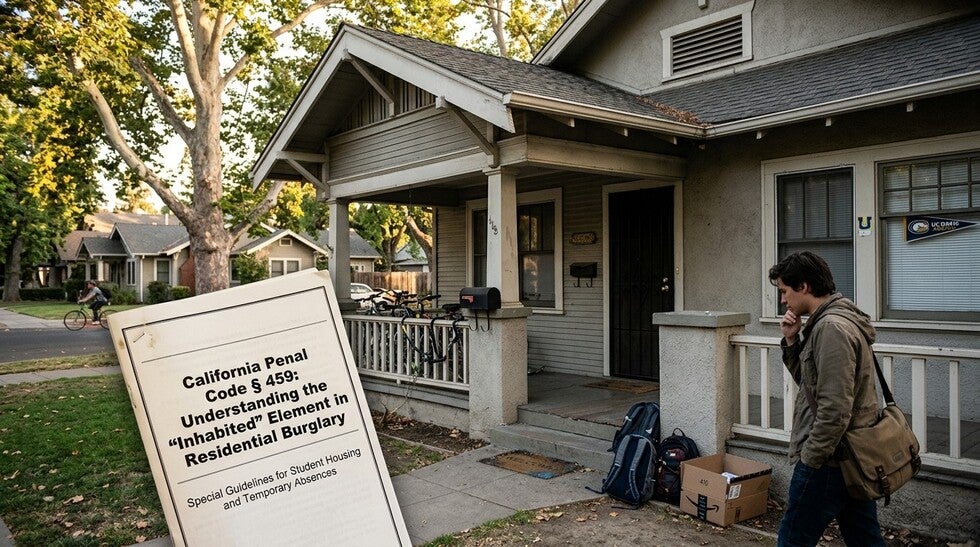
Burglary in Yolo County cases often turn on one issue before anything else: what type of structure did the person enter? Under California Penal Code 459, burglary generally requires entry into a building, room, vehicle, or other covered structure with the intent to commit theft or another felony inside.
The charge becomes much more serious when prosecutors allege first degree residential burglary. A Davis student apartment, a UC Davis residence hall room, a Winters vacation home, a West Sacramento warehouse, or a Woodland retail store can all create different legal issues. The defense must examine the structure, authorization, timing, intent, value, and whether the conduct is really burglary or a lesser theft-related offense.
Burglary in Yolo County under PC 459
California burglary does not require breaking a door or window. Entry can be minimal. The key legal question is whether the person entered with the required criminal intent. If the intent formed only after entry, the prosecution may have a harder time proving burglary.
Common Yolo County burglary allegations involve:
- Residential entries in Davis apartments or student housing.
- Retail entries in Woodland, Davis, or West Sacramento.
- Warehouse or logistics facility entries in West Sacramento.
- Storage units, garages, and vehicles.
- Vacation properties near Winters or rural areas.
- Employee or contractor access disputes.
For a broader overview of the statute, California Penal Code 459 and entry with intent explains why the timing of intent is often the center of a burglary defense.
First degree versus second degree burglary
California divides burglary into degrees. First degree burglary generally involves burglary of an inhabited dwelling. It is a felony and carries much more serious consequences than second degree burglary. Second degree burglary covers other burglaries, including many commercial structures, and is often a wobbler that may be charged as either a felony or misdemeanor depending on the facts.
The difference matters because first degree residential burglary can carry state prison exposure and serious felony or strike consequences. Second degree burglary may allow more room for reduction, misdemeanor treatment, diversion discussions, immigration-sensitive negotiation, or a non-strike outcome.
In practical terms, the defense should not accept a first degree theory without testing the inhabited element. Was the property actually used as a dwelling? Had the occupant moved out? Was the unit between tenants? Was it a vacant student apartment, a residence hall room, or a commercial space?
Burglary in Yolo County and the inhabited element
A dwelling can be inhabited even if no one is home at the moment of entry, if it is ordinarily used as a residence and the occupants intend to return. Temporary absence, travel, school break, hospitalization, or vacation does not automatically make a home uninhabited.
But the question can become contested when a property is vacant, abandoned, between leases, cleared of personal belongings, under renovation, or no longer being used as a residence. Yolo County creates real disputes because of student housing, agricultural rentals, vacation properties, temporary worker housing, and shared living arrangements.
Evidence that may matter includes:
- Lease status.
- Move-out date.
- Whether personal property remained inside.
- Utility status.
- Whether the resident intended to return.
- Whether the space was between tenants.
- Whether the structure was used as a dwelling or for storage.
- Building management records and maintenance logs.
Davis student housing and burglary allegations
Davis student housing creates some of the hardest inhabited-dwelling questions. Students leave for winter break, summer, internships, study abroad, family emergencies, athletic travel, and academic programs. Some units remain occupied by roommates while others are fully vacated between leases.
A Davis apartment where the student is away for two weeks but intends to return is likely treated differently from an apartment where the lease ended, the student moved out, and the unit is being cleaned for a new tenant. A residence hall room during an academic break may also require review of university housing policies, occupancy status, and whether personal items remained.
For UC Davis students, a burglary accusation can also trigger student conduct proceedings. The criminal defense and school defense should be coordinated so statements, admissions, and disciplinary findings do not harm the court case.
West Sacramento warehouses and authorization defenses
West Sacramento's industrial, port-adjacent, logistics, and warehouse corridor creates a different type of burglary defense: authorization. A person may be accused of entering a commercial building or restricted area, but the defense may be that the entry was allowed or reasonably believed to be allowed.
Authorization can be formal or informal. A contractor may have a code. A former employee may still have a badge that was never deactivated. A maintenance worker may have after-hours access. A logistics employee may enter a warehouse based on prior practice. A service provider may believe the job scope included entry.
The defense should gather:
- Employment records.
- Access cards, codes, or key logs.
- Texts, emails, work orders, and service agreements.
- Prior after-hours entries without objection.
- Security policies and revocation notices.
- Video showing non-forced entry.
- Witnesses who can explain the access arrangement.
A person who entered with a good-faith belief in authorization may have a strong defense against the unlawful-entry and intent theories.
Retail burglary and Prop 47 shoplifting
Many retail cases should be analyzed under California's shoplifting statute, not automatically charged as felony commercial burglary. Penal Code 459.5 generally applies when a person enters an open commercial establishment during regular business hours with intent to commit theft of property valued at $950 or less.
When those facts fit, the conduct is usually misdemeanor shoplifting rather than burglary of the same property. This distinction matters in Woodland, Davis, West Sacramento, and other Yolo County retail cases where prosecutors may initially file or threaten a more serious burglary theory.
For noncitizens, students, workers, and people with prior records, reducing a burglary theory to shoplifting can be especially important. Immigration, licensing, employment, and housing consequences may differ significantly depending on the final charge and record.
Burglary, robbery, and theft are different offenses
People often confuse burglary, robbery, and theft. Burglary focuses on entry with intent. Theft focuses on taking property. Robbery involves taking property from another person's possession by force or fear.
A person can commit burglary without successfully stealing anything. A person can commit theft without entering a building. A robbery case usually requires direct confrontation with a person. The difference between burglary and robbery matters because the elements, penalties, strike risks, and defenses are not the same.
Intent defenses in Yolo County burglary cases
The prosecution must prove intent at the time of entry. That can be difficult when the facts show confusion, intoxication, mistake, permission, emergency, mental health crisis, homelessness, property dispute, or a later-formed decision.
Common intent defenses include:
- No intent to steal or commit a felony at the time of entry.
- Good-faith belief in permission to enter.
- Entry to retrieve personal property.
- Entry based on employment, housing, or contractor authorization.
- Mistaken room, unit, house, or building.
- Evidence supports trespass or theft, not burglary.
- Property value supports shoplifting or petty theft treatment.
- Identification evidence is unreliable.
Video, access logs, text messages, door records, receipts, witness statements, and building policies can all help show what the person believed and intended.
Immigration consequences of burglary
Noncitizens should treat any burglary allegation as urgent. Residential burglary, commercial burglary, shoplifting, theft, attempted theft, and trespass can all raise different immigration issues depending on the statute, sentence, record of conviction, intended offense, and whether the case is treated as a crime involving moral turpitude or aggravated felony.
A residential burglary conviction with a one-year sentence can create particularly serious immigration risk in some cases. The defense should avoid unnecessary admissions about intent to steal, occupied dwellings, violence, or aggravated conduct when a safer resolution may be possible.
For H-2A workers, DACA recipients, lawful permanent residents, visa holders, and undocumented defendants in Yolo County, immigration analysis should happen before any plea.
Comparing Yolo County burglary cases to other counties
California burglary law is statewide, but local facts matter. Yolo County cases may involve UC Davis housing, West Sacramento logistics, Woodland retail, agricultural housing, and Winters vacation properties. Other counties raise different factual patterns.
For example, burglary defense in Fresno County under PC 459 may involve agricultural properties, warehouses, and Central Valley retail cases. Burglary defense in Merced County under PC 459 may involve rural housing, campus-adjacent issues, and commercial entries.
Coastal and urban counties can look different. Burglary defense in San Luis Obispo County under PC 459 may involve student housing, tourism, and vacation rentals. San Jose burglary defense under PC 459 may focus on technology workplaces, apartments, and high-density retail. San Francisco burglary defense under PC 459 may involve multi-unit buildings, retail theft allegations, and complex surveillance evidence.
Yolo County Superior Court and what to expect
Yolo County burglary cases are generally handled through Yolo County Superior Court's Criminal Division at 1000 Main Street, Woodland, CA 95695. The case may involve arraignment, bail or release conditions, discovery, protective orders, pretrial conferences, motions, plea negotiations, preliminary hearing, trial, sentencing, and restitution if there is a conviction.
Early release conditions may include stay-away orders from a store, residence, campus, apartment complex, warehouse, or alleged victim. A defendant should understand the order before leaving court. Violating a stay-away order can create new exposure even if the burglary defense is strong.
Yolo County Superior Court, prosecutors, law enforcement agencies, UC Davis, housing providers, retailers, warehouse operators, and public offices are independent entities. Bulldog Law is not affiliated, endorsed, partnered, connected, or associated with any court, prosecutor, law enforcement agency, university, business, housing provider, or government institution.
What to do after a burglary arrest in Yolo County
- Do not discuss why you entered, what you intended, or whether you had permission without legal counsel.
- Preserve texts, emails, lease records, work orders, access codes, and employment documents.
- If the case involves Davis student housing, document lease status, occupancy, move-out dates, and personal property in the unit.
- If the case involves West Sacramento commercial property, preserve access authorization and work history.
- If the case involves a retail store, document business hours, property value, receipts, and whether the store was open.
- If the case involves a vacation property, gather evidence of occupancy pattern, utilities, and intended return.
- Do not contact alleged victims, witnesses, landlords, roommates, or store employees if a stay-away order exists.
- If you are not a U.S. citizen, get immigration analysis before any plea.
Burglary in Yolo County lawyers in California
Bulldog Law defends clients facing burglary, residential burglary, commercial burglary, shoplifting, trespass, theft, robbery-related allegations, Davis student housing cases, West Sacramento warehouse cases, Woodland retail cases, and Winters vacation property cases in Yolo County and throughout California.
Burglary in Yolo County requires more than reading the charge sheet. The defense must examine whether the structure was inhabited, whether entry was authorized, whether intent existed at entry, whether Prop 47 shoplifting applies, whether the evidence supports a lesser offense, and how to protect immigration, school, licensing, employment, and strike consequences from the start.