
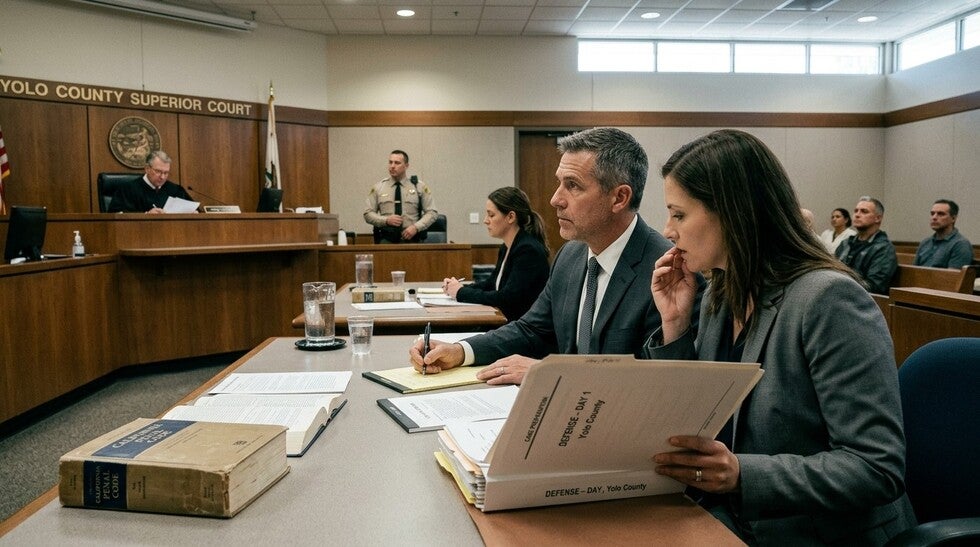
Murder Charges in Yolo County are among the most serious cases a person can face in California. Under Penal Code 187, murder is the unlawful killing of a human being, or fetus, with malice aforethought. That single phrase, malice aforethought, often becomes the center of the defense.
A Yolo County murder case may begin with an arrest in Woodland, Davis, West Sacramento, Winters, on I-80, in a rural area, or after a multi-agency investigation. From the first day, the defense must address evidence preservation, witness statements, forensic testing, search warrants, bail or detention, protective orders, media risk, and the preliminary hearing timeline.
Murder Charges in Yolo County under PC 187
California murder charges require proof of an unlawful killing and malice aforethought. Malice can be express, meaning an intent to kill, or implied, meaning the accused intentionally committed an act dangerous to human life, knew the danger, and acted with conscious disregard for life.
The prosecution may charge first degree murder, second degree murder, felony murder, attempted murder, manslaughter, or related offenses depending on the facts. The defense must immediately identify the exact theory because the evidence needed to defend against premeditation may differ from the evidence needed to defend against implied malice or felony murder.
Cases may involve shootings, stabbings, fights, drug-related deaths, DUI-related deaths, domestic incidents, robberies, gang allegations, child death accusations, self-defense claims, or mistaken identity. Each theory must be tested separately.
First degree, second degree, and felony murder
First degree murder may be alleged when prosecutors claim willfulness, deliberation, and premeditation, or when the killing occurred under certain statutorily listed circumstances. A first degree murder conviction generally carries 25 years to life, and special circumstances can expose a defendant to life without parole or other severe punishment.
Second degree murder generally involves murder with malice that does not meet first degree requirements. A second degree murder conviction typically carries 15 years to life, with higher exposure in certain cases, such as specific peace officer victim circumstances.
Felony murder requires careful analysis. California law now limits murder liability for certain non-killers. A person who was not the actual killer may face murder liability only under specific conditions, such as intent to kill assistance, or being a major participant in an underlying felony while acting with reckless indifference to human life, depending on the felony and evidence.
Murder Charges in Yolo County and the preliminary hearing
The preliminary hearing is one of the first major defense opportunities in a felony murder case. It is not a trial. The judge does not decide guilt beyond a reasonable doubt. The question is whether there is enough evidence to hold the defendant to answer for the charges.
In California felony cases, the preliminary hearing is generally set within 10 court days of arraignment or plea unless time is waived or there is good cause to continue. A 60-day rule may also apply depending on waiver and timing. Whether to waive time is a strategic decision that should be made only after reviewing discovery, investigation needs, custody status, and defense goals.
The preliminary hearing can help the defense:
- Cross-examine key witnesses under oath.
- Test whether probable cause supports murder rather than a lesser offense.
- Challenge weak identification evidence.
- Expose forensic gaps or missing testing.
- Preserve testimony for later impeachment.
- Identify search, seizure, or confession issues.
- Create leverage for reduction or dismissal of unsupported allegations.
Malice aforethought and why it matters
Malice is the dividing line between murder and many lesser homicide offenses. A killing may be tragic, but tragedy alone does not prove murder. The prosecution must prove the required mental state.
In federal cases, malice has its own body of law and terminology. Malice aforethought in federal murder law shows why the mental state behind the killing can be the defining issue in homicide litigation.
In California, the defense may argue that the evidence supports accident, self-defense, imperfect self-defense, heat of passion, lack of intent, lack of conscious disregard, or another theory inconsistent with murder. The goal is not only to dispute what happened, but also to dispute what the prosecution says the accused knew, intended, or consciously disregarded.
Murder versus manslaughter
Manslaughter is an unlawful killing without malice. Voluntary manslaughter may involve heat of passion or imperfect self-defense. Involuntary manslaughter may involve criminal negligence or an unlawful act not amounting to felony murder. Vehicular manslaughter may involve driving conduct that caused death without the malice required for murder.
The difference between manslaughter and murder can decide whether a person faces a life sentence or a much different sentencing range. In many homicide cases, the defense focuses on reducing or defeating malice rather than denying that a death occurred.
Important facts can include provocation, timing, prior threats, fear, intoxication, mental health, weapon access, defensive wounds, emergency calls, medical causation, and whether the accused tried to help after the incident.
Defense from day one
A murder defense cannot wait for the first court date. Evidence can disappear quickly. Surveillance video may be overwritten. Witnesses may talk to each other. Phones may be lost. Scene conditions may change. Vehicles may be repaired. Social media may be deleted. Police narratives may harden before the defense has investigated.
Immediate defense work may include:
- Preserving surveillance, dash camera, phone, and location data.
- Inspecting the scene before conditions change.
- Identifying witnesses before memories shift.
- Reviewing 911 calls, dispatch logs, and body camera footage.
- Challenging search warrants and digital extractions.
- Retaining forensic, medical, ballistics, or accident reconstruction experts.
- Protecting the client from interrogation or recorded jail calls.
- Evaluating immigration, licensing, school, and family consequences.
Common defenses in PC 187 cases
No two murder cases are the same. A defense that works in a self-defense shooting may not apply to a drug-related death, and a forensic defense may not address a witness credibility problem.
- Self-defense or defense of others.
- Imperfect self-defense reducing murder to manslaughter.
- Heat of passion or provocation.
- Accident or lack of criminal negligence.
- No intent to kill and no implied malice.
- Misidentification or unreliable eyewitness testimony.
- False confession or coercive interrogation.
- Unlawful search, seizure, or digital warrant.
- Forensic flaws in DNA, ballistics, pathology, or timing of death.
- Insufficient proof of causation.
- Overbroad felony murder or accomplice liability theory.
Federal murder and violent crime overlap
Most Yolo County murder cases are prosecuted in state court under PC 187. Federal issues can arise when the case involves federal land, drug trafficking, interstate conduct, firearms, organized crime, civil rights allegations, or a death connected to another federal offense.
When a federal drug case involves a death, the federal murder cross-reference in drug cases can dramatically change sentencing exposure. Federal law can also connect murder concepts to other violent offenses, and 18 U.S.C. 1111 and federal violent crime classifications may affect guideline calculations and sentencing arguments.
If state and federal exposure are both possible, the defense must coordinate strategy carefully. Statements, plea decisions, forensic stipulations, or admissions in one case can create consequences in the other.
How Yolo County murder cases compare to other counties
California murder law is statewide, but local facts matter. Yolo County cases may involve UC Davis, rural roads, agricultural communities, I-80, West Sacramento, Woodland neighborhoods, family disputes, student housing, and cross-county investigations involving Sacramento, Solano, Napa, Colusa, or Sutter counties.
For comparison, Solano County murder defense under PC 187 may involve different courthouse practices, police agencies, and cross-Bay Area evidence issues. Tulare County murder charges under PC 187 may involve different rural, agricultural, and Central Valley investigation patterns.
The defense should adapt to the local evidence and court process while grounding every argument in the elements of PC 187, the prosecution's burden, and the specific facts.
Yolo County Superior Court and what to expect
Murder cases in Yolo County are generally handled through Yolo County Superior Court's Criminal Division at 1000 Main Street, Woodland, CA 95695. The process may include arrest, arraignment, bail or detention hearings, protective orders, discovery, preliminary hearing, information filing, second arraignment, motions, expert litigation, plea negotiations, trial, sentencing, and appeal if there is a conviction.
Because murder cases are high-stakes, prosecutors may oppose release or seek strict conditions. The court may issue no-contact orders, firearm restrictions, stay-away orders, or other conditions while the case is pending. A defendant must avoid discussing the case on jail phones, social media, text messages, or with anyone other than defense counsel.
Yolo County Superior Court, prosecutors, law enforcement agencies, forensic laboratories, probation, federal agencies, and public offices are independent institutions. Bulldog Law is not affiliated, endorsed, partnered, connected, or associated with any court, prosecutor, police agency, laboratory, probation department, federal agency, or government entity.
What to do after a murder arrest or investigation
- Do not speak with detectives without defense counsel.
- Do not explain the incident to friends, family, media, or witnesses.
- Do not delete messages, photos, search history, location data, or social media.
- Do not contact alleged witnesses, co-defendants, or the victim's family.
- Preserve information about self-defense, threats, injuries, and prior conflict.
- Identify cameras, vehicles, phones, and witnesses that may preserve evidence.
- Tell your lawyer about mental health, substance use, immigration status, and prior cases.
- Take the preliminary hearing strategy seriously from the first consultation.
Murder Charges in Yolo County lawyers in California
Bulldog Law defends clients facing Murder Charges in Yolo County, PC 187 allegations, attempted murder, manslaughter, self-defense cases, felony murder theories, preliminary hearings, forensic evidence, federal homicide overlap, and life-sentence exposure in California.
Murder Charges in Yolo County require immediate defense because the early record can shape the entire case. The defense must challenge malice, degree, causation, identification, forensic evidence, statements, warrants, accomplice liability, felony murder theories, and preliminary hearing proof before the prosecution's narrative becomes fixed.