
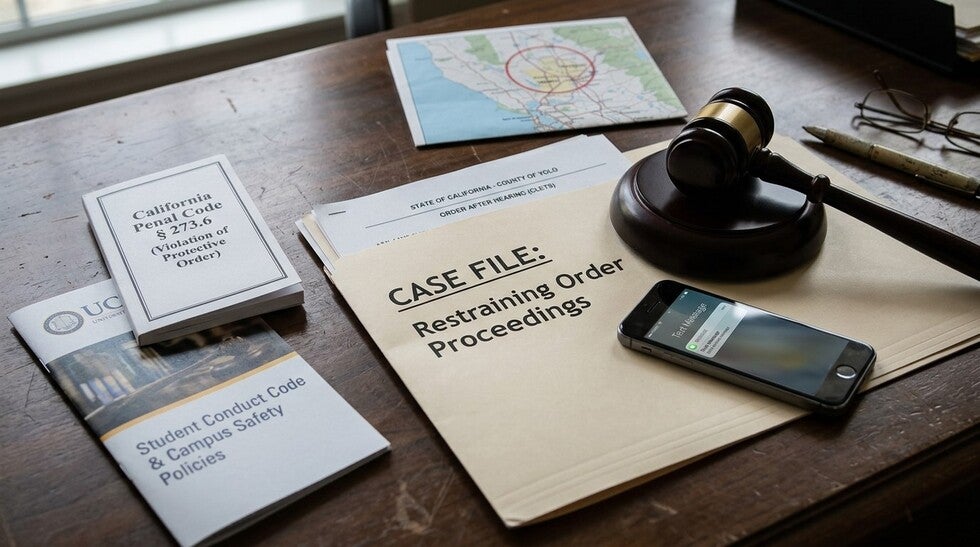
Restraining Order Violations in Yolo County can turn one text message, one campus encounter, one third-party warning, one social media reaction, or one accidental-looking appearance into a new criminal case. Under Penal Code 273.6, prosecutors must prove a knowing and intentional violation of a valid protective order, restraining order, or covered court order.
The contact that changes everything is often small. A person may believe the protected party “wanted to talk,” that a UC Davis campus no-contact directive was not the same as a court order, that a store stay-away order was only civil, or that a mutual friend could pass along a message. Those assumptions can create arrest, probation violations, jail exposure, firearm consequences, immigration concerns, school discipline, and family court damage.
Restraining Order Violations in Yolo County under PC 273.6
Penal Code 273.6 makes it a misdemeanor to knowingly and intentionally violate certain protective orders. The covered orders can include domestic violence restraining orders, criminal protective orders, civil harassment orders, workplace violence orders, elder or dependent adult abuse orders, and qualifying out-of-state orders recognized in California.
For a basic misdemeanor violation, punishment can include up to one year in county jail, a fine of up to $1,000, or both. If the violation results in physical injury, the penalties can increase, including a fine of up to $2,000 and a minimum jail term that the court may have limited discretion to reduce in the interests of justice. Repeat violations, violence, credible threats, or injury can create more serious exposure, including possible felony treatment in certain circumstances.
Prosecutors must still prove the elements. A valid order must exist. The defendant must have known about it. The violation must be intentional. The conduct must actually violate a term of the order.
The order matters: DVRO, CPO, campus directive, or stay-away
Not every restriction is the same. A family court Domestic Violence Restraining Order, criminal protective order, emergency protective order, civil harassment order, UC Davis no-contact directive, housing directive, workplace order, or retail exclusion can have different consequences.
A court order can support a PC 273.6 charge if the statute covers it and the violation is proven. A campus no-contact directive may trigger university discipline, housing removal, class-access issues, or student conduct consequences, but it does not automatically become a PC 273.6 criminal case unless there is also a covered court order or another criminal statute applies.
That distinction is critical for UC Davis students. A student may be under a university no-contact order, a criminal protective order, a family court order, or all of them at once. The defense must identify which order was allegedly violated and what exact language it contained.
Restraining Order Violations in Yolo County and the contact that changes everything
Many violations are not dramatic. Prosecutors may rely on digital records, location data, witness statements, screenshots, Ring camera footage, campus reports, or police observations to argue that contact occurred.
Common allegations include:
- Texting, calling, emailing, or direct messaging the protected person.
- Commenting on or reacting to social media posts.
- Sending money with a message through a payment app.
- Asking a friend, roommate, child, classmate, or co-worker to deliver a message.
- Appearing near a dorm, apartment, workplace, classroom, store, or parking lot.
- Driving by the protected person's home or campus location.
- Responding after the protected person initiated contact.
- Failing to move out or surrender firearms when ordered.
The protected person cannot simply “waive” a court order by inviting contact. If the order prohibits contact, a reply can still be charged. The safer response is usually no response unless counsel or the court has clarified the issue.
Domestic violence restraining orders and broad abuse allegations
Domestic violence restraining order cases can involve more than physical violence. California family courts may consider harassment, threats, disturbing the peace, coercive control, stalking, unwanted contact, property interference, technology abuse, and other conduct depending on the facts.
The broad definition of abuse in California domestic violence restraining orders is important because a person may be restrained based on conduct they did not realize could support a DVRO.
Once the order is issued, the criminal question changes. The issue in a PC 273.6 case is not whether the underlying DVRO was fair or whether the protected person exaggerated. The issue is whether the order existed, whether the defendant knew about it, and whether the defendant intentionally violated it. Challenges to the original order usually require a separate family court strategy.
Burden of proof: getting the order versus violating the order
The burden of proof depends on the proceeding. A restraining order hearing is civil. A criminal PC 273.6 case requires proof beyond a reasonable doubt. Confusing those standards can lead to bad decisions.
In family court, the burden of proof for domestic violence restraining orders in California is lower than the criminal standard. That means a judge may issue an order based on evidence that would not be enough to convict someone of a crime.
In criminal court, the prosecution must prove the violation beyond a reasonable doubt. That can create defenses based on unclear notice, ambiguous order terms, accidental proximity, mistaken identity, lack of intent, unreliable screenshots, or incomplete digital records.
Retail crime restraining orders and store stay-away issues
Restraining order violations are not limited to domestic violence. California law also allows certain retail crime restraining orders in qualifying circumstances. These orders can restrict a person from entering a store, shopping center, or retail location after specific alleged retail theft or related conduct.
California Penal Code 490.8 retail crime restraining orders can create criminal exposure if a person returns to a restricted location after receiving a covered order.
In Yolo County, this can matter in Woodland, Davis, West Sacramento, and other retail areas. The defense should review whether the person was properly served, whether the location was clearly identified, whether the person entered intentionally, and whether the order was still active.
UC Davis campus stay-away orders
UC Davis cases can involve several layers of restrictions. A student may receive a campus no-contact directive from the university, a housing directive, an interim suspension, a Title IX-related order, a criminal protective order, or a family court restraining order. Each one has different enforcement mechanisms.
A campus directive can affect enrollment, housing, student employment, labs, internships, athletic participation, and access to buildings. A court order can create criminal exposure under PC 273.6. When both exist, the student must comply with the stricter practical limits unless the court or university modifies the order.
Common campus problems include shared classes, dining halls, dorms, libraries, labs, Greek life events, internships, club meetings, and mutual friend groups. The defense should map the order against the student's actual schedule and seek modification if compliance is impossible without academic damage.
Defenses to PC 273.6 in Yolo County
Every restraining order violation case depends on the exact order and the evidence. The defense should not assume that a screenshot, police report, or protected party statement proves the case.
- The order was not valid or not in effect at the time.
- The accused did not know about the order.
- The order terms were ambiguous.
- The alleged contact was accidental or unavoidable.
- The accused did not intentionally contact the protected person.
- The protected person misidentified the sender or account.
- The digital evidence was altered, incomplete, or taken out of context.
- The alleged conduct did not violate the specific order language.
- The accused was lawfully present at a required location such as court, school, work, or child exchange.
- The prosecution cannot prove the violation beyond a reasonable doubt.
When the protected person initiated contact, the defense may not be a full legal answer, but it can matter. It may affect intent, credibility, context, negotiation, and whether the order needs modification.
Firearms, probation, immigration, and collateral consequences
Restraining order cases can affect more than jail exposure. Certain protective orders can restrict firearm possession. A separate firearm charge may apply if a person knowingly possesses, receives, purchases, or owns a firearm while prohibited by a covered order.
If the violation is domestic violence-related and probation is granted, the court may impose domestic violence probation terms, counseling, payments, restitution, and stay-away conditions. A violation can also trigger consequences in an existing criminal case, custody case, immigration matter, or professional licensing review.
Noncitizens should get immigration analysis before entering any plea. A result that seems minor in criminal court can still affect immigration, visas, naturalization, admissibility, or removal risk depending on the facts and record.
How Yolo County cases compare to other counties
California restraining order law is statewide, but local facts matter. Yolo County cases may involve UC Davis, West Sacramento workplaces, Woodland family court disputes, rural communities, retail stay-away orders, and cross-county relationships involving Sacramento, Solano, Napa, or Colusa County.
For comparison, San Bernardino County restraining order violation defense under PC 273.6 may involve different court calendars, law enforcement practices, and local negotiation patterns.
Bay Area and Southern California counties can also present different issues. Santa Clara County restraining order violation cases under PC 273.6 may involve technology evidence, workplace proximity, and dense housing, while Orange County restraining order violation defense under PC 273.6 may involve family court overlap, beach city policing, and multi-county contact allegations.
Yolo County Superior Court and what to expect
Restraining order violation cases in Yolo County are generally handled through Yolo County Superior Court's Criminal Division at 1000 Main Street, Woodland, CA 95695. Family court restraining order matters may also proceed through the same courthouse system, but the family case and criminal case are separate tracks.
The criminal process may include arraignment, release conditions, protective orders, discovery, pretrial conferences, motions, negotiations, trial, sentencing, probation, and restitution if there is a conviction. The court may issue or modify a criminal protective order while the case is pending.
Yolo County Superior Court, prosecutors, law enforcement agencies, UC Davis, campus offices, probation, and public agencies are independent institutions. Bulldog Law is not affiliated, endorsed, partnered, connected, or associated with any court, prosecutor, police agency, university, probation department, campus office, or government entity.
What to do after a restraining order violation accusation
- Do not contact the protected person, even to apologize or explain.
- Do not respond if the protected person contacts you first.
- Preserve texts, screenshots, call logs, emails, payment app records, and location data.
- Save the exact order and every page of its terms.
- Identify how and when you were served or told about the order.
- Document unavoidable contact, such as shared school, work, custody, or court obligations.
- If you are a student, do not respond to a campus conduct inquiry without legal advice.
- If the order is impossible to follow, seek modification through the court instead of violating it.
Restraining Order Violations in Yolo County lawyers in California
Bulldog Law defends clients facing Restraining Order Violations in Yolo County, PC 273.6 charges, DVRO violations, criminal protective order violations, campus stay-away conflicts, UC Davis student cases, retail crime restraining orders, digital contact allegations, family court overlap, and probation violation risks.
Restraining Order Violations in Yolo County require immediate attention because one message or appearance can create new criminal exposure. The defense must examine the order, notice, intent, digital evidence, campus directives, protected party contact, family court history, and whether the prosecution can prove every element beyond a reasonable doubt.