
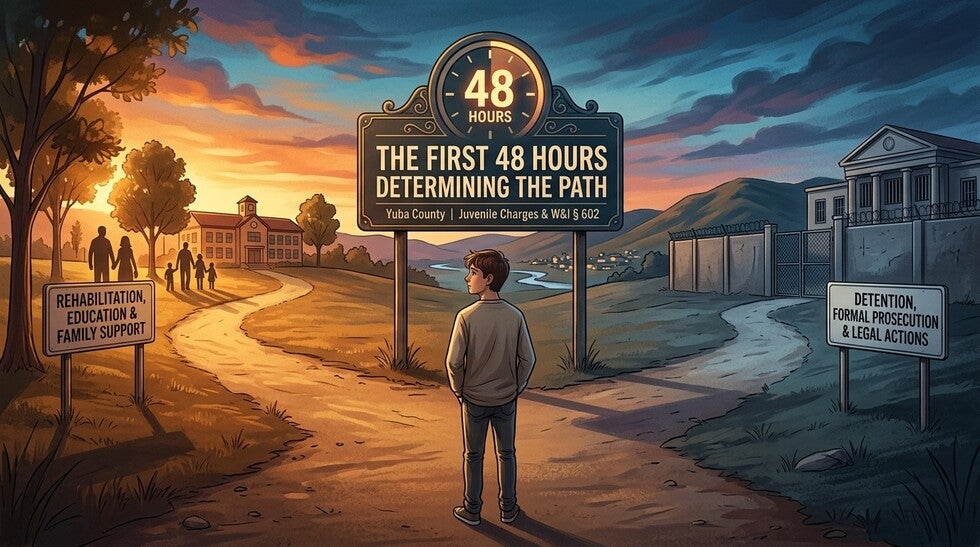
Juvenile Charges in Yuba County can move quickly after a child is cited, detained, questioned, released to a parent, or delivered to probation. Under Welfare and Institutions Code § 602, California juvenile court may handle cases involving minors accused of violating criminal laws. The case is not supposed to function exactly like adult criminal court, but the consequences can still affect school, immigration, driving privileges, military plans, employment, and future record sealing.
The first 48 hours often determine the direction of the case. That is when parents may learn whether the child will be released, whether probation will get involved, whether the prosecutor may file a petition, whether a detention hearing is needed, and whether damaging statements have already been made. Fast action can protect the child from avoidable custody, unnecessary admissions, and a record that could follow them longer than the family expects.
What Juvenile Charges in Yuba County mean under W&I § 602
Welfare and Institutions Code § 602 gives the juvenile court authority over many delinquency cases involving minors who are accused of violating California law, federal law, or local ordinances. In most cases, this applies to youth between 12 and 17. Children under 12 are generally outside delinquency jurisdiction except in narrow serious-offense situations.
Juvenile court uses different language from adult court. A child is not usually “convicted” in the same way an adult is convicted. Instead, the prosecutor may file a petition, the court may decide whether the petition is true, and the court may declare the minor a ward of the court if the legal requirements are met.
Common Yuba County juvenile cases can involve:
- Fights, battery, or assault allegations
- Theft, shoplifting, or vehicle-related allegations
- Drug possession, sales, or school-related drug incidents
- Graffiti, vandalism, or property damage
- Threats, weapons, or school discipline overlap
- Probation violations or failure to follow court orders
- Traffic, alcohol, tobacco, or infraction matters
Parents should not assume a juvenile case is minor because the child was released home. A citation can still lead to probation contact, a court appearance, restitution, school consequences, and a juvenile record.
Juvenile Charges in Yuba County and the first 48 hours
When law enforcement takes a minor into temporary custody, officers may release the minor, deliver the minor to a parent or guardian, refer the case to probation, or seek continued detention depending on the facts. If the child is held, California law imposes strict timing rules. In many situations, a detained youth must be released within 48 hours, excluding noncourt days, unless a petition or legally required notice has been filed.
The first hearing for a detained youth is commonly called a detention hearing. The court decides whether the minor should remain detained or be released while the case proceeds. This hearing can affect school attendance, family contact, counseling, probation conditions, electronic monitoring, no-contact orders, and whether the child can return home.
During this period, families should focus on:
- Where the child is being held or whether the child has been released
- Whether law enforcement questioned the child
- Whether the child spoke with a lawyer before any custodial interrogation
- Whether phones, backpacks, school records, or social media accounts were searched
- Whether there is video, body camera footage, or witness evidence
- Whether school discipline or suspension proceedings are also starting
- Whether the child has immigration, disability, mental health, or special education issues
California gives minors important protections during custodial interrogation. A youth 17 or younger must consult with legal counsel before custodial interrogation and before waiving Miranda rights. That consultation cannot be waived by the youth or parent. Families should treat any statement made without proper protections as a major defense issue.
Release, citations, and probation intake
Not every juvenile arrest means the child will be locked up. Some youth receive citations and are released to a parent or guardian. Others are referred to probation for intake, informal supervision, diversion consideration, or a recommendation to file a formal petition.
Parents should take a citation seriously. A promise to appear, probation letter, court notice, or school referral can become the beginning of a formal delinquency case if deadlines are missed or if the family responds without legal guidance.
Bulldog Law's article on juvenile citation release in California explains why release from custody does not always mean the case is over.
Where juvenile cases are handled in Yuba County
Yuba County juvenile matters are handled through the Juvenile Division of the Superior Court of California, County of Yuba, located at 215 Fifth Street, Suite 200, Marysville, CA 95901. Families should rely on the court notice, probation paperwork, attorney instructions, and official court calendar for exact hearing details.
Youth who are detained may be held at the Tri-County Youth Development Center, located at 938 14th Street in Marysville. Parents should confirm visitation, phone, school, medication, and release information through the appropriate facility and probation channels.
A juvenile case may involve probation intake, detention hearing, arraignment-type proceedings, jurisdiction hearing, disposition hearing, restitution, school coordination, probation terms, counseling, community service, and later record sealing. The court process may be less public than adult court, but it can still be stressful and consequential.
School, graffiti, and community service consequences
Juvenile cases often overlap with school discipline. A fight, threat, vaping allegation, drug incident, graffiti case, or vandalism report can lead to both juvenile court involvement and school consequences. Suspension, expulsion, school transfer, special education services, and extracurricular eligibility may all be affected.
Graffiti and vandalism cases deserve special attention because restitution and community service can become significant. A small act may create a large cleanup bill, especially if multiple minors are accused or if the property owner claims extensive damage.
When a case involves tagging or property damage, juvenile graffiti charges and community service requirements should be analyzed before the family accepts a restitution number or informal resolution.
Immigration, DACA, and noncitizen youth
Juvenile adjudications are not always treated the same as adult criminal convictions for immigration purposes, but families should not assume there is no immigration risk. Conduct admissions, drug allegations, gang allegations, adult transfer, immigration applications, DACA renewals, and discretionary relief can all be affected by a juvenile case.
For immigrant youth and families in Yuba County, the defense should consider both the juvenile court result and the immigration record created by statements, petitions, police reports, and probation documents. This is especially important for DACA recipients, undocumented youth, lawful permanent residents, and families with pending immigration cases.
Immigrant families may benefit from understanding deportation and removal proceedings in California, the limits of judicial review in immigration cases, and education or training opportunities connected to immigrant workforce preparation. Families connected to aviation, travel, or vessel-related work should also understand that immigration penalties and clearance restrictions for vessels and aircraft can create additional concerns in some cases.
Transfer to adult court and serious felony allegations
Most juvenile cases remain in juvenile court. In serious cases, prosecutors may seek transfer to adult criminal court under Welfare and Institutions Code § 707. Transfer is not automatic. The juvenile court must consider whether the minor is amenable to rehabilitation within the juvenile system, and the prosecution must meet the applicable legal standard.
Transfer risk may arise in serious violence, weapons, sex offense, robbery, homicide, or other high-level allegations. Families should act immediately if the petition or police report suggests adult court exposure. The defense may need school records, mental health evidence, trauma history, special education documents, family support evidence, treatment options, and expert evaluation.
Even when adult transfer is not at issue, the defense should still focus on rehabilitation, accountability where appropriate, and avoiding unnecessary long-term harm.
Record sealing and why the case outcome matters
One goal in many juvenile cases is protecting the child's future record. California law provides pathways to seal many juvenile records, but eligibility depends on the case, outcome, age, completion of probation, later conduct, and statutory exclusions.
Parents should think about sealing from the beginning. A quick admission may seem easier in the moment, but the specific offense, restitution order, probation terms, and completion record can affect future sealing. A carefully handled case may improve the child's ability to apply for school, work, housing, licenses, and military opportunities later.
Juvenile defense should not be limited to “what happens at the next hearing.” It should address the child's future.
How Yuba County juvenile defense compares with other counties
California juvenile law applies statewide, but local practice can vary by county. Yuba County's smaller court system, probation practices, school relationships, and community ties can make juvenile cases feel more personal than cases in larger urban courts.
Defense approaches used in Sacramento County juvenile cases under WIC § 602, San Jose juvenile defense matters, Fresno County juvenile charges, and San Francisco juvenile crime cases may involve the same statutes but different probation intake practices, court calendars, and community resources.
What parents should do after Juvenile Charges in Yuba County
Parents should stay calm, but they should not wait. The first two days can decide whether a child is detained, whether statements are used, whether school discipline expands, and whether probation receives only the police version of events.
Immediate steps include:
- Tell the child not to discuss the facts with police, probation, classmates, or social media contacts.
- Do not delete messages, videos, posts, or account history.
- Preserve school records, special education plans, counseling records, and medication information.
- Identify witnesses who saw the full incident, not just the ending.
- Save screenshots, but also preserve complete message threads.
- Follow all court, probation, and release conditions carefully.
- Get legal advice before any meeting with probation, school officials, or law enforcement.
A juvenile case can often be redirected, reduced, diverted, or resolved in a way that protects the child's future, but that depends on early evidence review and careful decision-making.
Juvenile Charges in Yuba County lawyers in California
Juvenile Charges in Yuba County require immediate attention because the first 48 hours can affect custody, statements, probation intake, school discipline, and the future record. W&I § 602 cases should be defended with a focus on both the allegation and the child's long-term opportunities.
Bulldog Law defends California juvenile cases with attention to detention hearings, interrogation rights, school consequences, immigration concerns, record sealing, and family-centered strategy. If your child has been cited, detained, questioned, or accused in Yuba County, the defense should begin before the first court appearance or probation meeting shapes the case.