
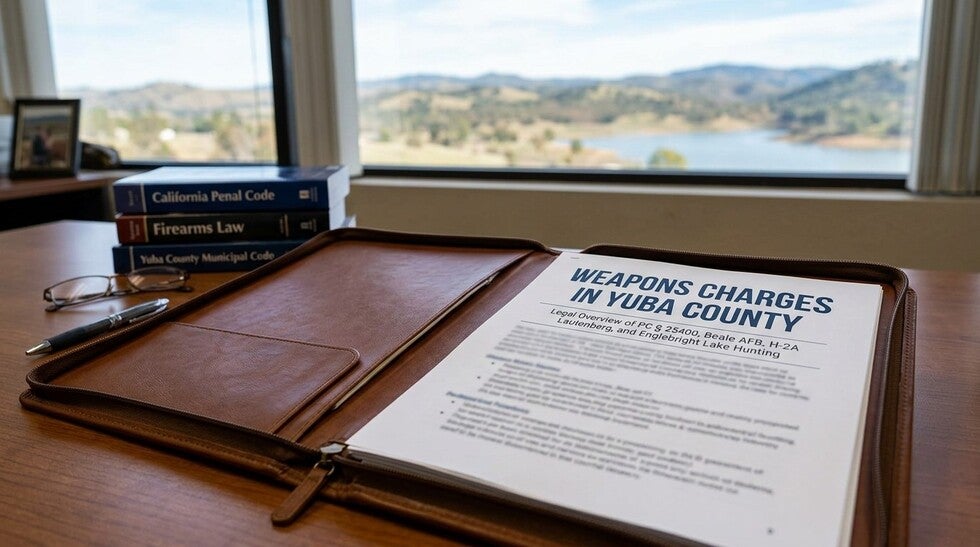
Weapons Charges in Yuba County often begin with a traffic stop, a hunting trip, a vehicle search, a protective order, or a firearm found during an investigation. California Penal Code § 25400 focuses on carrying a concealed pistol, revolver, or other firearm capable of being concealed on the person, including concealed firearms carried in a vehicle. A case may seem straightforward in the police report, but the defense often turns on the type of firearm, how it was stored, whether it was loaded, whether the stop was lawful, and whether the accused was legally prohibited from possessing it.
Yuba County weapons cases can involve Beale AFB service members, Wheatland agricultural workers, Englebright Lake hunters, Highway 20 travelers, and people who legally own firearms but misunderstand California's transport rules. The goal of the defense is to separate a technical mistake, lawful transport issue, or unlawful search from conduct that prosecutors may try to characterize as dangerous or criminal.
What Weapons Charges in Yuba County require under PC § 25400
Penal Code § 25400 generally applies when a person carries a concealed firearm on their person, carries a concealed firearm in a vehicle, or causes a concealed firearm to be carried in a vehicle in which they are an occupant. The statute is usually focused on concealable firearms, such as handguns. Long guns may raise different legal issues, including loaded firearm allegations, prohibited weapon rules, or hunting and Fish and Game Code concerns.
A PC § 25400 case can be charged as a misdemeanor or felony depending on the facts. Felony risk can increase if the person has a prior felony conviction, the firearm is alleged to be stolen, the firearm is not lawfully registered to the person when required, the person is prohibited from possessing firearms, or other aggravating facts are alleged.
Defense issues may include:
- Whether the firearm was actually concealed
- Whether the accused knew the firearm was present
- Whether the firearm was capable of being concealed on the person
- Whether the firearm was unloaded and lawfully transported
- Whether the stop, detention, or search was constitutional
- Whether the accused was legally prohibited from firearm possession
- Whether the case was overcharged as a felony
California weapons law has been reorganized over time, so older case law and prior statutory language can still matter. The defense may need to understand weapons-law continuity under Penal Code § 16010 and California's Deadly Weapons Recodification Act under Penal Code § 16005 when interpreting current charges.
Weapons Charges in Yuba County and firearm transport rules
California handgun transport rules are more specific than many people realize. A person who may lawfully possess a handgun generally must transport it unloaded and locked in the trunk or in a locked container. A glove compartment or utility compartment is not treated as a locked container for this purpose.
The law does not create one simple rule that every firearm and all ammunition must always be separated in every situation. But ammunition location can still matter if prosecutors claim the firearm was loaded, readily accessible, or being carried for unlawful use. The defense should review the exact storage method, container, lock, trunk access, ammunition location, and officer body camera footage.
Common transport questions include:
- Was the firearm in the trunk, a locked case, a backpack, a console, or under a seat?
- Was the firearm unloaded under California law?
- Was the container actually locked?
- Was the firearm a handgun, rifle, shotgun, or another regulated weapon?
- Was the person going to or from a lawful activity?
- Was the person a prohibited possessor because of a conviction, restraining order, or federal law?
When the firearm was discovered only because of a vehicle stop, the search issue may be as important as the storage issue. If the stop, detention, pat-down, vehicle search, probation search, or inventory search was unlawful, the defense may seek suppression of the firearm and related statements.
Beale AFB, military carry authorization, and California public roads
Beale AFB service members may lawfully handle or carry firearms as part of military duties on the installation. That does not automatically create authority to carry a concealed firearm off base on Highway 20, Beale Air Force Base Road, or other California public roads. Military duty authorization and California civilian carry law are separate systems.
A Security Forces member or other service member may have a genuine misunderstanding about where military authorization ends. That misunderstanding may not be a complete legal defense, but it can be important context when negotiating a case, explaining the person's background, and showing the absence of criminal purpose.
For service members, the consequences can extend beyond criminal court. A civilian weapons conviction may affect command review, security clearance disclosure, weapons access, duty assignments, and administrative action. The defense should account for both the Yuba County criminal case and the military consequences before the service member speaks to law enforcement, command, or investigators.
Wheatland H-2A workers, Lautenberg, and firearm prohibitions
For Wheatland agricultural workers, H-2A workers, and other noncitizens, firearm cases can carry consequences beyond the immediate charge. A person may be prohibited from possessing firearms because of a prior felony, a domestic violence restraining order, certain domestic violence convictions, or another state or federal prohibition.
The Lautenberg Amendment is especially important. Under federal law, a qualifying misdemeanor crime of domestic violence can prohibit a person from possessing firearms or ammunition. The age of the conviction, the state where it happened, and the fact that it was a misdemeanor do not automatically remove the risk. California expungement also may not solve the federal firearm problem.
A Yuba County traffic stop that uncovers a firearm can become more serious if the accused has a prior domestic violence conviction. The state case may be charged under PC § 25400 or another California statute, while federal firearm exposure may need separate review. The defense should identify any prior conviction before the client makes statements about ownership, possession, storage, or the reason the firearm was in the vehicle.
Englebright Lake hunting and Tahoe National Forest travel
Englebright Lake, the Yuba River corridor, and routes toward Tahoe National Forest can produce firearm transport cases involving hunters, anglers, campers, and recreational shooters. A valid hunting license or lawful outdoor purpose can be important, but it is not a blanket exemption from California firearm transport law.
California law includes an exemption for licensed hunters and fishermen carrying certain concealable firearms while engaged in hunting or fishing, or transporting those firearms unloaded while going to or returning from that expedition. The details matter. The firearm type, whether it was unloaded, whether the person was actually going to or returning from hunting or fishing, and whether other laws apply can all affect the defense.
A hunter who lawfully possesses a firearm in the field may still face problems when driving on a public road if the firearm is loaded, improperly stored, or carried in a way that violates California law. Hunting context may help explain the person's purpose and support a more favorable resolution, but it should be combined with a careful review of the stop, search, firearm type, and transport facts.
Highway 20 travelers and out-of-state carry permits
Highway 20 brings travelers through Yuba County from Nevada, Placer County, Nevada County, and other parts of Northern California. Some drivers carry firearms because they have an out-of-state permit or come from a state with more permissive carry laws. California generally does not honor out-of-state concealed carry permits for carrying concealed firearms in California.
Good-faith confusion about another state's permit may be useful context, but it is not the same as a California concealed carry license. The defense should preserve the out-of-state permit, travel itinerary, lawful ownership documents, and facts showing the firearm was not possessed for a criminal purpose.
Regional weapons defense often involves similar issues in neighboring counties. A case in Yuba County may overlap with concerns seen in Placer County PC § 25400 weapons cases and Plumas County concealed firearm allegations, while larger court systems may handle Riverside County weapons charges and Sacramento County PC § 25400 cases with different local practices.
Schools, airports, jails, and sensitive locations
The location of the firearm can change the legal analysis. A weapon allegation at or near a school, airport terminal, courthouse, jail, or correctional facility may involve statutes beyond PC § 25400. These cases can create higher risk because the government may argue the location itself increased public safety concerns.
A firearm or weapon allegation connected to school property may require analysis of Penal Code § 626.10 school grounds weapons charges. Airport terminal cases may involve Penal Code § 171.5 airport terminal weapons allegations. Jail or custodial setting allegations can raise separate issues under Penal Code § 4574 weapons and contraband in correctional facilities.
Not every object is treated the same way under California weapons law. In some cases, exemptions may matter, including Penal Code § 22215 exemptions for certain impact weapons. The defense must identify the exact object, statute, location, and alleged use before evaluating exposure.
Protective orders, surrender duties, and firearm relinquishment
Some Yuba County weapons cases begin after a domestic violence restraining order, criminal protective order, emergency protective order, or civil order requiring firearm surrender. A person who does not understand the order may keep a firearm in a vehicle, storage unit, relative's home, or workplace and later face a new criminal allegation.
California law can require firearms to be surrendered, sold, or transferred through lawful procedures when an order prohibits possession. The accused should not casually move firearms, ask someone else to hide them, or make statements about possession without legal advice.
When a court order requires relinquishment, California weapons surrender under Penal Code § 18000 should be reviewed carefully so the person complies without creating new evidence or additional exposure.
Where weapons cases are handled in Yuba County
Yuba County criminal cases are handled at the Superior Court of California, County of Yuba, located at 215 Fifth Street, Suite 200, Marysville, CA 95901. Defendants should rely on the court notice, attorney instructions, and official court calendar for exact appearance details.
A weapons case may involve arraignment, bail or release conditions, protective orders, firearm surrender issues, discovery, body camera footage, search and seizure motions, plea negotiations, readiness conferences, and trial. Felony cases may also involve a preliminary hearing, where the prosecution must present enough evidence for the case to proceed.
Because weapons charges can affect military service, immigration status, employment, licensing, firearm rights, and future background checks, the defense should address collateral consequences from the first court appearance.
Defense strategies for Weapons Charges in Yuba County
A strong defense starts with the stop and search. Many weapons cases begin with a traffic stop on Highway 20, Highway 70, roads near Beale AFB, routes through Wheatland, or access roads near Englebright Lake. If officers lacked a valid basis for the stop, unlawfully prolonged the detention, or searched without legal authority, the defense may challenge the evidence.
Potential defenses may include:
- No knowledge that the firearm was present
- No concealment under PC § 25400
- Lawful transport of an unloaded handgun in a locked container or trunk
- Valid hunting or fishing context under the applicable statute
- Unlawful stop, detention, search, or interrogation
- Invalid consent to search
- Incorrect claim that the firearm was loaded
- Misidentification of the owner or possessor
- No qualifying prior conviction or prohibition
- Overcharged felony where misdemeanor treatment is appropriate
The defense should also review whether the firearm was seized, whether the person is eligible to get it back, and whether there are separate administrative or civil steps needed after the criminal case.
What to do after a weapons arrest in Yuba County
After a weapons arrest, do not explain the firearm, ownership, purpose, storage method, hunting trip, military duties, or prior convictions to officers without legal advice. Statements about protection, habit, hunting, or who owned the gun can become important evidence.
Important steps include:
- Invoke the right to remain silent and ask for a lawyer.
- Do not consent to additional searches of vehicles, phones, homes, or storage spaces.
- Preserve photos or documents showing how the firearm was stored.
- Save hunting licenses, tags, travel records, military authorization documents, or out-of-state permits.
- Identify any prior domestic violence, felony, restraining order, or firearm-related history.
- For Beale AFB service members, get advice before speaking with command or investigators.
- For noncitizens, address immigration consequences before any plea discussion.
Early defense work can make the difference between a felony, a misdemeanor, a dismissal, or a resolution that protects the client's future.
Weapons Charges in Yuba County lawyers in California
Weapons Charges in Yuba County require careful review of California firearm transport rules, PC § 25400, loaded firearm allegations, hunting context, military authorization, federal firearm prohibitions, and search-and-seizure issues. A case involving Beale AFB, Wheatland agricultural work, Englebright Lake hunting, Highway 20 travel, or an out-of-state permit should not be treated as a routine gun case.
Bulldog Law defends serious California weapons cases with attention to constitutional challenges, firearm storage, prohibited-person issues, military consequences, immigration concerns, and long-term record damage. If you or a loved one is facing a Yuba County weapons charge, legal strategy should begin before statements are made, firearms are forfeited, or the prosecution's theory becomes fixed.