
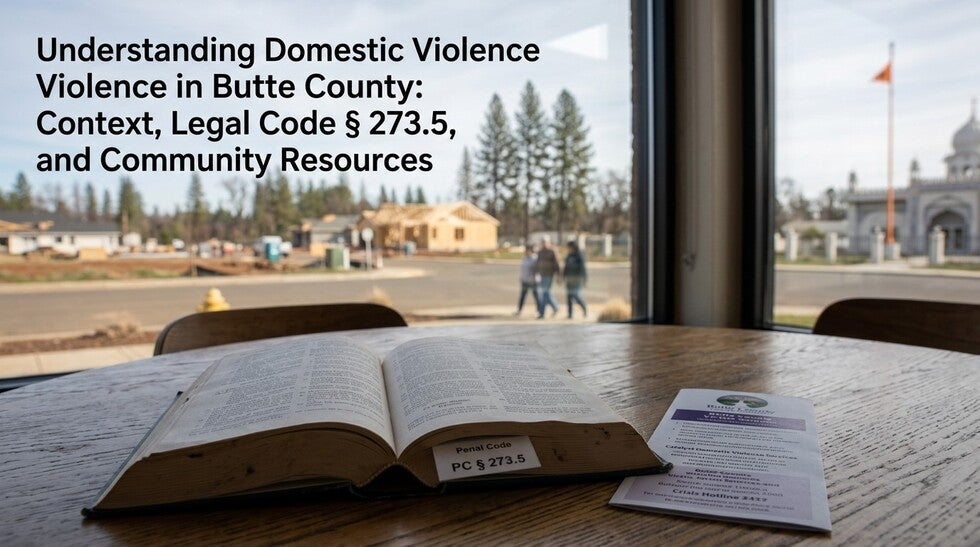
Domestic Violence in Butte County is often prosecuted from the evidence collected at the scene: 911 recordings, body camera footage, injury photographs, officer observations, emergency protective orders, statements from neighbors, and statements made in the first minutes after police arrive. A later decision by the alleged victim not to cooperate does not automatically end the case. The Butte County District Attorney may still decide whether to file or continue charges based on the available evidence.
For people in Chico, Oroville, Paradise, Gridley, Biggs, and surrounding rural communities, a domestic violence arrest can affect criminal court, family court, firearms rights, immigration status, employment, professional licensing, housing, parenting time, and community reputation. The stakes can be especially high in Gridley's Sikh community, Paradise's post-Camp Fire rebuild community, CSU Chico households, agricultural worker families, and licensed professions.
What Domestic Violence in Butte County means under PC § 273.5
Penal Code § 273.5 applies when prosecutors allege that a person willfully inflicted a corporal injury resulting in a traumatic condition on a qualifying intimate partner or family-related victim. The protected relationship may include a spouse, former spouse, cohabitant, former cohabitant, fiancé, fiancée, dating partner, former dating partner, co-parent, or person connected through other covered relationships.
A “traumatic condition” can include visible injury, bruising, swelling, redness, cuts, pain-related marks, or other physical injury caused by the alleged force. PC § 273.5 can be charged as a misdemeanor or felony depending on the facts, injury evidence, prior record, alleged threats, weapons, and other circumstances. A felony conviction can carry two, three, or four years. A misdemeanor can carry up to one year in county jail.
Domestic violence defense should begin by reviewing:
- 911 audio and dispatch notes.
- Body camera footage.
- Photos of injuries on both sides.
- Medical records.
- Prior incident history.
- Witness statements.
- Text messages, voicemails, and social media records.
- Emergency protective orders and later restraining orders.
Evidence may look different after full review than it looked to officers at the scene.
Domestic Violence in Butte County and the alleged victim's cooperation
Many defendants believe the case will disappear if the alleged victim recants, refuses to testify, or tells the prosecutor they do not want charges. That is not a safe assumption. Prosecutors may rely on bodycam footage, 911 calls, injury photos, excited utterances, medical records, neighbor testimony, or other evidence independent of later cooperation.
Domestic violence response may also involve law enforcement, prosecutors, victim advocates, probation, child welfare, medical providers, and community organizations. The role of domestic violence multidisciplinary teams can affect how evidence is gathered, shared, and used in related criminal and protective-order proceedings.
The defense should not pressure, contact, or ask anyone else to contact the alleged victim. If a protective order exists, any contact can create new charges or make the original case worse.
Gridley's Sikh community and reputational consequences
Gridley sits within the broader North Valley Sikh community connected through family, agriculture, business, and Gurdwara networks across Butte, Sutter, and surrounding counties. In that environment, a domestic violence case can affect more than the court file. It may affect family relationships, employment opportunities, business reputation, community standing, and future marriage or family considerations.
The defense should recognize these community realities without treating them as legal proof of guilt or innocence. The legal case still turns on evidence, elements, credibility, injury, self-defense, and whether the prosecution can prove the charge beyond a reasonable doubt.
For noncitizens in agricultural communities, the immigration consequences may be severe. A domestic violence conviction can create deportability, inadmissibility, visa renewal issues, and future status problems depending on the exact offense, sentence, immigration status, and record of conviction. Immigration-safe defense must begin before any plea is entered.
Paradise rebuild families and community visibility
Paradise and surrounding communities experienced a shared trauma after the 2018 Camp Fire. Many families evacuated together, lived through displacement together, and returned to rebuild in a community where neighbors often know each other's history. In that setting, a domestic violence case may become widely known quickly.
Community visibility should not replace legal strategy. The defense should focus on protecting the record, challenging unsupported allegations, preserving evidence, and seeking the least damaging lawful outcome. A dismissal, reduction, acquittal, or carefully structured resolution can matter not only in court, but also in how the person moves forward in a small rebuild community.
For people rebuilding homes, businesses, insurance claims, family stability, and employment, the collateral damage of a domestic violence conviction may be just as important as the formal sentence.
DVROs, emergency orders, and family court overlap
A domestic violence arrest can create immediate protective orders in criminal court and may also lead to a Domestic Violence Restraining Order in family court. Temporary orders and longer-term orders have different procedures, deadlines, evidence standards, and consequences.
The difference between temporary and permanent domestic violence restraining orders matters because a short-term emergency order can quickly become a longer family court order affecting custody, housing, firearms, pets, property, and contact. The burden of proof in DVRO cases is different from the burden in criminal court, where the prosecution must prove guilt beyond a reasonable doubt.
Renewal is another issue. A person facing a request for renewing a domestic violence restraining order should review the history of compliance, alleged fear, prior incidents, and whether the requested renewal is supported by current evidence.
Probation, classes, firearms, and diversion limits
Domestic violence cases can carry probation terms that affect daily life. If probation is granted in a California domestic violence case, the court generally must impose domestic violence probation conditions, which often include a criminal protective order, fines or fees where applicable, and a 52-week batterers' intervention program under Penal Code § 1203.097.
Standard misdemeanor judicial diversion is generally not available for offenses involving domestic violence. Some alternative outcomes may still be possible depending on the charge, facts, county practice, mental health issues, evidentiary weaknesses, or negotiated resolution, but no defendant should assume that domestic violence diversion is automatic or available simply because the case is a first offense.
Firearms consequences also require careful review. A felony conviction can trigger state and federal firearm prohibitions. A qualifying misdemeanor crime of domestic violence can trigger the federal Lautenberg prohibition. Domestic violence restraining orders can also restrict firearms while the order is active. The exact consequence depends on the conviction, relationship, order terms, sentence, and federal law.
Evidence Code § 1109 and prior domestic violence allegations
Domestic violence cases can involve prior incident evidence. California Evidence Code § 1109 may allow prosecutors, in certain domestic violence cases, to introduce evidence of prior domestic violence conduct to show propensity, subject to legal limits and objections. This can make old allegations, dismissed cases, or prior police reports important even when they are not the current charge.
The defense should analyze whether prior-incident evidence is legally admissible, whether it is too remote, whether it is more prejudicial than probative, whether the prior allegation was reliable, and whether the jury would misuse it. The analysis in People v. Kerley and Evidence Code § 1109 shows why prior domestic violence evidence must be challenged carefully.
Prior allegations should not be allowed to overwhelm the facts of the current case. The prosecution must still prove the charged offense.
Self-defense and bilateral injury evidence
Many domestic violence calls involve injuries on both sides. Officers may arrest the person they believe was the dominant aggressor, but that decision can be incomplete. A defendant may have acted in self-defense, defense of others, or in response to aggression not fully documented in the initial report.
Important defense evidence includes:
- Photos of the defendant's injuries taken immediately.
- Medical records for both parties.
- 911 calls made by either side.
- Bodycam footage showing demeanor and visible injuries.
- Neighbor or family witness statements.
- Prior threats or violence by the alleged victim.
- Texts and messages before and after the incident.
- Evidence of intoxication, mental health crisis, or mutual conflict.
Bruises, scratches, swelling, and redness can change within hours. Time-sensitive evidence should be preserved immediately.
How Butte County compares with other domestic violence cases
California domestic violence law is statewide, but county context matters. Tehama County domestic violence cases may involve rural households and smaller-court dynamics. Sutter County domestic violence cases may involve neighboring agricultural communities and North Valley family networks. Stanislaus County domestic violence cases may involve Central Valley family and employment issues, while Solano County domestic violence cases often involve Bay Area commuter, military, and suburban dynamics.
Butte County cases often involve Chico student housing, Oroville criminal court practice, Gridley agricultural families, Paradise rebuild community visibility, and rural-law-enforcement response times.
Where Domestic Violence in Butte County cases are handled
Domestic Violence in Butte County criminal cases are generally handled through the Criminal Division of the Butte County Superior Court at the Butte County Courthouse, located at One Court Street, Oroville, CA 95965. Butte County also operates the North Butte County Courthouse at 1775 Concord Avenue, Chico, CA 95928, but criminal misdemeanor and felony matters are handled through the criminal division in Oroville. Defendants should rely on court notices, attorney instructions, and official court communications for the correct hearing location and appearance requirements.
A domestic violence case may involve arraignment, protective orders, discovery, bodycam footage, 911 recordings, medical records, witness statements, prior incident evidence, DVRO proceedings, negotiations, trial readiness, and trial.
The first court date matters because the court may issue or modify criminal protective orders, firearm restrictions, stay-away terms, residence exclusions, child-contact restrictions, alcohol terms, and release conditions.
Defenses to Domestic Violence in Butte County charges
The strongest defense depends on the evidence. The defense may challenge injury, intent, relationship status, causation, identity, credibility, self-defense, or whether the prosecution can prove every element beyond a reasonable doubt.
Potential defenses include:
- The injury was accidental.
- The accused acted in self-defense.
- The alleged victim was the aggressor.
- The injury was not caused by the accused.
- The injury does not meet the charged offense.
- Statements were exaggerated, intoxicated, or inconsistent.
- Bodycam footage contradicts the report.
- The relationship does not fit the charged statute.
- Prior allegations are unreliable or inadmissible.
- The case should be reduced or dismissed based on weak evidence.
The defense should also evaluate immigration-safe outcomes, licensing-sensitive resolutions, firearms consequences, probation terms, and family court overlap before any plea is entered.
What to do after a domestic violence arrest in Butte County
After a domestic violence arrest, do not contact the alleged victim if any order prohibits contact. Do not ask relatives, friends, children, clergy, coworkers, or community members to pass messages. Do not post about the case online. Do not explain your side on recorded jail calls.
Important steps include:
- Read and follow every protective order.
- Photograph your own injuries immediately.
- Preserve texts, voicemails, emails, and social media messages.
- Identify witnesses who saw or heard the incident.
- Write down the sequence of events while memory is fresh.
- For noncitizens, get immigration-aware defense before any plea.
- For licensed professionals, get employment and licensing advice early.
- Do not surrender, sell, or move firearms without understanding the order and legal requirements.
Early defense work can preserve evidence, prevent new violations, address DVRO issues, and reduce the risk that a single emergency call controls the entire case.
Domestic Violence in Butte County lawyers in California
Domestic Violence in Butte County requires careful review of PC § 273.5, bodycam footage, injury evidence, 911 calls, protective orders, DVROs, Evidence Code § 1109, self-defense, immigration consequences, firearms restrictions, Gridley community visibility, Paradise rebuild context, and courtroom strategy in Butte County Superior Court.
Bulldog Law defends California domestic violence cases involving PC § 273.5, misdemeanor and felony allegations, self-defense, mutual conflict, restraining orders, prior incident evidence, noncitizen defense, professional licensing issues, family court overlap, and trial defense. If you or a loved one is facing a domestic violence charge in Butte County, legal strategy should begin before statements are made, injuries fade, or protective-order violations create new exposure.