
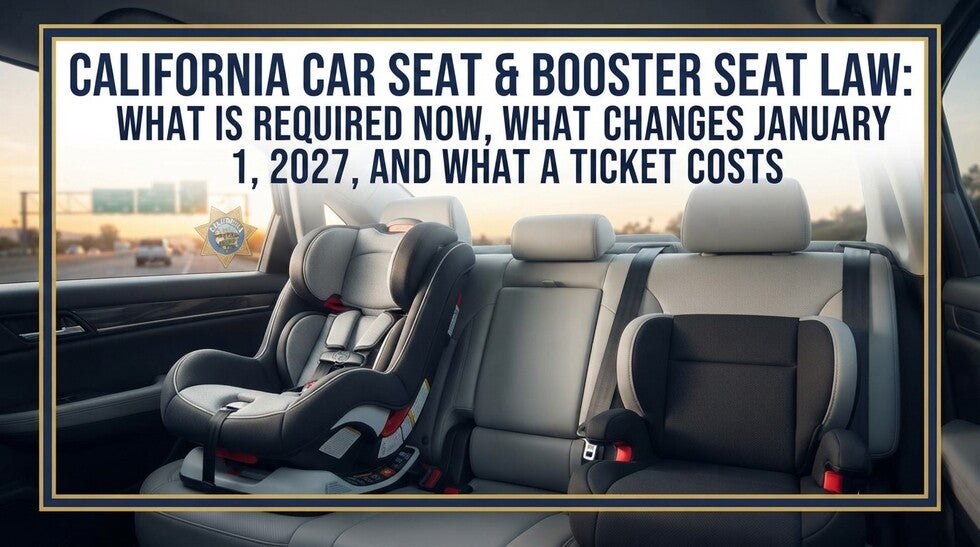
Updated August 2026 | The Bulldog Law | California Traffic and Criminal Defense
California's car seat law (Vehicle Code 27360 and 27360.5) requires children under 2 to ride rear-facing unless they weigh 40 pounds or more or are at least 40 inches tall, children under 8 to ride in the back seat in a car seat or booster, and children 8 and older, or at least 4 feet 9 inches tall, to use a seat belt. Beginning January 1, 2027, Assembly Bill 435 adds a five-step fit test: a child aged 8 through 15 may ride with a seat belt alone only if the belt actually fits, and otherwise must stay in a booster. A violation is an infraction with a base fine of $100 for a first offense and $250 after that, roughly $500 and $1,100 with assessments, plus one DMV point.
Most parents search this topic because a child is about to outgrow a booster, a grandparent is driving the kids, or a ticket just arrived. Our team law as it stands through the end of 2026, the change coming in 2027, the front seat rules and exceptions, what a ticket costs and how to reduce it, and the narrow situations where an unrestrained child turns a traffic stop into a criminal case. For a ticket or a charge, The Bulldog Law's traffic defense team can help call (888) 928-1609.
California Car Seat Requirements by Age (Current Law Through December 31, 2026)
|
Child |
Requirement |
Code section |
|
Under 2 |
Rear-facing car seat in the back seat, unless the child weighs 40 lbs or more or is 40 inches or taller |
VC 27360(a) |
|
Under 8 |
Car seat or booster in the back seat, secured per the manufacturer's instructions |
VC 27360(a) |
|
8 to 15, or 4 ft 9 in or taller |
May use the vehicle seat belt; a booster is still recommended until the belt fits |
VC 27360.5 |
|
Under 8, front seat |
Only under the VC 27363 exceptions (no rear seat, rear seats unusable, rear seats full of children under 8, medical reason) |
VC 27363 |
|
Rear-facing seat in front of an active airbag |
Prohibited at any age |
VC 27363(b) |
The statute is short and worth reading directly at Vehicle Code 27360. Two details trip people up. First, the under-2 rear-facing rule has a size escape hatch: a large toddler who hits 40 pounds or 40 inches before their second birthday can legally face forward, though safety agencies recommend rear-facing as long as the seat allows. Second, the 4-foot-9 height rule lets a tall 6 or 7-year-old out of a booster before age 8, which is exactly the gap AB 435 was written to close.
What Changes on January 1, 2027: AB 435 and the Five-Step Test
Assembly Bill 435, signed in October 2025, takes effect January 1, 2027. It does not change the rules for children under 8. What it changes is the transition out of a booster for children 8 through 15. Under the current law, a child can graduate to a seat belt on their eighth birthday no matter how the belt fits. Under AB 435, a child in that age range is properly restrained by a seat belt only if all five of these are true:
- The child sits with their back all the way against the vehicle seat.
- The child's knees bend comfortably at the edge of the seat cushion.
- The lap belt lies across the upper thighs, not the stomach.
- The shoulder belt crosses the middle of the chest and shoulder, not the neck or face.
- The child can stay seated that way for the entire trip.
A child who fails any one step must ride in a booster, regardless of age. There is no new height or weight number; the test replaces the number. For most children the belt fits somewhere between ages 10 and 12, which is why safety organizations have long said 4 feet 9 inches was too early. Parents of children between 8 and 12 should run the test now, because a child who passes today under the old rule may not pass under the new one.
AB 435 also applies the fit test to children on charter buses that have seat belts, and it keeps the existing exemptions for school buses and other vehicles not required to have belts. Because secondary sources have reported the 2027 age bands inconsistently, check the chaptered text on leginfo.legislature.ca.gov if a specific age matters to you.
Front Seat Rules and the Exceptions
The back seat requirement for children under 8 has five exceptions listed in Vehicle Code 27363:
- The vehicle has no rear seat (a two-seat pickup or sports car).
- The rear seats are side-facing jump seats or rear-facing seats.
- The child restraint system cannot be installed properly in the rear seat.
- All rear seats are already occupied by children under 8.
- A physician has determined that a medical reason requires the child to ride in front.
Even when an exception applies, a rear-facing seat can never go in front of an active airbag. Beyond age 8 the law is silent on seating position; the widely quoted "back seat until 13" rule is a safety recommendation from the National Highway Traffic Safety Administration and the American Academy of Pediatrics, not a California statute, and an officer cannot cite a 10-year-old for riding in front.
Other exemptions worth knowing: taxis and rideshare vehicles are not exempt from the car seat law in California, which surprises many visitors; buses and school buses are exempt; and an emergency situation where no car seat is available is a defense but not a blanket exemption.
What a Car Seat Ticket Costs
A Vehicle Code 27360 or 27360.5 violation is an infraction. The base fine is $100 for a first offense and $250 for each subsequent offense, but California adds state and county penalty assessments, court fees, and surcharges that multiply the base. In most counties a first ticket totals around $500 and a second around $1,100 or more. The violation also adds one point to your DMV driving record, which stays on the record for three years and can raise insurance premiums. Points matter more for commercial drivers and anyone already close to the negligent operator threshold.
The ticket goes to the driver, not the parent, if they are different people. A grandparent, babysitter, or rideshare driver transporting an unrestrained child is the one cited.
Reducing or dismissing the ticket
For a first offense, the statute lets the court reduce or waive the fine when the defendant shows proof of obtaining an appropriate child restraint and, in many counties, completing a child passenger safety education class. Many courts treat this as a correctable violation in practice. Other defenses include:
- The child met an age, weight, or height threshold the officer did not verify.
- A VC 27363 exception applied and was not considered.
- The restraint was properly used and the officer misjudged it through a window at a stop.
- The vehicle was not on a highway as defined by the Vehicle Code (a private lot, for example).
A single car seat ticket is usually handled by mail. It becomes worth an attorney's time when it is bundled with other charges, when the driver holds a commercial license, or when the driver already has points and the extra one triggers a suspension. If a ticket went unpaid and you suspect a failure-to-appear, check how to find out if you have a warrant.
When a Car Seat Violation Becomes a Criminal Case
By itself, an unrestrained child is an infraction. It becomes a crime only in combination with something else. The three most common situations:
DUI with a child in the car
A DUI with a passenger under 14 carries a mandatory sentence enhancement under Vehicle Code 23572 of 48 hours to 90 days in jail depending on the number of prior convictions, and prosecutors frequently add a Penal Code 273a child endangerment count. An unrestrained child in a DUI case makes the endangerment count easier to prove and harder to negotiate away.
Reckless driving, speed contests, or a crash
An unrestrained child combined with reckless driving, a street race, or a collision that injures the child supports a Penal Code 273a charge, which is a wobbler when the circumstances are likely to produce great bodily harm or death. The car seat violation is the evidence of willful disregard. In a fatal crash, it can become a factor in a vehicular manslaughter prosecution.
Leaving the scene
Parents sometimes drive away from a minor collision because they know the child was not properly restrained and fear the ticket. That converts a $500 infraction into a hit-and-run charge, which is a misdemeanor for property damage and a felony if anyone was injured. Stay, exchange information, and deal with the car seat issue separately.
A conviction on any of those criminal charges carries consequences the infraction does not: a criminal record, possible jail, and, for non-citizens, potential immigration consequences. Child endangerment in particular can affect custody proceedings and CPS involvement.
Car Seat Law and Injury Claims
If a child is injured in a crash caused by another driver, the at-fault driver's insurer may argue that the child's injuries were worsened by improper restraint. California's comparative fault rules allow that argument to reduce, but not eliminate, a recovery, and courts have limited how far insurers can push it when the child was restrained in a way that complied with the law at the time. Parents in that situation should talk to a personal injury attorney before giving a recorded statement to the other driver's insurer about how the child was seated.
Frequently Asked Questions
What is the California booster seat law right now?
Through December 31, 2026: children under 2 must ride rear-facing unless they weigh 40 pounds or more or are 40 inches or taller; children under 8 must ride in the back seat in a car seat or booster; and children 8 and older, or any child who is at least 4 feet 9 inches tall, may use the vehicle seat belt. Starting January 1, 2027, children ages 8 through 15 may use a seat belt alone only if they pass the five-step fit test; otherwise they stay in a booster.
What is the five-step test in the new California car seat law?
Under AB 435, a child is properly restrained by a seat belt only if all five are true: the child sits with their back fully against the vehicle seat; the knees bend comfortably at the edge of the seat; the lap belt sits low on the upper thighs, not the stomach; the shoulder belt crosses the middle of the chest and shoulder, not the neck or face; and the child can stay seated that way for the whole trip. Failing any step means the child needs a booster, regardless of age or height.
How much is a car seat ticket in California?
Vehicle Code 27360 sets a base fine of $100 for a first offense and $250 for each later offense. With California's mandatory penalty assessments and fees, a first ticket typically costs around $500 and a second around $1,100 or more. The violation also adds one point to your DMV record. For a first offense, the court can reduce or waive the fine if you show proof that you obtained a proper car seat and, in many counties, completed a child passenger safety class.
When can a child sit in the front seat in California?
The law requires children under 8 to ride in the back seat. There are exceptions in Vehicle Code 27363: the vehicle has no rear seat, the rear seats are side-facing or rear-facing jump seats, the car seat cannot be installed properly in the rear, all rear seats are already occupied by children under 8, or a medical reason documented by a physician. A rear-facing car seat may never be placed in front of an active airbag. Safety agencies recommend the back seat until age 13, but that is guidance, not law.
Can a car seat violation lead to child endangerment charges?
By itself, no. A car seat violation is an infraction under the Vehicle Code, not a crime. Prosecutors reach for Penal Code 273a child endangerment when the unrestrained child is combined with something else dangerous, such as DUI, street racing, reckless driving, or a crash that injures the child. In those cases the car seat violation becomes evidence of the willful disregard the endangerment statute requires.
Related Guides
- Child endangerment under Penal Code 273a
- Is jaywalking illegal in California?
- California traffic violation defense
Cited for a Car Seat Violation or Facing a Related Charge? Call The Bulldog Law
The Bulldog Law defends traffic infractions, DUI, child endangerment, and hit-and-run cases across California, and represents families in injury claims when a child is hurt on the road. Visit our criminal defense page, call (888) 928-1609, or reach us online for a confidential consultation.