
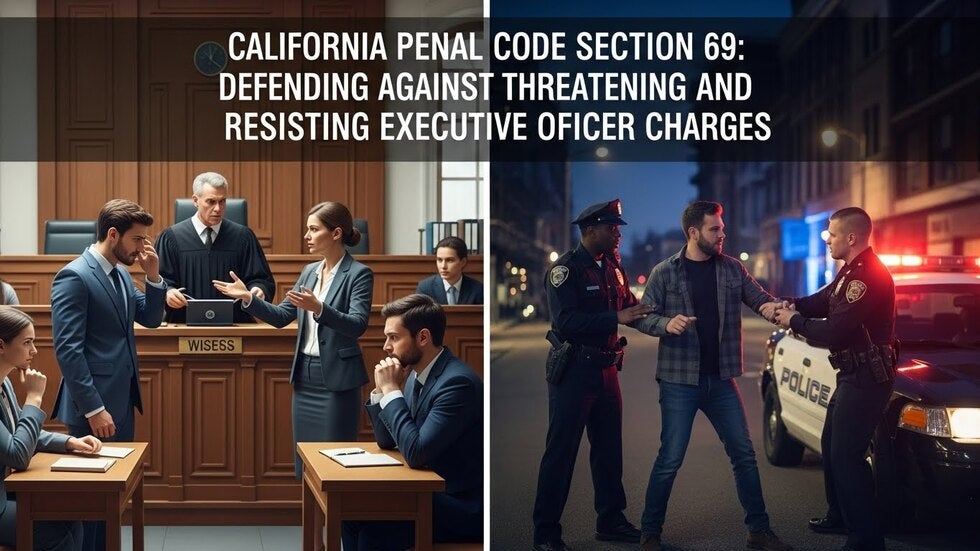
When Words and Actions Collide with Authority: The Dual Nature of Section 69
California Penal Code Section 69 represents one of the most frequently charged yet complex statutes in the California criminal code, criminalizing two distinct forms of conduct that can trap defendants in vastly different circumstances. Whether someone makes angry statements during a heated political protest or physically struggles with law enforcement during an arrest, they may find themselves facing identical charges under Section 69, despite the fundamentally different nature of their conduct.
As a defense attorney who has handled countless resisting arrest cases, I've seen how prosecutors use Section 69's broad language to criminalize everything from protected political speech to legitimate self-defense actions. Understanding the statute's dual nature and developing targeted defense strategies for each form of violation is essential for protecting clients' constitutional rights while navigating California's aggressive law enforcement culture.
Understanding Section 69's Two Distinct Offenses
California Penal Code Section 69 creates criminal liability through two separate and distinct pathways, each with different elements, mental state requirements, and constitutional implications.
First Form: Threatening Executive Officers
The first form of Section 69 violation involves attempting, by means of threats or violence, to deter or prevent an executive officer from performing a duty imposed by law. This provision criminalizes conduct that occurs before or independent of any actual confrontation with law enforcement and is often charged in cases involving threatening public officers, even when no physical contact or arrest ultimately takes place.
Key Elements of Threat-Based Violations:
- Making threats of unlawful violence toward an executive officer
- Specific intent to deter the officer from performing lawful duties
- The threat must be intended to interfere with official duties, either immediately or in the future
- No requirement that the officer be actively engaged in duties when the threat is made
Second Form: Resisting Executive Officers
The second form involves knowingly resisting, by use of force or violence, an executive officer in the performance of their duty. This provision addresses physical confrontations that occur during actual law enforcement encounters.
Key Elements of Resistance-Based Violations:
- Use of force or violence against an executive officer
- Officer must be engaged in lawful performance of duties at the time of resistance
- General intent standard (defendant must act knowingly but need not intend to interfere with duties)
- Actual physical confrontation or resistance required
The Critical Intent Distinctions
Understanding the different mental state requirements for each form of Section 69 violation is crucial for developing effective defense strategies.
Specific Intent for Threat-Based Charges
Threat-based Section 69 charges require specific intent to interfere with an officer's performance of their duties. This heightened mental state requirement creates significant defense opportunities:
Intent to Deter: Prosecutors must prove that defendants specifically intended their threats to deter officers from performing lawful duties, not merely that they were angry or made inflammatory statements.
Future vs. Immediate Deterrence: The Sivongxxay decision clarifies that threats can target future duty performance, not just immediate actions, but prosecutors must still prove specific intent to deter lawful duties.
Distinguishing Lawful from Unlawful Duties: Defendants cannot be convicted for threatening to interfere with unlawful official conduct, creating opportunities to challenge the lawfulness of targeted duties.
General Intent for Resistance-Based Charges
Resistance-based charges require only general intent, meaning defendants must act knowingly but need not specifically intend to interfere with official duties:
Knowing Conduct: Defendants must know they are resisting an officer, but prosecutors need not prove they intended to obstruct justice or interfere with specific duties.
Lawful Performance Requirement: Officers must be engaged in lawful duty performance at the time of resistance, creating opportunities to challenge unlawful arrests or excessive force situations.
Force or Violence Element: The resistance must involve actual force or violence, not mere passive non-compliance or verbal objections.
Constitutional Protections and First Amendment Defenses
Section 69's threat provision intersects significantly with First Amendment protections, creating important defense opportunities in speech-related cases.
Protected Political Speech
The Sivongxxay decision emphasizes that Section 69 cannot criminalize protected First Amendment speech:
True Threat Standard: Threats must constitute "true threats" of unlawful violence rather than protected political hyperbole or rhetoric.
Context Analysis: Courts must consider the entire context of statements, including the setting, audience, and speaker's apparent intent.
Political Protest Protection: Statements made during political protests or demonstrations receive enhanced First Amendment protection that limits Section 69 application.
Unlawful Violence Requirement
For threats to violate Section 69, they must involve unlawful violence, creating defense opportunities:
Lawful Self-Defense Threats: Threats to use lawful force in self-defense cannot support Section 69 convictions.
Conditional Threats: Threats conditioned on unlawful official conduct may not satisfy the statute's requirements.
Vague or Ambiguous Statements: Statements that don't clearly threaten unlawful violence may be protected speech rather than criminal threats.
Defense Strategies for Threat-Based Charges
Defending against threat-based Section 69 charges requires careful analysis of both the speech involved and the constitutional protections that apply.
Challenging Specific Intent
The specific intent requirement provides the strongest defense opportunity in threat-based cases:
Lack of Intent to Deter: Demonstrating that statements were made in anger, frustration, or emotional distress without specific intent to deter official duties.
Venting vs. Threatening: Distinguishing between emotional venting or complaining about government actions and genuine threats intended to deter official conduct.
Context and Circumstances: Using the circumstances surrounding statements to show lack of specific intent to interfere with duties.
First Amendment Analysis
Constitutional protections provide powerful defenses in speech-related Section 69 cases:
Protected Political Speech: Demonstrating that statements constitute protected political criticism or protest rather than criminal threats.
Hyperbole and Rhetoric: Showing that statements represent protected hyperbole or political rhetoric rather than genuine threats of violence.
True Threat Analysis: Challenging whether statements meet the constitutional standard for true threats that can be criminalized.
Challenging Officer Status and Duties
Not all government employees qualify as executive officers for Section 69 purposes:
Executive Officer Definition: Challenging whether the alleged victim qualifies as an executive officer with law enforcement duties.
Scope of Duties: Demonstrating that threatened interference targeted conduct outside the officer's lawful duties.
Personal vs. Official Capacity: Showing that threats targeted officers in their personal rather than official capacity.
Defense Strategies for Resistance-Based Charges
Defending against resistance-based Section 69 charges often involves challenging the lawfulness of officer conduct and the defendant's response.
Unlawful Arrest and Excessive Force Defenses
California law recognizes limited rights to resist unlawful police conduct:
Unlawful Arrest: When arrests lack probable cause or legal justification, defendants may have limited rights to resist, though this defense is narrow and risky.
Excessive Force Response: Defendants may use reasonable force to defend against excessive police force, though this defense requires careful factual development.
Proportionality Analysis: Any defensive force must be proportional to the threat posed by unlawful officer conduct.
Challenging the "Force or Violence" Element
Not all physical contact constitutes force or violence under Section 69:
Passive Resistance: Purely passive resistance, such as going limp or refusing to cooperate, typically doesn't constitute force or violence.
Defensive vs. Aggressive Conduct: Distinguishing between defensive actions and aggressive conduct that constitutes criminal resistance.
Involuntary Actions: Physical responses caused by medical conditions, intoxication, or involuntary reflexes may not constitute knowing resistance.
Officer Conduct Analysis
The lawfulness of officer conduct is crucial for resistance-based defenses:
Lawful Performance Requirement: Officers must be engaged in lawful duty performance for Section 69 to apply, creating opportunities to challenge unlawful police conduct.
Scope of Authority: Demonstrating that officers exceeded their authority or acted outside their jurisdiction.
Procedural Violations: Showing that officers violated required procedures or constitutional protections during the encounter.
Penalty Structure and Sentencing Considerations
Section 69 violations carry significant penalties that can be enhanced based on various factors.
Base Penalties
Section 69 violations are punishable by:
- Fines up to $10,000
- Imprisonment in state prison or county jail for up to one year
- Both fine and imprisonment
Enhancement Factors
Various factors can enhance Section 69 penalties:
Great Bodily Injury: When resistance causes great bodily injury to officers, additional penalties may apply under Penal Code Section 12022.7.
Weapon Use: Using weapons during Section 69 violations can trigger weapon enhancement penalties.
Prior Convictions: Defendants with prior convictions may face enhanced sentences under California's recidivist statutes.
Alternative Sentencing Options
Depending on circumstances, alternative sentencing may be available:
Probation: Many Section 69 cases resolve with probationary sentences, particularly for first-time offenders.
Community Service: Courts may impose community service requirements as alternatives to incarceration.
Anger Management: In appropriate cases, anger management or counseling programs may be ordered.
The Intersection with Related Charges
Section 69 cases often involve multiple charges that create complex defense considerations.
Resisting Arrest (Penal Code Section 148)
Section 69 and Section 148 often overlap, creating strategic choices:
Lesser Included Offense: Section 148 may be a lesser included offense to Section 69, providing plea negotiation opportunities.
Double Jeopardy Issues: Multiple charges for the same conduct may raise double jeopardy concerns.
Charging Strategy: Understanding when prosecutors charge Section 69 versus Section 148 helps develop appropriate defense strategies.
Assault and Battery Charges
Physical resistance often results in additional assault or battery charges:
Self-Defense Claims: Self-defense arguments that apply to assault charges may also support Section 69 defenses.
Intent Analysis: The intent requirements for different charges may conflict, creating opportunities for defense arguments.
Penalty Coordination: Understanding how multiple charges affect overall penalty exposure is crucial for plea negotiations.
Domestic Violence Considerations
When Section 69 cases involve domestic situations, additional considerations apply:
Domestic Violence Enhancement: When officers respond to domestic violence calls, additional penalties may apply.
Protective Orders: Section 69 convictions may affect domestic violence protective order proceedings.
Family Court Implications: Criminal convictions can impact custody and visitation rights in family court proceedings.
Investigation and Evidence Issues
Section 69 cases often involve complex evidence that requires careful analysis and challenge.
Body Camera and Video Evidence
Modern Section 69 cases frequently involve video evidence:
Video Analysis: Careful frame-by-frame analysis of body camera footage can reveal exculpatory evidence or contradict officer testimony.
Audio Quality: Poor audio quality may make it difficult to prove threat-based charges or determine what was actually said.
Missing Footage: When video evidence is missing or incomplete, defendants may argue that it would have been exculpatory.
Witness Testimony Issues
Section 69 cases often depend heavily on officer testimony:
Credibility Challenges: Officers may have incentives to exaggerate threats or resistance to justify their actions.
Inconsistent Statements: Comparing officer reports with testimony and video evidence may reveal inconsistencies.
Civilian Witnesses: Independent civilian witnesses can provide crucial testimony about the actual events.
Conclusion: Navigating Section 69's Complex Terrain
California Penal Code Section 69 represents one of the most challenging areas of criminal defense, requiring attorneys to navigate complex constitutional issues, understand different mental state requirements, and develop strategies tailored to the specific form of violation charged. The statute's dual nature means that effective defense requires understanding both First Amendment principles and the practical realities of police encounters.
For defendants facing Section 69 charges, the stakes extend beyond immediate criminal penalties to include impacts on employment, professional licenses, and constitutional rights. Early intervention by experienced Criminal defense counsel is crucial for preserving evidence, challenging unlawful police conduct, and developing effective defense strategies.
Success in Section 69 cases requires attorneys who understand the intersection of criminal law, constitutional rights, and law enforcement practices. Whether defending against speech-based charges that implicate First Amendment protections or resistance charges involving complex police encounters, skilled advocacy can mean the difference between conviction and acquittal.
The evolution of Section 69 law continues to reflect the ongoing tension between law enforcement authority and individual rights that defines much of modern criminal law. For defendants caught in this complex legal framework, experienced representation that understands both the statute's technical requirements and its constitutional limitations provides the strongest protection against prosecutorial overreach and helps ensure fundamental rights remain protected even in the face of aggressive enforcement.
For immediate guidance, contact Bulldog Law at (888) 928-1609 or visit thebulldog.law to speak with experienced criminal defense counsel and protect your rights from the outset.