
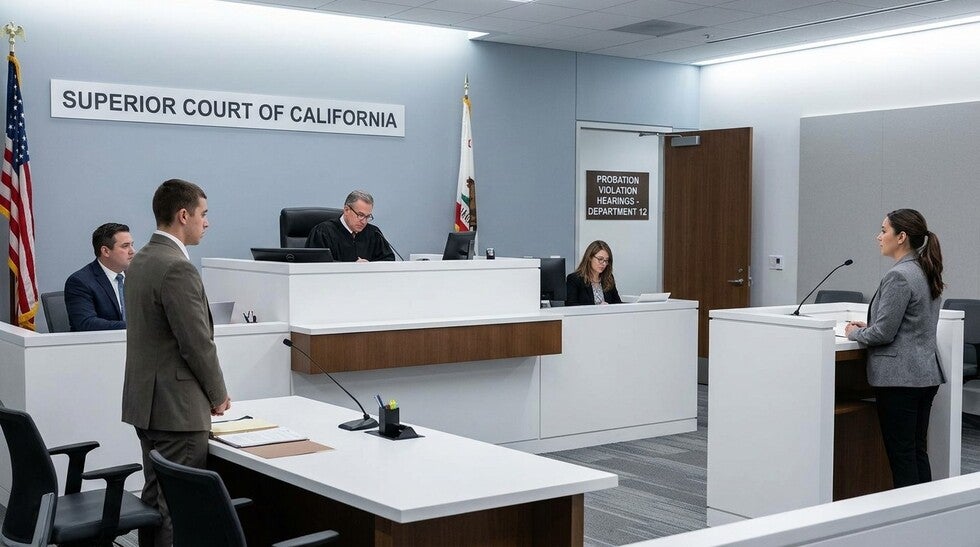
California Probation Violations Under Penal Code § 1203.2: What You Need to Know
By The Bulldog Law Criminal Defense Team • Reviewed by a licensed California criminal defense attorney
A probation violation under California Penal Code § 1203.2 is not a new crime. It is an accusation that you did not follow one or more of the rules of your probation. A judge decides whether a violation happened.
The standard is lower than the standard used in a criminal trial. The court generally uses a preponderance of the evidence standard. This means the judge must decide that it is more likely than not that the violation happened. Some hearsay evidence may also be allowed.
The possible result can be serious. A judge may keep you on probation, change your probation terms, add a jail sanction, or revoke probation and impose all or part of the sentence that was previously suspended.
One important word can make a major difference: willful.
If you could not follow a probation rule because of a real problem that was outside your control, that can be important to your defense. This guide from The Bulldog Law's criminal defense team explains how probation violations happen, what happens at a violation hearing, and what defenses may help.
What Is a Probation Violation?
Probation is a court-ordered period where you must follow certain rules instead of serving some or all of your sentence in custody. These rules can be different from one person to another.
Common probation conditions may include:
-
Reporting to a probation officer
-
Going to required classes or treatment
-
Taking drug or alcohol tests
-
Paying fines, fees, or restitution
-
Following stay-away or no-contact orders
-
Following travel restrictions
-
Obeying all laws
-
Completing community service
-
Taking part in a required program
A violation can happen when someone does not follow one of these conditions.
If the alleged violation involves a new criminal charge, the situation can become more complicated because the new case and the probation case may affect each other.
If you are facing a new criminal charge, it is also helpful to understand the difference between an accusation and a conviction. Our guide on what a criminal charge means in California explains this difference.
How Probation Violations Happen
Probation violations generally fall into two broad groups.
New Criminal Offense
A person on probation may be accused of violating probation because they were arrested or charged with a new offense.
Examples can include allegations involving:
-
DUI
-
Drug possession
-
Theft
-
Assault
-
Domestic violence
-
Weapons offenses
-
Hit-and-run
An arrest does not automatically mean that the person is guilty of the new crime. The new criminal case still has its own legal process.
For example, California has different rules for offenses such as drug possession under Health and Safety Code § 11350. A lawyer may need to work on both the new criminal case and the probation issue at the same time.
Technical Probation Violations
Not every probation violation involves a new crime.
A person may face a violation allegation for:
-
Missing a probation appointment
-
Missing a required class
-
Failing a drug or alcohol test
-
Missing a test
-
Falling behind on payments
-
Failing to complete a program
-
Traveling without permission
-
Contacting someone when a court order says not to
-
Failing to report a change in address or employment
These cases can sometimes be resolved without ending probation, especially when the problem was not willful and the person takes steps to fix it.
What Happens After an Alleged Violation?
The process can move quickly.
Probation or the district attorney may bring the alleged violation to the court. The court may also temporarily revoke probation and issue a warrant in some situations.
The case can then move to a probation violation or revocation hearing.
At the hearing, there is no jury. A judge makes the decision. The person facing the allegation has important rights, including the right to have an attorney, receive notice of the alleged violation, present evidence, and challenge evidence as allowed by the rules that apply to probation hearings.
This is different from a regular criminal trial. The prosecution does not have to prove the probation violation beyond a reasonable doubt.
Because the rules and possible consequences can be serious, it is important to prepare before making an admission or agreeing to a result.
What Can the Judge Do?
The judge has several possible options.
Reinstate Probation
The judge may allow probation to continue under the same conditions.
This can be a common result in some first-time or technical violations, especially when the person shows that they are taking probation seriously.
Modify the Probation Terms
The judge may change or add conditions.
For example, the court may require:
-
More treatment
-
Additional classes
-
Community service
-
More testing
-
A payment plan
-
Other conditions allowed by law
Impose a Jail Sanction
Depending on the case and the law that applies, the court may impose a jail sanction while allowing probation to continue.
Revoke Probation and Impose a Sentence
In a more serious case, the court may revoke probation and impose a sentence based on the original case.
This is why even a person who believes the violation is minor should take the hearing seriously.
The Most Important Defense: The Violation Was Not Willful
One of the most important issues in many probation violation cases is whether the failure was willful.
There is a big difference between refusing to follow a probation condition and being unable to follow it because of a real problem.
For example, someone may miss a payment because they lost their job. Another person may miss a required appointment because they were hospitalized. Someone else may be unable to start a required program because there is no available space.
The facts and evidence matter.
Inability to Pay
A person should not simply assume that missing a payment automatically means they will be found in violation.
If the person could not pay because of genuine financial hardship, evidence about their ability to pay may be important.
Useful documents may include:
-
Proof of job loss
-
Pay records
-
Job applications
-
Bank records
-
Medical records
-
Bills
-
Payment history
-
Communications with probation
The goal is to show the court what happened and why the failure was not intentional.
Other Possible Defenses
1. You Actually Complied
Sometimes a person followed the rule, but the probation record does not show it.
For example, you may have completed a class but lost the certificate. You may have taken a required test at an approved location, but the result was not added to your file.
Keep copies of important documents whenever possible.
Records can be much stronger than trying to remember every detail at the hearing.
2. You Could Not Complete the Requirement
Sometimes a person makes a real effort but cannot complete a requirement because of circumstances outside their control.
Examples may include:
-
A treatment program has a long waiting list
-
A medical emergency prevents attendance
-
Transportation breaks down
-
A required office is closed
-
A probation officer changes
-
A program changes its schedule
Evidence showing the problem and the effort you made to fix it can help explain the situation.
3. The Alleged Violation Is Based on a New Criminal Case
A new arrest can create two connected problems: the new criminal case and the probation violation allegation.
The two cases should be considered together.
For example, a person may be accused of a new DUI while on probation. The defense may need to address the DUI case while also dealing with the probation hearing.
California DUI cases can have serious consequences, so it is important to understand the facts and possible defenses in the new case.
4. Show the Court That You Are Fixing the Problem
What you do before the hearing can matter.
If you missed a class, you may be able to enroll again. If you fell behind on payments, you may be able to restart payments. If you missed testing, you may be able to show recent clean test results.
Other helpful evidence may include:
-
Proof of completed classes
-
Treatment records
-
Payment records
-
Employment records
-
Clean test results
-
Letters from employers or program providers
-
Proof of new enrollment
This does not guarantee a particular result. But it can give the judge a better picture of your current situation.
Do Not Ignore a Probation Violation Notice or Warrant
Ignoring the problem usually does not make it disappear.
If you learn that a probation violation has been filed or that a warrant may exist, speak with a lawyer as soon as possible.
You can also learn more about checking for an outstanding warrant through our guide on how to find out if you have a warrant in California.
The sooner you understand what the court is alleging, the more time your attorney has to review the records and prepare a response.
Should You Admit the Violation?
Not every case should be handled the same way.
Sometimes an admission may be part of a negotiated agreement. In another case, admitting the violation may give up a strong defense.
Before admitting a violation, you should understand:
-
What condition you are accused of violating
-
What evidence the court has
-
Whether the violation was willful
-
What sentence could follow
-
Whether there is a better negotiated result
-
How the admission could affect a pending criminal case
A quick admission may feel like the easiest choice, but it can have long-term consequences.
Frequently Asked Questions
How much time can a probation violation give you?
The possible sentence depends on the original case, the probation terms, and the law that applies. In some cases, the court may have authority to impose all or part of a previously suspended sentence.
For example, if a sentence was suspended in the original case, a probation violation may put some or all of that sentence at issue.
The actual result can be much lower than the maximum. The court may instead reinstate probation, change the terms, or impose another lawful sanction.
Do I get a jury for a probation violation?
No. A judge decides a probation violation hearing.
The standard is generally a preponderance of the evidence, meaning the judge decides whether it is more likely than not that the violation occurred.
You still have important rights. These can include the right to counsel, notice of the allegation, and the opportunity to present evidence and challenge evidence as allowed by law.
I missed payments because I lost my job. Is that a violation?
Not necessarily.
If you could not pay because of a genuine inability to pay, that can be important to the court's decision.
Bring documents that show what happened. These may include proof of job loss, financial records, job applications, medical records, or other evidence of your financial situation.
Do not wait until the problem becomes much larger. Tell your attorney about the missed payments and the reason for them as soon as possible.
Can a probation violation affect my criminal record?
It can affect the status and outcome of your criminal case and may also affect later post-conviction relief.
Once probation is successfully completed, you may have options for cleaning up your record depending on the case and your eligibility. For example, California Penal Code § 1203.4 provides a process commonly called an expungement.
You can learn more about the process in our guide on what expungement means and how to expunge a record.
California also has other record-relief options. Our California Clean Slate Law guide explains another important area of California record relief.
Should I just admit the violation to get it over with?
Do not make that decision without understanding the consequences.
An admission may affect your probation, possible sentence, and other legal matters. In some cases, a negotiated admission with an agreed result may make sense. In others, there may be a strong defense based on the facts.
Talk with a criminal defense attorney before making an admission.
Take a Probation Violation Seriously
A probation violation does not always mean that you will go to jail or lose your probation. The result depends on the facts, the alleged violation, the evidence, your history, and the options available to the judge.
The most important thing is to act quickly.
Keep your records. Follow your probation conditions as closely as possible. Take steps to fix problems that have already happened. Most importantly, get legal advice before admitting a violation or appearing in court alone.
The Bulldog Law's criminal defense team handles criminal defense matters throughout California.
Contact the firm online or call (888) 928-1609 to discuss your situation.