
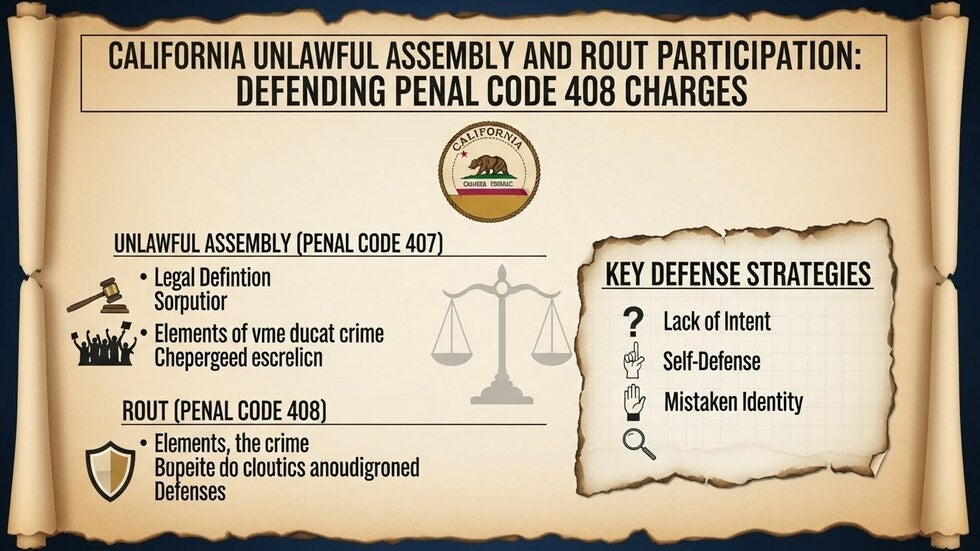
California Penal Code Section 408 makes it a misdemeanor to participate in any rout or unlawful assembly. This broadly worded statute gives law enforcement and prosecutors powerful tools to charge participants in protests, demonstrations, and gatherings that authorities deem problematic, even when no violence or property destruction occurs. Understanding what constitutes participation in these assemblies, how to distinguish lawful protest from criminal conduct, and what defenses protect your constitutional rights becomes critical when facing charges under this section. This comprehensive guide examines Section 408 from a defense perspective, providing essential knowledge for protecting your freedom when authorities target your assembly activities.
Understanding Unlawful Assembly Under California Law
Section 408 criminalizes participation in unlawful assemblies, making California's definition of this offense essential to understanding when criminal liability attaches. Penal Code Section 407 defines unlawful assembly as a gathering of two or more persons assembled to do an unlawful act, or to do a lawful act in a violent, boisterous, or tumultuous manner.
This definition creates two distinct categories of unlawful assembly. The first involves groups gathering with the specific purpose of committing unlawful acts. Examples include assemblies formed to attack individuals, destroy property, obstruct law enforcement, or engage in other criminal conduct. The unlawful purpose makes the assembly itself criminal even before participants carry out their intended illegal acts.
The second category involves assemblies gathered for lawful purposes but conducted in violent, boisterous, or tumultuous manners. This provision recognizes that even legitimate gatherings can become criminal when participants employ violent or severely disruptive methods. A group assembled to protest government policies engages in protected activity, but if that protest involves violence, threats, or conduct creating serious public disorder, it may cross into unlawful assembly territory.
The terms violent, boisterous, and tumultuous carry specific legal meanings that affect whether assemblies qualify as unlawful. Violent refers to physical force against persons or property. Boisterous suggests loud, rough, or unruly conduct beyond normal demonstration activity. Tumultuous indicates disorder, confusion, or agitation creating significant public disturbance. Courts examine the totality of circumstances to determine whether assembly conduct satisfies these standards.
What Constitutes Rout Participation
Section 408 also criminalizes participation in routs, which Section 406 defines as assemblies of two or more persons making attempts or advances toward acts that would constitute riots if completed. Rout occupies a unique position between unlawful assembly and riot, addressing situations where groups have progressed beyond merely gathering with problematic intent but have not yet committed the violence defining actual riots.
Participating in a rout requires involvement in an assembly that has moved toward violent action without completing that action. The group must demonstrate concrete progression toward riot conditions through preparatory conduct, escalating actions, or clear movement in the direction of collective violence. Mere presence at a gathering where some participants harbor violent intentions does not constitute rout participation absent evidence that the assembly collectively advanced toward riot commission.
The distinction between lawful protest and criminal rout proves especially important in contemporary contexts where demonstrations sometimes escalate unexpectedly. Protesters who attend peaceful events cannot automatically face rout charges if violence develops later, particularly when they did not participate in or encourage the escalation toward disorder.
The Participation Requirement
Section 408's central term is "participates," which requires active involvement rather than mere presence. This distinction provides critical protection for individuals who find themselves near unlawful assemblies without actually engaging in the conduct that makes those assemblies criminal.
Participation typically requires conduct contributing to or furthering the unlawful assembly's purpose or methods. This includes personally engaging in violent or tumultuous behavior, actively supporting others who do so, remaining present to encourage participants through numbers and presence, or providing assistance that enables the assembly to continue its unlawful activities.
Courts distinguish between active participants and innocent bystanders who happen to be present when assemblies become unlawful. Journalists covering events, legal observers monitoring police conduct, residents unable to leave their homes or businesses, and passersby trapped in areas where unlawful assemblies occur do not automatically become criminal participants. The prosecution must prove active involvement beyond simple presence.
The timing of presence significantly affects participation analysis. Someone who arrives at a peaceful protest that later becomes an unlawful assembly faces questions about whether they remained voluntarily after the assembly's character changed or whether they attempted to leave once disorder began. Continued presence after an assembly clearly becomes unlawful may constitute participation, while leaving immediately upon perceiving the unlawful nature demonstrates lack of the voluntary involvement required for criminal liability.
When Peaceful Protest Becomes Unlawful Assembly
Many Section 408 prosecutions arise from protests and demonstrations that begin as constitutionally protected activities but allegedly transform into unlawful assemblies. Understanding this transformation proves essential for defending charges that blur the line between lawful expression and criminal conduct.
First Amendment protections cover a broad range of protest activities including marches, rallies, demonstrations, picketing, and other collective expressions of political viewpoints. This protection extends to controversial, offensive, or deeply unpopular messages because the Constitution specifically safeguards dissenting speech that majority populations might prefer to silence.
Protected protest can involve significant disruption including blocking sidewalks, creating noise, and making people uncomfortable. Government tolerance for these disruptions reflects constitutional priorities favoring robust political debate even at some cost to public convenience. Not every disruptive protest qualifies as unlawful assembly despite the inconvenience or annoyance it creates.
Assemblies cross into unlawful territory when they involve violence, threats of immediate violence, property destruction, or such severe disruption that they go beyond protected expression into conduct the government may legitimately restrict. The key involves distinguishing between disruption inherent in political protest and violence or extreme disorder that falls outside constitutional protection.
Police declarations that assemblies have become unlawful do not automatically make them so for legal purposes. Officers sometimes declare assemblies unlawful based on their subjective assessments of crowd mood or potential future disorder rather than actual violence or extreme disruption that has occurred. Courts examine the underlying facts independently to determine whether assemblies actually met statutory requirements for unlawful assembly rather than simply deferring to police characterizations made during tense situations.
Constitutional Defenses to Section 408 Charges
First Amendment protections provide powerful defenses against Section 408 prosecutions, particularly when charges target political protests or demonstrations on controversial issues. Understanding these constitutional limitations helps defendants challenge inappropriate charges that threaten fundamental freedoms.
Government bears a heavy burden when restricting speech and assembly rights. Laws limiting these freedoms must survive strict scrutiny, meaning they must serve compelling government interests and be narrowly tailored to achieve those interests without unnecessarily burdening protected activity. While preventing violence and severe public disorder constitutes a compelling interest, prosecuting people for peaceful protest does not.
The key constitutional question involves whether the defendant's specific conduct falls within protected or unprotected categories. Peaceful protest receives robust protection regardless of how uncomfortable it makes authorities or how disruptive it proves to normal community activities. Only when protest crosses into violence, true threats, incitement to imminent lawless action, or similar unprotected territory may government impose criminal sanctions.
Defense strategies emphasize that ambiguous conduct should be interpreted as protected expression rather than criminal assembly participation. When evidence could support either characterization, constitutional principles favor protecting speech and assembly rights over expansive criminal liability. Prosecutors must prove beyond reasonable doubt that conduct was unprotected, and any reasonable doubt must be resolved in favor of constitutional freedoms.
Common Defense Strategies
Defending Section 408 charges requires carefully examining each element and identifying weaknesses in the prosecution's evidence. Several approaches prove effective depending on case circumstances.
Challenging whether the assembly qualified as unlawful provides a threshold defense that eliminates criminal liability regardless of your presence or conduct. Evidence that the gathering remained peaceful, that any disruption fell within constitutionally protected levels, or that the assembly's purpose and methods were lawful undermines the foundational element supporting charges. Expert testimony about crowd dynamics and constitutional law often supports arguments that assemblies remained within protected territory.
Establishing lack of participation addresses Section 408's core requirement. Evidence showing you were a journalist documenting events, a legal observer monitoring police conduct, a resident trapped in your home or business, or someone who left immediately upon disorder beginning demonstrates the absence of active involvement required for criminal liability. Witness testimony, video evidence, and credible personal accounts support these defenses.
Demonstrating that you exercised First Amendment rights to peaceful protest distinguishes constitutionally protected activity from criminal conduct. Evidence that you engaged only in protected speech and assembly, that you did not personally commit violence or extreme disruption, and that police arrested you for lawful protest activities rather than criminal participation establishes constitutional defenses that override statutory prohibitions.
Challenging the adequacy of police dispersal orders or warnings provides another defense avenue. If authorities did not clearly communicate that they deemed the assembly unlawful or did not provide reasonable opportunity to disperse before making arrests, your continued presence may not demonstrate the voluntary participation required for conviction. Video evidence of police communications and testimony about what you actually heard and understood supports these challenges.
The Role of Mass Arrests in Section 408 Cases
Section 408 prosecutions frequently arise from mass arrest situations where police detain dozens or hundreds of people simultaneously during protests or demonstrations. These scenarios create unique issues affecting both prosecution and defense strategies.
Mass arrests often involve minimal individualized probable cause, with officers arresting everyone present in designated areas regardless of their specific conduct. This approach raises serious constitutional concerns because the Fourth Amendment requires that arrests be based on individualized suspicion that particular persons committed crimes. Arresting entire crowds without distinguishing active participants from innocent bystanders, journalists, or legal observers violates these constitutional requirements.
Defense attorneys challenge mass arrests by arguing that police lacked probable cause to believe each specific defendant participated in unlawful assembly. If officers cannot articulate particular facts supporting suspicion regarding individual defendants, arrests may be unconstitutional regardless of whether some crowd members engaged in unlawful conduct.
Processing hundreds of arrestees creates logistical challenges that sometimes benefit defendants. Booking errors, inadequate documentation of individual conduct, overwhelmed court systems, and limited prosecutorial resources all create opportunities for negotiating favorable dispositions or obtaining dismissals. Prosecutors handling massive caseloads from mass arrests often lack time to thoroughly investigate each defendant's actual conduct, making them more willing to dismiss charges against people whose participation was minimal or nonexistent.
Video Evidence and Its Limitations
Modern Section 408 prosecutions rely heavily on video evidence from police body cameras, surveillance systems, news coverage, and social media posts. This evidence presents both challenges and opportunities for defense attorneys.
Video can exonerate defendants by showing they engaged only in peaceful activity, attempted to leave when disorder began, or were arrested despite not participating in unlawful conduct. Defense attorneys carefully review all available footage to identify frames supporting their clients' accounts and contradicting prosecution theories.
However, video evidence requires cautious interpretation. Footage from limited angles or brief time periods may not capture complete context. Someone visible in a crowd during unlawful assembly may have been attempting to leave rather than participating. Video showing presence does not automatically prove the active involvement required for conviction.
Prosecutors sometimes present cherry picked video clips that make defendants appear guilty while ignoring longer footage or additional angles that would provide exculpatory context. Defense attorneys demand complete video records and present the full story rather than allowing juries to see only the portions most damaging to defendants.
Penalties and Practical Consequences
Section 408 classifies unlawful assembly and rout participation as misdemeanors, subjecting convicted defendants to potential county jail sentences up to six months, fines reaching one thousand dollars, or both incarceration and monetary penalties under California's default misdemeanor punishment provisions.
Actual sentences vary dramatically based on circumstances including the assembly's nature, whether violence or property damage occurred, the defendant's specific role, criminal history, and expressions of remorse. First time offenders arrested at protests who did not personally commit violence often receive probation or minimal punishment, particularly when they can demonstrate their conduct involved primarily protected expression.
Courts commonly impose probation conditions including staying away from future protests in certain locations, completing community service, paying restitution if property was damaged, and complying with search requirements. Probation provides an alternative to incarceration but creates restrictions and obligations that violations can convert into jail time.
Beyond formal criminal penalties, Section 408 convictions create lasting consequences affecting employment opportunities, professional licensing, educational prospects, and personal reputation. While unlawful assembly is not a violent crime, any criminal conviction can create obstacles in situations requiring background checks or involving moral character assessments.
Immigration consequences prove particularly serious for non citizens convicted under Section 408. Depending on the specific facts and how courts characterize the conviction, it could potentially be deemed a crime involving moral turpitude or otherwise create immigration problems including deportation risks. Non citizen defendants must consult immigration attorneys alongside criminal defense counsel to understand potential consequences before accepting any plea offers.
Negotiating Favorable Resolutions
Many Section 408 cases resolve through plea negotiations rather than trial, and understanding the strategic landscape helps defendants make informed decisions about disposition options.
Prosecutors handling multiple arrests from single events often offer standardized plea deals to resolve cases efficiently. Common offers include pleading to reduced charges like disturbing the peace, completing diversion programs allowing eventual dismissal, or accepting probation without jail time. Evaluating these offers requires analyzing evidence strength, trial risks, and long term consequences of different outcomes.
Defendants with strong defenses may reject initial offers and negotiate better terms or proceed to trial. Prosecutors make improved offers when defense attorneys demonstrate serious weaknesses in the state's case and credible willingness to try cases rather than accepting whatever terms prosecutors initially propose.
Diversion programs provide particularly attractive options when available. These programs allow defendants to complete requirements like community service, counseling, or educational programs in exchange for dismissal. Successfully completing diversion avoids conviction entirely, eliminating most collateral consequences while resolving criminal charges.
Protecting Your Rights During Protests
Understanding Section 408 before attending protests or demonstrations helps you protect your rights and avoid criminal liability. Several principles guide safe and legal protest participation.
Know your rights under the First Amendment and state law. You have constitutional protections to protest peacefully on public property, express controversial viewpoints, and criticize government actions. Police cannot arrest you for exercising these rights even if your message offends others or disrupts normal activities to some degree.
Leave immediately if protests become violent or severely disorderly. Your presence during unlawful assembly, even if you personally remain peaceful, can create criminal liability. Protecting yourself legally sometimes requires abandoning protests when they escalate beyond protected expression into criminal territory.
Document your conduct and the events around you. Video recording your own activities and the assembly's nature provides evidence that you engaged only in peaceful protest if charges later arise. However, be aware that police sometimes view recording as threatening and may target those filming for arrest.
Follow lawful police dispersal orders when given clear instructions and reasonable opportunity to comply. Refusing lawful orders to disperse after assemblies become unlawful eliminates an important defense and strengthens prosecution cases. Comply with directions to leave while documenting whether orders were clear and whether police provided adequate time and routes for dispersal.
Moving Forward After Section 408 Charges
Facing charges for participating in unlawful assembly or rout creates stress and uncertainty, particularly when you believe you exercised constitutional rights to protest peacefully. These cases often involve dozens or hundreds of co defendants, complex factual scenarios with competing narratives, and significant questions about where lawful protest ends and criminal conduct begins.
Understanding Section 408's requirements, the distinction between presence and participation, constitutional protections for peaceful protest, and defense strategies available when fighting these charges provides essential knowledge for protecting your freedom. While California may legitimately address assemblies that involve genuine violence or extreme disorder, the law must respect fundamental constitutional rights to collective expression and political dissent.
Whether challenging identification evidence, demonstrating that you engaged only in protected activity, establishing that the assembly remained lawful, or negotiating favorable disposition terms, you need representation that understands both criminal defense principles and the First Amendment issues these prosecutions frequently involve. Section 408 cases require attorneys who can navigate mass arrest scenarios, analyze extensive video evidence, present compelling constitutional arguments, and effectively advocate for dismissal or reduction when charges inappropriately target protected expression rather than criminal conduct. If you are facing Section 408 charges, protect your rights and your voice. Visit thebulldog or call (888) 928-1609 to speak with experienced criminal defense attorneys who know how to defend protest-related cases aggressively and strategically.