
Updated October 2026 | The Bulldog Law | California Traffic and Criminal Defense
California's window tint law, Vehicle Code 26708, allows almost no aftermarket tint on the front: the front side windows must transmit at least 70 percent of visible light, measured through the glass and any film together, and the windshield may be tinted only in the top four inches above the AS-1 line. The rear side windows and the back window may be as dark as you like, provided the car has side mirrors on both sides. Red, amber, and blue tints and highly reflective film are prohibited up front, and the medical exemption covers clear UV-blocking film with a doctor's letter, not dark tint. A first tint ticket is normally a fix-it ticket: remove the film, get it signed off, pay $25, and it is dismissed with no fine and no point. The reason the law matters more than its penalty is that tinted front windows are the single most common reason California police stop a car they wanted to stop anyway.
The Bulldog Law's attorneys see tint from two angles. The first is the ticket, which is minor and usually resolved for $25. The second is the stop, which is not minor at all: a large share of the drug, firearm, and DUI cases that come through our office began with an officer who saw dark front windows, and the tint citation at the bottom of the police report is the legal foundation for everything that followed. What follows is the law as it actually reads, what shops will not tell you, the ticket process, and what the tint stop means for the rest of the case. Call (888) 928-1609 or message our team if a tint stop turned into something else.
The limits, window by window
|
Window |
What the law allows |
Code |
|
Windshield |
Tint only in the top 4 inches, above the AS-1 line. Clear UV film with a medical certificate. Nothing else. |
VC 26708(b)(4), (b)(10) |
|
Front side windows (driver and passenger) |
Must allow at least 70% of visible light through, film and factory glass combined. Clear, colorless, transparent film only. |
VC 26708(b)(11), (d) |
|
Rear side windows |
Any darkness, if the vehicle has outside mirrors on both sides. |
VC 26708(b)(5), 26709 |
|
Back window |
Any darkness, if the vehicle has outside mirrors on both sides. |
VC 26708(b)(5), 26709 |
|
Colors |
No red, amber, or blue tint on the windshield or front side windows. |
VC 26708(d) |
|
Reflectivity |
Film may not be more reflective than standard window glass. |
VC 26708(d) |
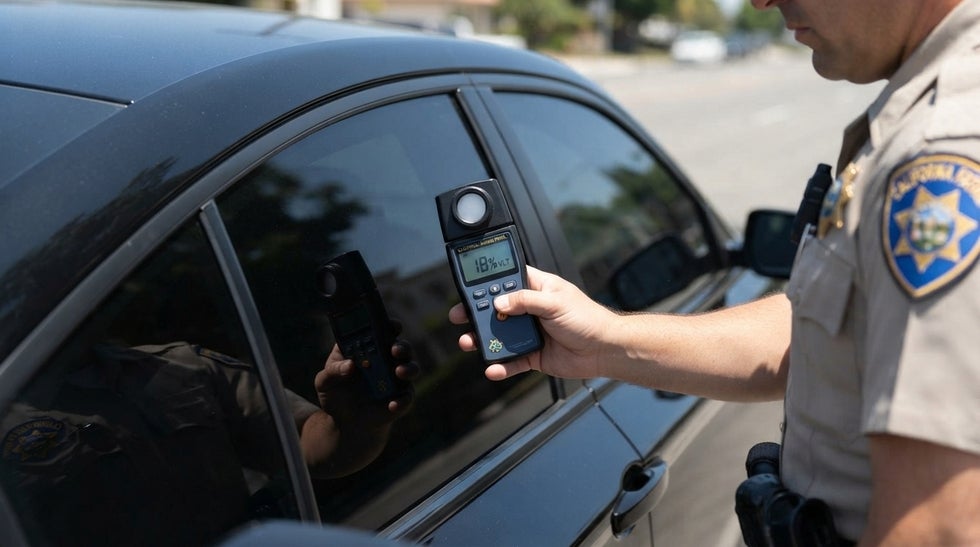
The number that matters is 70 percent, and it is measured on the combined result, not the film. Factory glass on most cars already blocks 10 to 20 percent of light. A film sold as 70 percent applied to glass that transmits 85 percent produces a combined transmission near 60 percent, which is illegal. The only aftermarket film that reliably keeps a front window above 70 percent is a clear or near-clear film, which is what Vehicle Code 26708(d) describes when it requires the material to be clear, colorless, and transparent. Shops sell 50, 35, and 20 percent film for front doors every day, and every one of those cars is in violation. Officers measure with a handheld meter at the roadside, and a reading below 70 is the citation.
The exemptions
The statute lists more than a dozen exemptions, most of them for stickers, toll transponders, and factory-installed glass. Two matter to drivers. Subdivision (b)(10) allows clear, colorless, and transparent film on the windshield and front side windows when the driver has a written certificate from a licensed physician or optometrist stating that the driver has a medical condition requiring protection from the sun, and the certificate is carried in the vehicle. The film must still be clear; the exemption does not permit dark tint, and officers who stop a car with 20 percent front tint and a doctor's letter write the ticket anyway. Subdivision (b)(11) is the general allowance for clear film on the front side windows meeting the 70 percent standard. Factory privacy glass on the rear windows of SUVs and trucks is lawful because it is in the rear; the same glass on the front doors is not.
The ticket
Tint is an infraction, and a first violation is almost always written as a correctable violation under Vehicle Code 40610, the fix-it ticket. The process: remove the film, or replace it with compliant film; have the correction verified and signed on the citation by any peace officer, a DMV office, or a CHP office; take the signed citation to the court clerk with a $25 transaction fee; the citation is dismissed. No fine, no point, no conviction. The deadline is the appearance date on the citation, and missing it converts the fix-it ticket into a failure to appear with a civil assessment and, eventually, a bench warrant and a DMV hold.
Officers may decline to write the citation as correctable, and the statute allows that where the violation is not immediately correctable or the driver has a history, and a court may treat a second or third tint ticket as a standard infraction. The fine for a non-correctable tint violation is small in base terms, around $25, but California's penalty assessments bring a first offense to roughly $197, with higher amounts for repeats. Tint violations carry no DMV point in any form, so the ticket itself has no insurance consequence; the cost is the removal and the fee. Our traffic attorneys rarely see a reason to contest a first tint ticket on its own, and the pages on our carpool and car seat laws describe the same fix-it process.
The stop: why tint matters more than the ticket
Dark front windows are visible from across an intersection, in daylight, before the officer can see the driver, the plate, or anything else. They are an objectively observable Vehicle Code violation, which under the rules our attorneys explain on our reasonable suspicion page is all a stop requires, and under federal law the officer's real motive for choosing that car does not matter. The result is that tint is the leading pretext stop in California. An officer who wants to look at a car, its occupants, or its contents, and who cannot articulate a reason, waits for a window.
What happens next is governed by the ordinary rules, and that is where the defense work is. The stop is limited to its mission: checking the tint, the license, the registration, and writing the citation. Under Rodriguez v. United States, extending the stop beyond that mission, to question the passengers about drugs, to walk a dog around the car, to wait for backup, requires new reasonable suspicion that arose during the stop, and the extension without it makes everything found afterward suppressible. A request to search is a request; consent must be voluntary, and a refusal is not suspicion. The smell of marijuana alone, as our attorneys note elsewhere, no longer supplies probable cause to search a car in California. And the citation itself must match the stop: an officer who wrote the report around the drugs and forgot to document the tint, or who never metered the windows, has a stop that is challenged on its foundation.
In the drug and firearm cases that begin this way, the motion to suppress under Penal Code 1538.5 is the case, and the tint is where it starts: whether the windows were actually below 70 percent, whether the officer could see that from where he was, whether the stop was extended, and whether consent was real. The exclusionary rule removes what an unlawful extension produced, and our attorneys obtain the bodycam and dashcam in every tint-stop case because the timeline is on the video. The same analysis applies to every minor equipment and moving violation used as a pretext, from a cracked taillight to rolling a stop sign, and tint is simply the most frequent.
Practical notes
Buying a car with existing tint. The violation belongs to whoever is driving, and a used car with 20 percent front tint is a ticket waiting at the first stop. Check the front windows before purchase, and budget for removal.
Out-of-state cars. Vehicle Code 26708 applies to vehicles operated on California roads, and visiting drivers with tint legal at home are cited here; officers tend to exercise discretion with out-of-state plates, but the law does not require it.
Commercial drivers. Tint on a commercial vehicle's front windows can also be a Department of Transportation issue, and a fix-it ticket is still a citation on a commercial record.
Meters. If you believe a citation was wrong, a tint shop can measure the windows with a calibrated meter and provide the reading; a reading above 70 is a defense to a non-correctable citation, and a reason to decline the fix-it route.
Frequently asked questions
What is the legal tint in California?
Front side windows must let at least 70 percent of light through, measured with the factory glass and any film together, which in practice means almost no aftermarket tint in front. The windshield may be tinted only in the top four inches, above the AS-1 line. Rear side windows and the back window can be tinted to any darkness, as long as the vehicle has side mirrors on both sides. Red, amber, and blue tints are prohibited on the windshield and front windows, and highly reflective film is not allowed.
Is 35 percent or 20 percent tint legal in California?
Not on the front side windows or the windshield. Thirty-five percent film on glass that already blocks some light produces a combined transmission far below the 70 percent minimum, and 20 percent is darker still. Both are legal on the rear side windows and the back window. Many shops sell 35 and 20 percent film for the front doors without mentioning the law, and those are the cars that get stopped.
How much is a tint ticket in California?
A first tint ticket is usually written as a correctable violation, a fix-it ticket, under Vehicle Code 40610: remove the tint, get the correction signed off by a police officer or the DMV, pay a $25 dismissal fee, and the citation is dismissed with no fine and no point. If it is written as a non-correctable infraction, or you do not fix it, the fine with assessments runs about $197 for a first offense and more for repeats. Tint violations do not add a point to your record either way.
Is there a medical exemption for window tint in California?
Yes, a limited one. Vehicle Code 26708 allows clear, colorless, and transparent material on the windshield and front side windows when a licensed physician or optometrist certifies in writing that the driver has a medical condition requiring protection from sunlight, and the letter must be kept in the vehicle. The exemption covers clear UV-blocking film, not dark tint; it does not authorize the dark front windows most people are asking about.
Can police stop you just for tinted windows?
Yes. An officer who sees front windows that appear darker than the law allows has reasonable suspicion of a Vehicle Code violation, and that is enough for a stop. Tint is one of the most common pretext stops in California, because it is visible from a distance and hard to dispute at the roadside. What happens after the stop, a search of the car, questions unrelated to the tint, a drug dog, is governed by the ordinary rules, and a stop extended beyond the tint citation without new suspicion is challengeable.
Related reading from our attorneys
- California carpool lane rules and tickets
- Reasonable suspicion vs. probable cause: stops and car searches
- Traffic violation defense in California
Tint stop that turned into a search? The stop is where our defense begins
The Bulldog Law's defense attorneys handle the drug, firearm, and DUI cases that begin with a tint stop across California, and the tint ticket itself when it matters. Visit our criminal defense page, call (888) 928-1609, or reach us online.