
Updated October 2026 | The Bulldog Law | California Criminal Defense
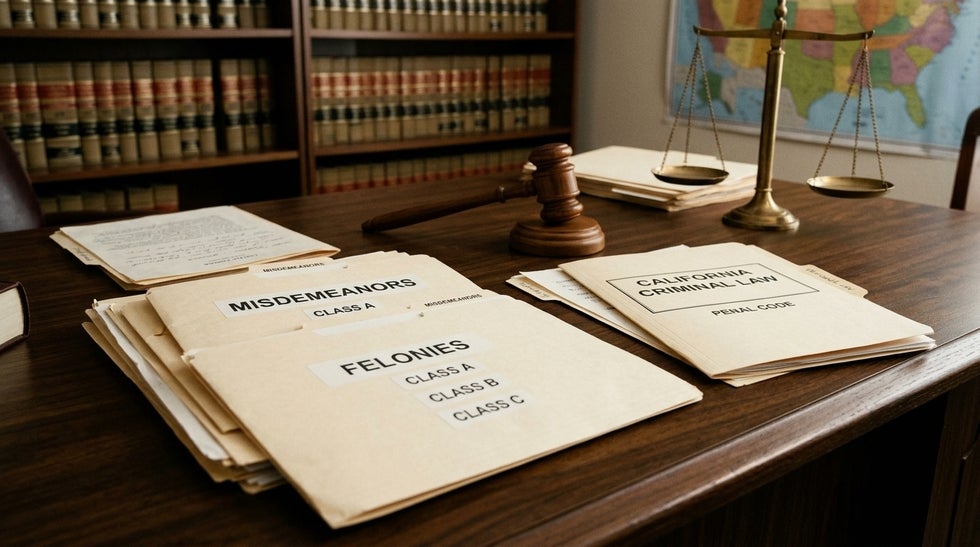
When a California driver sees a “Class A misdemeanor” on a background check, the label can feel like a warning sign, yet the Golden State never actually uses those letters.
Understanding how other states and the federal system label crimes helps you see why a California conviction often translates differently.
How Other States and Federal Law Classify Crimes
Across the country, many legislatures sort offenses into letter grades so lawmakers can attach a single penalty range to each class.
A Class A misdemeanor typically carries up to one year in jail and a few thousand dollars in fines, while a Class C misdemeanor is usually a fine-only violation.
States such as Texas, Illinois, and New York also assign letters to felonies; a Class A felony often means a maximum imprisonment term of life or 15 years to life, whereas lower classes cap sentences at a few years. These labels guide sentencing, probation periods, and restitution orders.
Letter grades for misdemeanors and felonies in representative states
Texas uses “Class A, B, C” for misdemeanors and “first-degree” through “third-degree” for felonies, with penalties ranging from one year to life. Illinois labels misdemeanors A-C and felonies with numbers plus a Class X tier, creating distinct maximum imprisonment terms.
New York applies letters to both misdemeanors and felonies; a Class B misdemeanor may result in up to six months, while a Class A felony can bring a maximum imprisonment term of 25 years. Each state's chart reflects its own policy goals.
Federal crime classes under 18 U.S.C. 3559
Federal law groups offenses by the longest possible sentence, as set out in 18 U.S.C. 3559. A “Class A felony” under this statute carries a maximum term of life imprisonment, influencing supervised release length and fine caps.
“Class B felony” offenses have a maximum of 25 years, while “Class C felony” tops out at 10 years. These categories also dictate eligibility for certain probation periods and restitution orders.
Why a class label means different penalties across jurisdictions
Because each state writes its own statutes, the same class can mean very different things.
A Class A misdemeanor in Texas may equal a California misdemeanor with a six-month jail term, but a Class A felony in another state might map to a California felony triad of 16 months, two, or three years.
Federal classifications tie the class directly to the maximum sentence, which then shapes supervised release and fine limits. When a state offense escalates to a federal charge, the class determines the federal penalties when state offenses become federal criminal charges.
Consequently, attorneys must translate the class into the appropriate California tier, considering both the statutory elements and the maximum imprisonment term, to advise clients accurately on potential strikes, licensing issues, or immigration consequences.
California's Penal Code system Without Classes
In my practice defending California felony cases, I often see clients confused by out-of-state “class” labels. California's system instead relies on the Penal Code, which defines offenses by type and specific penalty ranges rather than letter grades.
Under Penal Code 17, a felony is any crime punishable by death, state prison, or more than one year in county jail; a misdemeanor is any crime punishable by jail; and an infraction is a fine-only violation.
Penal Code 17: Felonies, misdemeanors, and infractions defined
Each statute sets its own maximum imprisonment term, so there is no internal “Class A” or “Class B” label. For example, burglary statutes may allow a triad of two, four, or six years behind bars.
Infractions, such as traffic tickets, carry only a statutory fine cap and no jail time. This clear separation helps courts apply the appropriate sentencing guidelines without class confusion.
Penal Code 19 and the default misdemeanor jail limits
Generally, misdemeanors are limited to six months in county jail, as set by Penal Code 19. Some statutes expressly permit up to one year, which the judge must follow.
The code also outlines standard probation periods and restitution orders for misdemeanor convictions, ensuring consistent treatment across the state.
Penal Code 17(b) wobbler reductions and their legal effect
When a wobbler is reduced under Penal Code 17(b), it becomes a misdemeanor for most purposes, including sentencing and background-check reporting. This reduction can affect eligibility for the Three-Strikes Law and future strike assessments.
However, some federal statutes still look at the original maximum sentence, so a reduced wobbler may retain federal consequences. Clients often ask about expungement eligibility after a reduction, which depends on the underlying offense and the California Sentencing Guidelines Council rules.
Understanding these nuances is key when making false statements under 18 U.S.C. 1001 or facing related charges that cross state and federal lines.
|
Statute |
Offense Type |
Maximum Penalty |
Key Feature |
|---|---|---|---|
|
Penal Code 17 |
Felony, misdemeanor, infraction |
Life, >1 yr, fine only |
No internal classes |
|
Penal Code 19 |
Misdemeanor default |
6 months (or 12 months if statute permits) |
Sets jail ceiling |
|
Penal Code 17(b) |
Wobbler reduction |
Reclassifies to misdemeanor |
Impacts strike & parole |
|
Triad sentencing |
Felony |
Varies (e.g., 16 months-2-3 yrs) |
Judge selects term |
Translating Out-of-State Class Labels to California Convictions
When a client presents a conviction labeled “Class A felony” from another state, we must map that label onto California's felony, misdemeanor, or infraction tiers based on the offense's maximum imprisonment term and statutory elements.
California courts look first at whether the out-of-state offense would be punishable by more than one year; if so, it aligns with a California felony, otherwise it fits within the misdemeanor range.
Mapping Class A - C misdemeanors to California misdemeanor ranges
A Class A misdemeanor elsewhere, with up to one year of jail time, corresponds to a California misdemeanor that may carry up to one year under Penal Code 19. The underlying conduct often matches California's “wobbler” statutes.
A Class C misdemeanor that is fine-only translates to a California infraction, since California infractions carry no jail time and only a statutory fine cap.
Mapping Class A - E felonies to California felony triads
A Class A felony in another state, with a maximum term of life or 15 years to life, fits California's most serious felony triads, such as 16 months-2-3 years or life without parole.
Lower classes, like a Class B felony, map to California felonies with triads such as two, four, or six years, while a Class C felony aligns with shorter triads, often 16 months-2-3 years.
Readers comparing related California statutes also review our guide on carrying a concealed firearm under Penal Code 25400.
Practical conversion chart for attorneys and clients
Attorneys start by comparing the out-of-state maximum imprisonment term to California's maximum imprisonment term thresholds. If the foreign maximum exceeds one year, the conviction is treated as a California felony.
Next, they examine statutory elements; if the California statute contains all elements of the foreign offense, the conviction can count as a strike under the Three-Strikes Law. Otherwise, it may only affect licensing boards.
Clients often wonder about the impact on future charges; understanding the difference between county jail and California state prison helps them gauge potential sentencing and parole implications.
Why Accurate Translation Impacts Extradition, Firearms, and Licensing
In my professional experience defending California felony cases, I see clients struggle when their records cross state lines. The lack of a class label creates confusion for out-of-state judges and agencies. Understanding this gap is essential for protecting your rights and future opportunities.
California law does not use letter grades, so every offense has a unique statutory penalty. This unique structure requires careful legal translation when dealing with federal rules. You must know how your specific California charge maps to other jurisdictions to avoid unexpected legal consequences.
Repeat-offender and habitual-felon rules in other states
Other states use Penal Code 17 equivalents to determine if a California conviction counts as a prior. They compare the specific elements of your California offense against their own statutory definitions. This comparison decides if you face enhanced sentencing as a repeat offender.
A public defender in another state must verify if your California crime matches their felony class. They look at the maximum possible sentence and the specific conduct involved. This process determines whether your prior conviction triggers their habitual felon statutes.
Federal firearm prohibition tied to 18 U.S.C. 3559 sentence thresholds
Federal law bans firearms for anyone convicted of a crime punishable by more than one year. This rule relies on the maximum sentence, not the actual time served. A California wobbler remains a felony until formally reduced by the court.
If your wobbler is reduced to a misdemeanor, you may avoid this federal ban. However, an unreduced felony conviction keeps you prohibited from owning guns. This distinction is critical for anyone seeking to restore their Second Amendment rights legally.
Licensing board inquiries and the need for precise class conversion
Professional licensing boards often ask about specific felony or misdemeanor classes. They need to know if your California conviction fits their definition of a serious offense. Providing an accurate translation helps prevent automatic disqualification from your professional license.
Employers and boards may also inquire about your diversion program history or successful completion. They want to assess your current risk level and rehabilitation progress. Accurate documentation of your final court disposition is important for maintaining your career prospects.
Before applying for a license, you should verify how your record appears. Consider checking for an active California arrest or bench warrant first. This ensures no outstanding legal issues complicate your application process or delay your approval.
How Other Jurisdictions Treat California Wobblers
California wobblers are the most common source of confusion for out-of-state agencies. A wobbler is technically a felony until the court reduces it. This status creates significant legal ambiguity when your record is reviewed elsewhere.
Most states and federal agencies accept the final reduced label as a misdemeanor. However, some federal statutes look at the original maximum sentence instead. This difference can drastically change your legal standing and future opportunities.
Final classification after a Penal Code 17(b) reduction
Under Penal Code 17(b), a wobbler becomes a misdemeanor once reduced. This change applies to nearly all state-level purposes and records. It effectively reclassifies your criminal history for most domestic legal matters.
Most out-of-state courts treat this reduced offense as a class b misdemeanor. They recognize the final court disposition as the controlling fact. This alignment helps prevent unnecessary enhancements in other jurisdictions.
Federal statutes that consider maximum sentence rather than final label
Some federal laws, including immigration statutes, ignore the reduced label entirely. They examine the maximum sentence the offense originally carried. This approach means a reduced wobbler can still have federal consequences.
For example, federal immigration law looks at the nature of the offense. It also considers the sentence imposed, not just the final class. This strict interpretation can affect your residency status or visa applications.
Defensive steps: reduction, expungement, and timing
You should seek a reduction under Penal Code 17(b) before moving states. This proactive step ensures your record reflects the lowest possible classification. It also helps when applying for jobs or licenses in new locations.
If eligible, you should also pursue expungement of the conviction. This process seals your records from most public employers. It provides a stronger foundation for your expungement eligibility in future legal proceedings.
Timing is critical for these legal maneuvers. You must wait for your probation period to end before filing. Acting too early can result in denied petitions and wasted legal resources.
Common Questions About Class Labels and California Convictions
I've handled cases like this across California courts where clients were confused by out-of-state terminology. Understanding the difference between class labels and California tiers is essential. This knowledge helps you navigate complex legal systems with confidence.
Many clients ask if their California conviction has a specific class letter. The answer is no, because California uses a different structural approach. Each statute defines its own penalty range instead of assigning a generic class.
What is a Class A misdemeanor in other states versus California?
In many states, a class a misdemeanor is the most serious misdemeanor grade. It typically carries up to one year in jail. In California, this would correspond to a misdemeanor punishable by up to one year.
California does not use this specific label, so you must translate it. You look at the maximum penalty listed in the specific statute. This comparison helps you understand how your offense fits into other state systems.
Does California use Class A, B, or C misdemeanors or felonies?
No, California does not use letter classes for any type of offense. The Penal Code 17 defines felonies, misdemeanors, and infractions. Each specific crime has its own unique statutory penalty range.
This system means you cannot assign a class to a California conviction. You must look at the specific statute and its maximum sentence. This precise approach ensures accurate legal evaluation in every jurisdiction.
How do expungement eligibility and court filing fees differ by offense type
Expungement rules vary significantly depending on the severity of your conviction. Misdemeanors often have clearer paths to sealing records than felonies. You must verify your specific expungement eligibility before filing any petitions.
Filing fees also depend on the type of case you are handling. A court filing fee is required to submit your petition to the judge. These costs can vary by county and the specific nature of your request.
Some clients qualify for fee waivers if they show financial hardship. This can reduce the upfront cost of seeking relief. Consulting with an attorney helps you understand these financial requirements clearly.
How Bulldog Law Helps Clients Navigate Class Conversions and Protect Their Rights
Our California criminal defense team reviews every police report, witness statement, and forensic file to pinpoint weaknesses before the prosecution rests. We safeguard your constitutional rights from the first arraignment through trial.
From filing pre-trial motions to negotiating plea deals, we tailor a strategy that reflects the unique penalty range of each charge. Call (888) 928-1609 for a confidential case review.
Official statutory text and procedural updates are published directly on federal statute, which California criminal courts apply across all 58 counties.
Frequently Asked Questions
What is a Class A misdemeanor and how does it compare to a California misdemeanor?
A Class A misdemeanor in states like Texas carries up to one year in jail and a fine of up to $4,000. California does not label misdemeanors by class; it simply allows up to one year in county jail under the applicable statute.
Because California lacks letter grades, a California misdemeanor that could be called “Class A” elsewhere still follows the same statutory maximum of one year and any fine set by the specific Penal Code provision.
Can a California wobbler be reduced under Penal Code 17(b) to avoid federal firearm bans?
Yes, a wobbler may be re-classified as a misdemeanor through a petition under Penal Code 17(b). The reduction can remove the felony label that triggers federal firearm prohibitions.
However, the federal government may still look at the original maximum sentence; if the offense originally carried a potential term of five years or more, it could remain a prohibited firearm offense under 18 U.S.C. 922(g)(1).
How does 18 U.S.C. 3559 affect someone with a California conviction when applying for a gun permit?
Section 3559 classifies felonies by maximum imprisonment. If a California conviction's maximum term is 10 years or more, it is a federal Class C felony, automatically disqualifying the applicant from a gun permit.
Even when the California court treated the offense as a misdemeanor, the statutory maximum still governs the federal classification, so the applicant must verify the exact penalty range before filing.
Do California felonies have Class A, B, or C designations for out-of-state licensing boards?
No. California law only separates crimes into felonies, misdemeanors, and infractions under Penal Code 17. Licensing boards compare the California felony's elements and maximum term to their own classification system.
When a board needs a class label, it translates the California felony into its own hierarchy, often matching a California felony with a maximum of 8-25 years to a “Class B” or “Class C” category in that jurisdiction.
What are the steps to get a reduced wobbler expunged before moving to another state?
First, file a petition for reduction under Penal Code 17(b) and obtain a court order changing the conviction to a misdemeanor. Next, wait the statutory waiting period, typically two years of clean conduct.
Finally, submit an expungement application under Penal Code 1203.4. Once granted, the record shows a dismissed misdemeanor, which other states usually treat as a non-felony prior.
How do repeat-offender statutes treat a California conviction that was originally a felony?
Repeat-offender laws, such as the “three strikes” provision in Penal Code 667(b), count the original classification. If the conviction was a felony before reduction, it may still trigger enhanced sentencing.
However, if the court officially reclassifies the offense to a misdemeanor before a second conviction, the repeat-offender statute may treat it as a misdemeanor, reducing the enhancement risk.
What court filing fees apply to a California felony versus a misdemeanor charge?
For a felony filing, the superior court charges a $435 filing fee, plus additional fees for preliminary hearings and possible jury demand. Misdemeanor filings typically cost $150.
Both fees are payable at the time of arraignment, and the court may waive them for indigent defendants who qualify under the California Courts of Appeal fee waiver guidelines.