
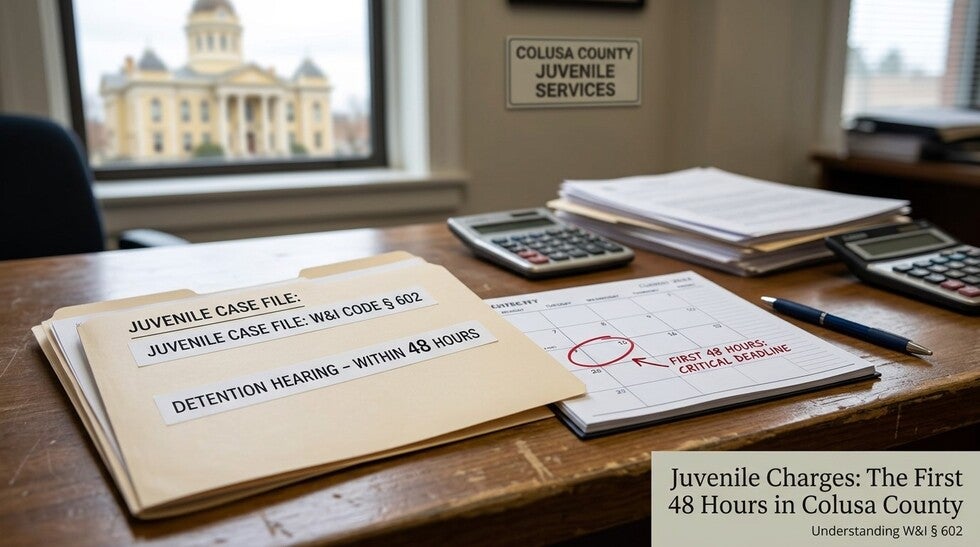
Your child was arrested in Colusa County. You got the call. Your mind is racing, your hands are shaking, and you have no idea what happens next. The first 48 hours after a juvenile arrest are not a waiting period. They are the most important window in the entire case, and what you do right now, before any petition is filed, before any court date is set, changes everything.
Your Child Was Arrested in Colusa County
The Probation Department's intake assessment, which happens before any petition is filed, before any court date, before most parents have fully understood what the arrest means, is the first moment where the defense makes its most important impact.
Representation that begins before that assessment concludes changes what the Probation Department recommends to the DA at the Oak Street courthouse. This is not something you want to figure out after the fact. Every hour matters.
Every parent who calls The Bulldog Law after a juvenile arrest in Colusa County is carrying specific fears about their child's specific future. The family whose child was arrested at Colusa High School or Williams High School and now faces both a criminal proceeding at the Colusa County Juvenile Court and a school disciplinary proceeding running at the same time. The Punjabi Sikh agricultural family whose son's adjudication, if not resolved through diversion, creates an immigration adverse factor affecting the family's continued participation in the H-2A guestworker program and circulates through Gurdwara community networks. The DACA family whose child's adjudication can affect DACA renewal. And every Colusa County family in a 22,000-person community where teachers, neighbors, and employers will know about the arrest within days.
California's juvenile justice system under Welfare & Institutions Code § 602 is built around rehabilitation. Records are confidential by default. Diversion outcomes exist because the legislature recognized that young people deserve resolution pathways that adult prosecution doesn't provide. But those pathways require active, early advocacy, starting at the Probation Department's intake assessment.
According to the California Courts self-help resource on juvenile delinquency, the juvenile justice system in California is designed to focus on rehabilitation rather than punishment, and outcomes like diversion and informal probation are explicitly available to qualifying minors. That design only works in your child's favor if someone is actively advocating for them from the very start.
How the Colusa County Juvenile Process Works
After a juvenile arrest in Colusa County, the Colusa County Probation Department conducts an intake assessment. That assessment determines two things right away: immediate detention versus release to parents, and recommendations about diversion eligibility, petition filing, and program placement.
The DA then decides whether to file a W&I § 602 petition or refer the case to diversion without filing. A sustained petition produces a juvenile record with real consequences, for DACA renewal, H-2A family situations, college applications, and the school enrollment and employment history that follow a young person for years.
What outcomes are available at Colusa County Juvenile Court:
Informal diversion without any petition being filed is the cleanest outcome. W&I § 654 informal probation means six months of supervision without a sustained petition, leaving no formal adjudication record. Beyond those, outcomes include formal probation with conditions, camp or ranch program placement, and in the most serious cases with prior adjudication history, Division of Juvenile Justice commitment.
In most first-offense Colusa County juvenile cases not involving serious violence, informal diversion or W&I § 654 informal probation are the outcomes that effective early representation produces. Building the case for those outcomes begins at the Probation Department's intake assessment, with school records, family circumstances, community and Gurdwara support, and the specific factors that show this young person's rehabilitation potential. We begin that work from the first consultation, before the intake assessment concludes, in every Colusa County juvenile case at the Oak Street courthouse.
If you want to understand how California's broader juvenile justice system works, our page on juvenile justice in California walks through the process from arrest through disposition.
Colusa High and Williams High Dual Track Defense
Colusa County's high schools, Colusa High School and Williams High School, generate school-based arrests where juvenile criminal proceedings and school disciplinary proceedings begin at the same time. These are two separate tracks, and they can hurt each other if they are not handled together.
For Colusa County youth whose academic progress and college prospects depend on avoiding suspension, expulsion, and a damaged educational record, both tracks need a coordinated strategy. I've seen cases where a parent focused entirely on the court side, only to have the school proceeding produce an expulsion that damaged the minor's future just as much as any adjudication would have.
We represent Colusa County minors in school disciplinary proceedings as a parallel defense component alongside juvenile court representation wherever both are started from the same incident. The goal is to prevent a bad outcome in one track from creating a bad outcome in the other, and to protect the minor's academic future through every stage of the process.
Sikh Agricultural Family and H-2A/DACA Youth Immigration Stakes
Colusa County's Punjabi Sikh agricultural family community generates juvenile cases where immigration consequences for minor children and their families require immediate analysis. This is a layer of the case that most families don't think about in the first hours, but it can be the most consequential part.
For DACA-status youth in agricultural families, certain juvenile adjudications carry immigration adverse factors that diversion producing dismissal avoids. According to the U.S. Citizenship and Immigration Services, DACA renewal is a discretionary process in which significant misdemeanors and other adjudicated offenses are weighed as adverse factors, making a clean resolution without a sustained petition substantially more valuable than it might appear at first.
For H-2A-status parents whose guestworker situation is affected by family-level immigration scrutiny, and where the case circulates through Gurdwara community networks, we address the complete family immigration and community context at the first consultation in every applicable Colusa County Sikh agricultural family juvenile case.
If you want more background on the DACA program and how adjudications interact with renewal, our page on a comprehensive understanding of the DACA program provides detailed context. We address DACA and H-2A implications at the first consultation in every applicable case at the Oak Street courthouse and pursue informal diversion or no-petition outcomes wherever the minor qualifies.
Small-County Community Knowledge
In Colusa County's 22,000-person community, a juvenile arrest becomes known fast. The same community networks that define small-county life, the teachers, the neighbors, the employers, the limited number of community gathering places, carry this information within days. Honestly, sometimes within hours.
While juvenile records are confidential by default, the practical community knowledge of an arrest circulates regardless of what the legal record says. This is something families in larger counties don't deal with the same way, and it matters enormously here.
Diversion outcomes that produce no sustained petition, informal diversion or W&I § 654 informal probation, provide the formal resolution that the community knowledge network responds to alongside the legal confidentiality. When neighbors and employers know the case was resolved and closed without a conviction, that matters. We pursue these outcomes as the priority wherever the minor qualifies.
Gang Allegations and Fitness Challenges
Colusa County's juvenile court generates cases where PC § 707 fitness motions for adult court transfer create the highest juvenile justice stakes. A fitness motion that succeeds transfers the case to adult criminal court, where juvenile confidentiality disappears, adult sentencing applies, and the rehabilitative framework of the juvenile system is gone.
We fight fitness motions through comprehensive rehabilitation amenability evidence, school records, community support documentation, family stability evidence, and every resource demonstrating this young person's rehabilitation potential within the juvenile system. Keeping the case in Juvenile Court keeps the record confidential, the outcomes rehabilitative, and the long-term pathway open.
If your child is also facing any related charges such as assault and battery under PC 240-242 or weapons charges under PC 25400 in Colusa County, those underlying charges directly affect fitness analysis and disposition options, and need to be addressed as part of a unified defense strategy.
Record Sealing
Most Colusa County minors who complete juvenile probation can petition to seal their records under W&I § 781. A sealed record means that for most purposes, college applications, job applications, housing, the adjudication does not appear.
We pursue dispositions from the earliest stage of every juvenile case that preserve sealing eligibility, keeping DACA renewal profiles, college admission prospects, and employment opportunities as clean as possible through every stage of proceedings. The choices made at the intake assessment stage affect sealing eligibility. This is another reason why early representation matters so much.
The Juvenile Court
Colusa County Superior Court 532 Oak Street, Colusa, CA 95932
What Families Need to Do Now
Ask to be present with your child immediately. Parents have the right to be present during law enforcement questioning of a minor.
Invoke your child's right to remain silent explicitly. A juvenile has the same Fifth Amendment protection as an adult.
Call The Bulldog Law at (888) 928-1609 before the Probation Department's intake assessment concludes.
Contact your child's school immediately to determine whether a parallel disciplinary process has begun.
If your child is DACA-status or from a Sikh H-2A agricultural family, contact The Bulldog Law about specific immigration implications at the first consultation.
Colusa County: Colusa County office | Colusa: Colusa office | Williams: Williams office | (888) 928-1609
What Parents Ask
How does a juvenile adjudication affect Colusa High or Williams High enrollment and college admission?
A sustained juvenile petition doesn't automatically produce school suspension or expulsion, but the school disciplinary proceeding that often accompanies a juvenile arrest operates independently under the school district's disciplinary policies. A juvenile adjudication can provide adverse evidence for the school disciplinary proceeding, and a school expulsion creates educational disruption that affects the minor's academic path and college admission prospects.
We represent Colusa County minors in both proceedings at the same time wherever both are started from the same incident, coordinating strategy to prevent adverse outcomes in either from creating adverse consequences in the other, or in subsequent college applications.
How does a Sikh agricultural family juvenile case affect immigration in Colusa County?
Certain juvenile adjudications involving conduct classified as significant misdemeanors or felony-equivalent offenses are considered adverse factors in DACA renewal discretionary analysis by USCIS. H-2A parents also face potential family-level immigration scrutiny from serious juvenile cases involving their children.
Diversion producing dismissal without a sustained petition is substantially better than a formally sustained petition for both DACA renewal and H-2A family considerations. We address DACA and H-2A implications at the first consultation in every applicable Colusa County Sikh agricultural family juvenile case at the Oak Street courthouse and pursue informal diversion or no-petition outcomes wherever the minor qualifies.
When can Colusa County try a minor as an adult?
The Colusa County DA can file a PC § 707 fitness motion when the charge involves specified serious offenses and the minor is at least fourteen years old. The Juvenile Court must find the minor not amenable to juvenile rehabilitation.
We fight fitness motions through comprehensive rehabilitation amenability evidence, school records, community support documentation, family stability documentation, and the specific Colusa County community relationships that demonstrate this young person's rehabilitation potential within the juvenile system. Keeping the case in Juvenile Court keeps the record confidential, the outcomes rehabilitative, and the long-term pathway open.
For more on Colusa County juvenile diversion programs, Colusa High and Williams High school-based arrest dual proceedings, Sikh agricultural family and H-2A/DACA youth immigration stakes, small-county community knowledge considerations, gang diversion and fitness challenges, record sealing, and juvenile defense at the Colusa County Juvenile Court in Colusa, visit The Bulldog Law criminal defense blog.