
Updated November 2026 | The Bulldog Law | California Drug Crime Defense
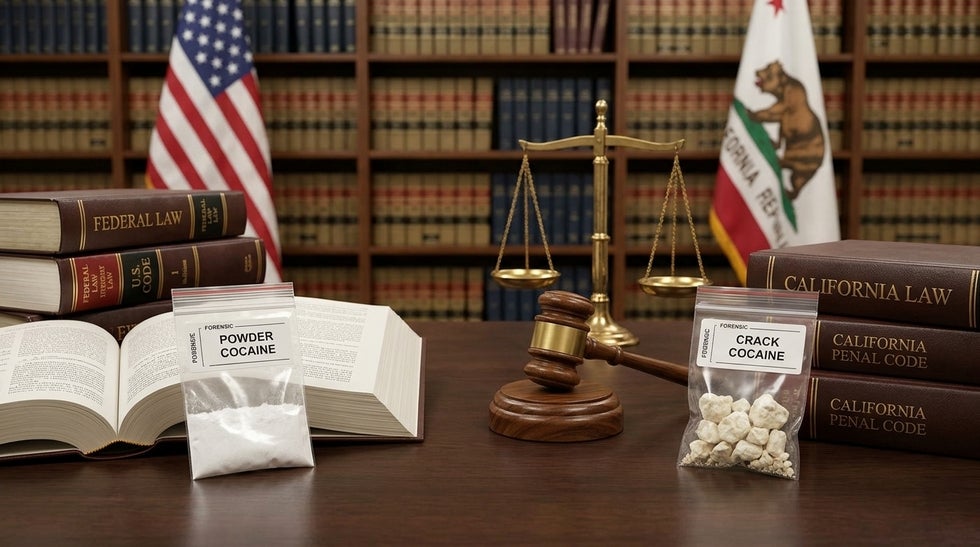
When a California client faces drug charges, the difference between crack and powder cocaine can change the courtroom strategy, the potential jail time, and even immigration outcomes, making it essential to understand both the chemistry and the statutes that govern each form.
Chemical Forms of Cocaine: Crack vs. Powder Cocaine
Powder cocaine is the hydrochloride salt known as cocaine hydrochloride, a white crystalline powder that dissolves in water and can be snorted or injected. The drug's molecular structure stays the same whether it's powdered or smoked.
Crack is the freebase conversion of that same molecule, created by mixing powder cocaine with baking soda and heat, which removes the hydrochloride and yields solid “rocks” that vaporize when smoked. Drug possession under Health and Safety Code 11350 treats both forms equally.
Cocaine Hydrochloride: Powder Form and Use
The powder, called cocaine hydrochloride, is a salt that easily dissolves, allowing users to inhale it through nasal insufflation or inject it directly into the bloodstream. Its chemical stability makes it the most common form found in street transactions.
Because it remains a hydrochloride salt, the drug can be measured precisely for legal thresholds, and law-enforcement labs often identify it using standard toxicology methods that differentiate it from its freebase counterpart.
Freebase Conversion: How Crack Is Made with Baking Soda
To produce crack, dealers dissolve powder cocaine in water, add baking soda, and apply heat. This process strips away the hydrochloride, leaving a solid base that can be broken into “rocks.”
The resulting substance, often called crack freebase, is less water-soluble but vaporizes quickly, allowing users to inhale the drug through a smoking pipe. The conversion does not alter the drug's core pharmacology once it reaches the blood.
Pharmacology and Onset: Smoking vs. Snorting
When smoked, crack delivers the drug to the brain within seconds, producing a rapid Cmax and a short, intense high. This fast onset drives the perception of higher danger, even though the chemical is identical.
Snorting powder cocaine results in a slower rise in blood plasma concentration, extending the high over several minutes. The difference lies in the route, not in the underlying benzoylmethylecgonine molecule.
Both forms ultimately bind to the dopamine transporter, increasing dopamine levels and reinforcing use. Researchers have long argued that the route alone should not justify disparate sentencing.
California Statutory Penalties for Crack and Powder Cocaine
In my practice defending California drug cases, I see how the state's statutes apply the same penalties to crack and powder cocaine, eliminating the old sentencing gap that once favored powder offenses.
Since SB 1010 took effect in 2015, the California Fair Sentencing Act equalized penalties, and Proposition 36 added a treatment-mandated felony option for repeat offenders. The difference between county jail and California state prison often hinges on whether a case is realigned under the three-year felony threshold.
|
Statute |
Offense |
Penalty (years) |
Notes |
|---|---|---|---|
|
HSC 11350 |
Simple possession |
Up to 1 (misdemeanor) |
Felony if prior violent felonies |
|
HSC 11351 / 11351.5 |
Possession for sale |
2-4 (felony) |
Same for powder and crack |
|
HSC 11352 |
Sale/transport |
3-5 (felony) |
Enhanced if moved across counties |
|
HSC 11370.4 |
Weight enhancements |
+3-25 |
Applies to both forms |
Possession and Possession-for-Sale Penalties (HSC 11350, 11351, 11351.5)
Simple possession of either form falls under Health and Safety Code 11350, a misdemeanor punishable by up to one year in county jail. A prior violent felony can elevate it to a felony.
Possession for sale of powder cocaine is charged under HSC 11351, while crack is charged under HSC 11351.5. Both carry a three-year felony range, reflecting the state's equal treatment after SB 1010.
Because the statutes no longer differentiate by form, the key question becomes the quantity and the defendant's intent, which guides whether the charge remains a misdemeanor or escalates to a felony.
Sale, Transportation, and Weight Enhancements (HSC 11352, 11370.4)
Sale, transportation, or furnishing of either form triggers Health and Safety Code 11352, a felony with a base range of three to five years. Moving the drug between noncontiguous counties adds a higher tier.
Weight enhancements under HSC 11370.4 add three years for over one kilogram, five years for over four kilograms, and up to 25 years for more than 80 kilograms, regardless of whether the drug is crack or powder.
The enhancements stack onto the base felony term, so a large-scale trafficking case can quickly exceed a decade behind bars, even though the underlying drug form is irrelevant.
Treatment-Mandated Felony and Proposition 36 (HSC 11395, Prop 36)
Effective December 18 2024, Health and Safety Code 11395 allows prosecutors to charge repeat possession as a treatment-mandated felony, offering dismissal upon successful completion of a program.
Under Proposition 36, a defendant who fails to complete treatment faces up to three years, but successful participants avoid a criminal record, a key factor for immigration and professional licensing.
Federal Sentencing Disparities: The 18-to-1 Ratio and Recent Reforms
When a case lands in federal court, the sentencing field changes dramatically, and the historic disparity between crack and powder cocaine can add years to a defendant's prison term.
Federal law still reflects the legacy of the 1986 mandatory minimums, which treated one gram of crack the same as 100 grams of powder, creating an 100-to-1 ratio that many critics called unfair.
Historical 100-to-1 Ratio and 1986 Mandatory Minimums
Congress enacted the 1986 statutes to impose harsh penalties for crack, setting a five-year mandatory minimum for simple possession of just 5 grams of crack, while powder required 500 grams for the same term.
These mandatory minimums forced judges to impose long sentences regardless of individual circumstances, fueling a massive incarceration disparity that still affects many defendants today.
Fair Sentencing Act of 2010 and the 18-to-1 Ratio
The Fair Sentencing Act reduced the disparity to 18-to-1, lowering the crack quantity needed for the same mandatory minimum and eliminating the five-year floor for simple possession.
Although the ratio improved, federal sentencing guidelines still embed the 18-to-1 factor, meaning crack offenses often receive higher advisory ranges than comparable powder offenses.
First Step Act, Terry v. United States, and Current Federal Guidelines
The First Step Act of 2018 opened a retroactive relief window, allowing many inmates sentenced under the old 100-to-1 regime to petition for reduced sentences.
However, the Supreme Court in Terry v. United States (2021) ruled that individuals sentenced for the lowest quantity tier are not eligible for that relief, preserving a gap for many low-level offenders.
Current thresholds in 21 U.S.C. 841 reflect the 18-to-1 ratio, and pending House bills aim to eliminate the disparity entirely, though they have stalled in the Senate. Drug transportation and trafficking under HS 11352 remains a key factor in deciding whether a case proceeds federally.
When State or Federal Court Handles a Crack or Cocaine Case
In my practice defending California drug offenses, I see most crack and cocaine matters filed under the Health and Safety Code by county district attorneys. The drug's form, crack or powder, does not change the statutory language.
Because the state treats both forms the same, the key questions become quantity, intent, and whether federal authorities have taken interest. The difference between crack vs cocaine laws often shows up in the venue, not the charge.
State Prosecution Under the Health and Safety Code
County prosecutors rely on Health and Safety Code 11350 for simple possession and on sections 11351, 11352 for possession for sale and trafficking. Sentences typically range from one-year county jail to three-year felonies, often served under realignment.
When a defendant faces a felony, the court may apply Health and Safety Code 11370.4 weight enhancements, adding three to twenty-five years for large kilograms. The statutes apply equally to crack and powder, reflecting the Health and Safety Code 11350 system.
Triggers for Federal Jurisdiction and Federal Sentencing Starts
Federal jurisdiction appears when a federal agency makes the arrest, a wiretap or task-force uncovers the operation, or the case involves a conspiracy, firearm, interstate transport, or a large quantity. In those situations, federal vs state drug case dynamics dominate.
Under 21 U.S.C. 841, an ounce of crack for sale starts at five years imprisonment, far higher than the typical county-jail term for the same amount.
Strategic Considerations: Timing, Witness Status, and Early Defense
Clients often wonder whether to resolve the state case first or risk a federal indictment. Early counsel can negotiate a plea that avoids federal exposure while preserving the chance to challenge evidence.
When a defendant is also a potential witness, prosecutors may delay state resolution to build a federal case. Acting quickly can protect the client from being compelled to testify against co-defendants.
We also evaluate whether the alleged conduct fits the possession for sale under Health and Safety Code 11351 definition, because that determines the applicable enhancements and the likelihood of a federal charge.
Defenses and Diversion Options in Crack and Cocaine Cases
In defending crack and cocaine matters, I start by reviewing the police stop, the alleged intent, and any lab or weight discrepancies. Each defense targets a specific element of the prosecution's case.
Clients often ask about crack freebase distinctions, but the law treats the substance uniformly. Successful defenses can reduce a felony to a misdemeanor or qualify the client for diversion programs.
Motion to Suppress Unlawful Stops and Searches
If the officer lacked reasonable suspicion for a traffic stop or a pat-down, a motion to suppress can exclude the drugs entirely. The Fourth Amendment requires specific articulable facts before a search.
When a warrant is over-broad or based on stale information, the court may grant a suppression hearing, potentially dismissing the case before any charge sticks.
Intent-Based Defenses: Personal Use vs. Sale
Proving the defendant possessed the drug for personal use hinges on quantity, lack of scales, and absence of packaging. These facts support a misdemeanor argument rather than a felony.
Conversely, the prosecution must show intent to sell, often using cash, baggies, or paraphernalia. Challenging those items can shift the charge back to simple possession.
Diversion Programs, Penal Code 1000, and Immigration Consequences
California offers pre-trial diversion under Penal Code 1000, drug court, or mental-health diversion. Successful completion can lead to dismissal, but many programs require a guilty plea.
Even a guilty plea can trigger immigration fallout; a conviction may be deemed an aggravated felony, making non-citizens deportable. Learn more about when state offenses become federal criminal charges and affect residency. Because diversion often involves a plea, we advise clients on the long-term immigration impact before accepting any agreement.
Collateral Consequences Beyond the Sentence
Beyond jail time, a drug conviction can reshape a person's future. The most immediate effect for non-citizens is the risk of removal, especially when the offense is labeled an aggravated felony.
Immigration authorities treat a felony drug conviction as an aggravated felony, which can lead to automatic deportation and bar re-entry, even if the underlying conduct was a misdemeanor in California.
Immigration Fallout and Aggravated Felony Designation
Any conviction for possession with intent to sell, or a sale conviction, falls under the aggravated felony category. This classification overrides state sentencing differences and triggers removal proceedings.
Even a diversion that ends with a guilty plea counts as a conviction for immigration purposes, so clients must weigh the benefits of dismissal against the risk of removal.
Professional Licenses, Firearm Rights, and Federal Benefits
A felony drug conviction can suspend or revoke professional licenses, from medical to legal fields. The state licensing board reviews the conviction under the California Uniform Controlled Substances Act.
Felony status also bars firearm possession under Penal Code 100 and can disqualify individuals from federal benefits such as student aid or housing assistance.
Expungement Options for California Convictions
Most California possession convictions are eligible for expungement after the sentence is completed, provided the individual has not reoffended. The process clears the public record but does not erase the conviction for immigration.
Expungement restores many civil rights, including voting and employment opportunities, and can improve the chance of obtaining a professional license after a period of good conduct.
How The Bulldog Law Protects Your Rights in Crack and Cocaine Cases
Our California criminal defense team reviews every police report, lab result, and witness statement to spot weaknesses before the prosecution files. We move quickly to suppress illegal evidence and keep your case on solid ground.
From the first phone call until trial, we safeguard your constitutional rights and negotiate aggressively for reduced charges or dismissal. Call (888) 928-1609 for a confidential case review today.
Frequently Asked Questions
What is the difference between crack and cocaine?
Crack is the freebase form of cocaine that can be smoked, while powder cocaine is the hydrochloride salt usually snorted or injected. Both contain the same active alkaloid but differ in preparation and typical use methods.
Under California law, crack falls under Health and Safety Code 11351.5 and powder cocaine under Health and Safety Code 11351. Federally, both are listed as Schedule II controlled substances.
Is crack punished more harshly than powder cocaine in California?
California treats simple possession of either drug as a misdemeanor under Health and Safety Code 11350, generally punishable by up to one year in county jail.
When intent to sell is proven, both crack and powder cocaine carry the same felony penalties, two, three, or four years, under the respective possession-for-sale statutes, so there is no statutory disparity.
Is crack punished more harshly than powder cocaine under federal law?
Yes. Federal law still imposes a much lower weight threshold for crack. Under 21 U.S.C. § 841, 28 grams of crack triggers a five-year mandatory minimum, while 500 grams of powder cocaine are required for the same sentence.
The ten-year mandatory minimum begins at 280 grams of crack or 5 kilograms of powder. The Fair Sentencing Act of 2010 reduced the old 100-to-1 ratio to roughly 18-to-1, but the gap remains.
How does Proposition 36 affect repeat possession charges?
Proposition 36, effective December 18 2024, allows a person with two or more prior drug convictions to receive a treatment-mandated felony under Health and Safety Code 11395 instead of a traditional prison term.
If the defendant completes the court-ordered treatment program, the felony conviction is dismissed, preserving future employment and housing opportunities while still addressing the underlying addiction.
What are the weight thresholds that trigger enhancements under California law?
For possession-for-sale, weight alone does not create a felony, but large quantities increase penalties. Holding more than one kilogram adds a three-year term, and amounts over 80 kilograms can raise the sentence to up to 25 years.
These enhancements apply to both crack and powder cocaine under the same statutes, reflecting the law's focus on trafficking rather than the drug's physical form.
Can a crack or cocaine possession charge be dismissed through diversion?
Yes. Many simple-possession cases qualify for pre-trial diversion under Penal Code 1000, which ends in dismissal after successful completion of a drug-education or treatment program.
Felony charges arising from Proposition 36 also disappear when the defendant fulfills the mandated treatment. Also, motions to suppress evidence from unlawful stops frequently result in case dismissal.
How does a conviction affect non-citizen immigration status?
A drug conviction, even a misdemeanor, can trigger removal proceedings or denial of future immigration benefits. Under federal immigration law, any conviction for a controlled-substance offense is considered a “crime involving moral turpitude.”
Because the consequences are severe, we work with immigration specialists early to assess options, challenge the conviction, or seek relief before the Department of Homeland Security takes action.