
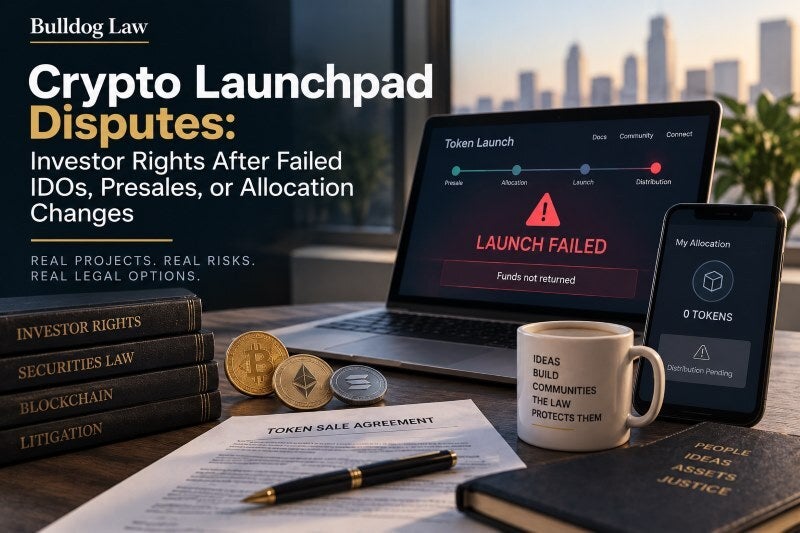
Crypto Launchpad Disputes can arise when an IDO or presale is canceled, token allocations are reduced after payment, vesting terms change, refunds are delayed, or investors receive something materially different from what the launchpad advertised. The legal question is not simply whether the token lost value. It is whether the launchpad, issuer, or another participant failed to honor enforceable terms, made misleading statements, mishandled investor funds, or violated another legal obligation.
Investors dealing directly with a token issuer may face issues similar to token-sale refund disputes involving failed launches and changed tokenomics, but launchpad cases add another layer: determining whether the platform itself assumed legal responsibility for the offering.
Quick answer
Investors may have legal options when a crypto launchpad changes allocations, fails to distribute purchased tokens, withholds refunds, or materially misrepresents an IDO or presale. Potential claims can involve breach of contract, fraud or misrepresentation, custody or escrow obligations, and securities laws in some offerings. Whether the launchpad itself is liable depends on its role, contractual terms, control over investor funds, representations, and relationship with the token issuer.
How Crypto Launchpad Disputes Arise
Crypto launchpads help projects distribute tokens before or around their initial market launch. Depending on the platform, investors may complete KYC, deposit stablecoins or other crypto, receive an allocation, and later claim tokens according to a vesting schedule.
Common disputes include:
- An IDO or presale being canceled after investors have paid.
- A confirmed allocation being reduced before token distribution.
- Vesting terms changing after the purchase.
- Refunds being delayed or denied.
- Tokens never being delivered.
- A project launching with materially different tokenomics.
- Launchpad marketing conflicting with the issuer's actual terms.
- Investor funds remaining locked after the offering fails.
The structure may resemble an older initial coin offering even when the project uses newer terminology such as IDO, IEO, presale, community round, or token generation event. Understanding how an initial coin offering is structured can help identify which promises were part of the transaction.
Is the Launchpad or the Token Issuer Responsible?
This is often the central issue. A launchpad may characterize itself as a technology platform that merely connects projects and purchasers. In another offering, it may collect funds, determine eligibility, calculate allocations, hold assets, administer refunds, or control token distribution.
The more operational control the platform exercises, the more closely its own conduct may need to be examined.
Relevant documents can include:
- Launchpad terms of service.
- Presale or IDO terms.
- Token purchase agreements.
- Allocation confirmations.
- Vesting schedules.
- Refund policies.
- Project disclosures and marketing materials.
- Smart contract documentation.
If token delivery or vesting occurs automatically, a dispute may also involve the relationship between written promises and smart contract and automated agreement terms.
When Allocation Changes May Support a Claim
An allocation change is not automatically unlawful. Launchpad terms may expressly reserve the right to adjust allocations because of oversubscription, eligibility requirements, regulatory restrictions, or calculation errors.
The situation becomes more concerning when the platform confirms a specific allocation, accepts payment, and later changes the amount in a way that conflicts with its contractual terms or prior representations.
For example, assume an investor is told that depositing $25,000 guarantees an allocation of 100,000 tokens. After accepting the funds, the platform delivers only 20,000 tokens without applying any disclosed allocation formula or refunding the difference. That may raise substantially different issues from a clearly disclosed oversubscribed sale in which every investor's allocation is proportionally reduced.
What if Investor Funds Were Supposed to Stay in Escrow?
Some launchpads hold deposits until minimum fundraising requirements are reached or until a token generation event occurs. The legal analysis may turn on who controlled those assets and when the platform was authorized to release them.
If funds were supposed to remain segregated but were transferred to the project early, investors may need to examine the escrow agreement and transaction history. Similar ownership and release issues arise in crypto escrow disputes involving unreleased digital assets.
Where the launchpad or another service provider holds cryptocurrency directly for investors, the dispute may instead resemble crypto custody disputes involving exchanges and wallet providers. Wallet structure, contractual ownership and control over private keys can become important evidence.
Crypto Launchpad Disputes and Securities Laws
Not every token is automatically a security. However, the circumstances surrounding a token offering can bring federal securities laws into the analysis when the transaction satisfies the requirements for a security, including an investment contract.
This can be particularly important during a presale, where purchasers may be funding a project before the network, application, or token utility is operational. The representations made by founders and launchpads about future managerial efforts, development and expected economic benefits can matter. A detailed analysis may require applying digital-asset securities principles and the Howey framework.
Token classification should also be separated from the legal character of the transaction itself. Current regulatory approaches recognize that different crypto assets and different transactions can require distinct treatment, an issue explored further in the SEC token taxonomy and digital-asset classification framework.
Does Calling a Sale “Crowdfunding” Change the Rules?
No. Using words such as community raise, crowdfunding, public round, or decentralized presale does not itself determine which securities rules apply.
If an issuer actually relies on Regulation Crowdfunding to sell securities, federal law imposes specific requirements, including use of an eligible registered intermediary and required investor disclosures. Crypto startups considering that route face issues discussed in Regulation Crowdfunding and cryptocurrency fundraising.
A launchpad should not be assumed to be an SEC-registered funding portal merely because it facilitates online fundraising.
What if the Token Launches but Immediately Collapses?
A falling token price does not by itself establish launchpad liability. Crypto assets can lose value because of market conditions, lack of demand, poor project execution, or speculative trading.
The legal analysis becomes different when the collapse is tied to allegedly undisclosed token sales, misleading liquidity promises, insider transactions, or arrangements affecting the market after launch.
For example, contractual relationships with liquidity providers may matter where investors were promised organized market support. The structure and risks of those arrangements are discussed in crypto market maker agreements for token projects.
If the project later disappears from major trading venues, investors should separately consider the consequences of crypto exchange delistings for projects and investors. A delisting does not automatically prove fraud, but it may affect liquidity, valuation and available recovery strategies.
Evidence to Preserve After a Failed IDO or Presale
Investors should preserve evidence before websites, dashboards or token-sale pages change. Useful records can include:
- Wallet addresses and transaction hashes.
- Allocation confirmations.
- Receipts and deposit records.
- Terms of service applicable on the purchase date.
- Presale and IDO terms.
- Vesting schedules.
- Refund requests and responses.
- Launchpad dashboard screenshots.
- Emails and support tickets.
- Telegram, Discord or other official project announcements.
- White papers and tokenomics documents.
- Smart contract addresses.
Investors should preserve the original material rather than relying only on later screenshots. On-chain records may show where funds moved, but additional evidence is often necessary to determine who controlled a wallet and what contractual rights applied.
What Remedies May Be Available?
Depending on the claims and facts, an investor may potentially seek a refund, contractual damages, rescission, fraud damages, an accounting, or other legally available relief. Emergency court orders may sometimes be considered when identifiable assets are being transferred, but such relief requires satisfying specific legal standards.
Recovery may become more complicated when the launchpad, issuer, developers and wallets are located in different countries. Determining which court can hear the case and exercise authority over relevant assets may require a digital-asset jurisdiction analysis.
Frequently Asked Questions About Crypto Launchpad Disputes
Can a launchpad reduce my allocation after I pay?
Potentially, if its governing terms clearly permit the adjustment. Whether a particular reduction was lawful depends on the agreement, representations and circumstances.
Can I demand a refund if the IDO never launches?
Possibly. Refund rights may depend on the purchase terms, whether specified launch conditions failed and who currently controls the funds.
Is a failed token launch automatically fraud?
No. Business failure and fraud are different. Fraud generally requires proof of particular false or misleading conduct and the other elements required by applicable law.
Can I sue a launchpad located outside California?
Possibly, but jurisdiction, forum-selection clauses, arbitration provisions and the location of defendants and assets can affect where a dispute may proceed.
Crypto Launchpad Disputes lawyers in California
Crypto Launchpad Disputes require identifying what each participant actually promised and controlled. A launchpad may be a passive technology provider in one sale and play a much more active role in collecting funds, allocating tokens and administering refunds in another.
Bulldog Law helps clients evaluate disputes involving failed IDOs, presales, token allocations, launchpads and digital-asset offerings. More complex matters can require broader blockchain litigation involving cryptocurrency transactions. Early review can help preserve on-chain evidence and distinguish ordinary investment losses from potentially actionable conduct. No particular recovery or result can be guaranteed.