
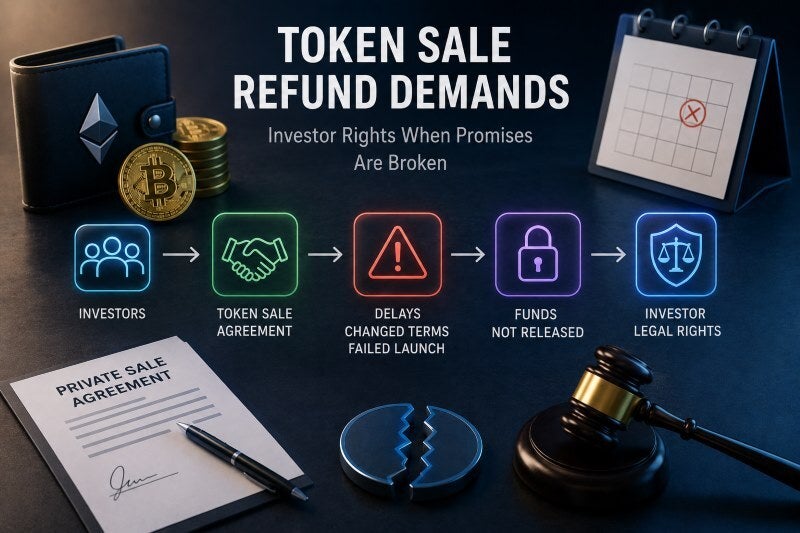
Token Sale Refund Demands often arise when investors paid for digital assets but the project delayed launch, changed tokenomics, missed a token generation event, failed to list the token, or delivered something materially different from what investors expected. In California, refund rights usually depend on the private sale agreement, offering materials, project disclosures, investor communications, securities issues, custody records, and whether the project made enforceable promises.
A failed or delayed token launch does not automatically require a refund in every case. But investors may have legal options if the project promised refund rights, misrepresented material facts, concealed launch problems, changed allocation terms unfairly, failed to deliver tokens, or sold tokens in a transaction that creates rescission, securities, fraud, or contract claims.
Why Token Sale Refund Demands happen
Token Sale Refund Demands commonly begin after a private sale, SAFT-style agreement, launchpad allocation, presale, seed round, advisor allocation, or community raise does not unfold as promised. The project may say market conditions changed. Investors may say they funded one deal but received a different one.
Common triggers include:
- The token generation event is delayed for months or years.
- The project changes total supply, vesting, lockups, or investor allocation percentages.
- The team announces new insiders, treasury wallets, market makers, or unlock schedules.
- The token launches but has little liquidity or no meaningful exchange access.
- The project refuses a refund despite a written refund clause.
- Investor funds are held by an exchange, custodian, foundation, DAO, or multisig wallet.
- The project claims regulatory, tax, sanctions, or listing concerns prevent delivery.
When changed token terms affect founders, advisors, employees, or early contributors, token vesting disputes over unpaid grants may overlap with investor refund claims because both sides may be fighting over the same token supply, lockups, and treasury records.
Token Sale Refund Demands and private sale agreements
Token Sale Refund Demands usually start with the written agreement. Private sale documents may describe the purchase amount, token allocation, purchase price, vesting schedule, lockup period, refund rights, transfer restrictions, risk factors, governing law, dispute forum, and whether the tokens are delivered directly or through a future claim process.
Important provisions may include:
- Whether the investor has an express refund right.
- Whether refund rights expire after a deadline or token generation event.
- Whether the project may delay delivery for compliance, technical, or listing reasons.
- Whether tokenomics can be changed without investor consent.
- Whether disputes must be arbitrated or filed in a specific court.
- Whether the investor represented that they were accredited or met eligibility requirements.
- Whether the agreement limits damages, rescission, or reliance on outside statements.
Investors should also compare the agreement to pitch decks, whitepapers, data rooms, Discord posts, investor updates, and private messages. A project may rely on risk disclosures, but investors may argue that the project's actual statements created a different promise or omitted material information.
Token Sale Refund Demands after delays and changed tokenomics
Token Sale Refund Demands become stronger when the investor can identify a specific promise that was broken. A vague roadmap delay may be harder to challenge than a written clause requiring token delivery or refund by a set date. The same is true for tokenomics. Projects often reserve flexibility, but a major change in supply, allocation, vesting, or insider rights may create legal risk if earlier investor materials were misleading.
Changed tokenomics can also affect market fairness. If insiders, founders, or preferred investors receive earlier liquidity while other investors remain locked, the dispute may involve disclosure, fiduciary-duty theories, unfair competition, or securities claims depending on the structure. If insiders traded on advance knowledge of listing, delisting, unlock, or supply changes, nonpublic token information and insider trading risk may become part of the evidence.
If a token was distributed through an airdrop instead of the originally promised sale mechanics, token airdrop tax and securities risks may affect whether the project's replacement distribution actually satisfied investor expectations. If investors were excluded from a later claim process because of wallet clustering or eligibility screening, airdrop eligibility and Sybil accusation disputes may become relevant.
Securities, tokenization, and disclosure issues
Some refund disputes involve securities-law questions. A token does not become a security merely because investors are unhappy, but the offer and sale of a digital asset may raise securities issues depending on the facts, including investor expectations, project promises, managerial efforts, marketing, and economic structure. The legal analysis is fact-specific.
If the offering involved investment-like promises, resale restrictions, expected profits, issuer efforts, or tokenized assets, cryptocurrency securities and tokenization law may affect claims for rescission, damages, disclosure failures, or regulatory exposure. Projects preparing or defending token sales may also need to evaluate crypto securities compliance strategies for token issuers before changing terms, refusing refunds, or making new public statements.
Tokenized securities and real-world asset projects can add another layer. If the investment involved tokenized equity, debt, fund interests, reserves, or regulated market infrastructure, tokenized securities proposals and investor issues may help frame the difference between ordinary token utility and regulated financial interests. If the project involves wholesale settlement, reserve assets, or institutional tokenization, tokenized reserve legal framework issues may also affect how rights and obligations are described.
Liquidity loss, exchange problems, and custody records
Many refund demands begin after liquidity disappears. A project may launch the token but fail to secure meaningful exchange access. Investors may argue that listing plans were exaggerated, delayed, or changed. If the token is later removed from a platform, exchange delisting legal risks may become part of the refund dispute because liquidity loss can affect damages, reliance, and disclosure arguments.
Custody records may also matter. Investor funds or tokens may be held by an exchange, custodian, wallet provider, project treasury, or foundation. If withdrawals are restricted, crypto exchange account freeze disputes may affect whether the project or investor can access assets. If the platform becomes insolvent, customer funds in crypto exchange bankruptcy may affect recovery timing and ownership records.
When the dispute is about who controls tokens or purchase funds, crypto custody disputes with exchanges and wallet providers may help determine whether the investor has a claim against the project, a platform, a custodian, or several parties.
DAO votes, multisig control, and treasury disputes
Some projects respond to refund demands by saying the treasury is controlled by a DAO, foundation, multisig wallet, or governance vote. That may be true, but it does not automatically eliminate legal duties created by the sale documents or investor communications.
If governance controls whether refunds are paid, DAO governance and treasury control disputes may affect who has authority to approve refunds, change tokenomics, or reject investor claims. If signers refuse to release refund funds or tokens, multisig wallet signer deadlock may require review of wallet authority, operating documents, and emergency court remedies.
Technical problems can also affect refund rights. If a smart contract flaw, exploit, or post-audit code change caused the project to miss launch milestones, smart contract audit dispute issues may determine whether the delay was caused by auditor negligence, developer decisions, treasury controls, or project management failures.
Family law and hidden asset issues involving token sale rights
Token sale rights can matter outside investor litigation. A founder, investor, or employee may hold refund rights, future token rights, warrants, SAFT interests, or locked tokens that become relevant in divorce, support, or creditor disputes. A party may argue that the assets are speculative or worthless because the project has not launched, while the other side may argue the rights still have value.
In California family law matters, digital assets in divorce proceedings may require tracing, valuation, and documentation of token purchase rights or refund claims. If token sale rights, wallets, or exchange accounts were not disclosed, hidden cryptocurrency discovery strategies may help identify undisclosed agreements, wallet activity, and exchange records.
Where token sale refund disputes may be handled in California
Token sale refund disputes may be handled through negotiation, mediation, arbitration, California Superior Court, federal court, bankruptcy court, or regulatory complaints depending on the agreement and claims. Private sale contracts often include forum selection clauses, arbitration clauses, governing law provisions, notice requirements, and limitation-of-liability language.
California state-law claims may include breach of contract, fraud, negligent misrepresentation, unfair competition, conversion, breach of fiduciary duty, accounting, declaratory relief, or rescission depending on the facts. Federal court may be involved if the dispute includes federal securities claims, diversity jurisdiction, bankruptcy, or other federal issues. Government agencies and courts are neutral public institutions and are not affiliated with Bulldog Law.
In urgent cases, investors or projects may consider temporary restraining orders, preliminary injunctions, preservation orders, accountings, expedited discovery, or orders protecting treasury assets. Whether those remedies are available depends on the contract, evidence, jurisdiction, and risk that assets or records may disappear.
Evidence investors and projects should preserve
Refund disputes are evidence-heavy. The strongest record usually connects the investor's payment, the project's promise, the changed facts, and the resulting loss.
- Private sale agreements, SAFTs, token purchase agreements, side letters, and amendments.
- Whitepapers, pitch decks, investor updates, data room materials, and tokenomics charts.
- Wallet addresses, transaction hashes, exchange records, custody records, and treasury dashboards.
- Communications from email, Telegram, Discord, Slack, Signal, X, and investor portals.
- Records showing token generation dates, delays, unlocks, vesting, allocations, and supply changes.
- Refund requests, rejection notices, settlement offers, and board or governance approvals.
- Valuation records showing token price, liquidity, exchange availability, and market conditions.
Projects should also preserve the reasons for any delay or denial. A later claim is easier to defend when the project can show a documented decision process, consistent communications, and records supporting why the launch, refund, or token delivery changed.
Practical steps after a token sale refund demand
Investors and projects should avoid making rushed public statements after a refund dispute begins. Practical steps may include:
- Review the private sale agreement and any amendments.
- Identify the exact refund clause, delivery deadline, token allocation, and dispute forum.
- Preserve payment records, wallet records, investor communications, and tokenomics versions.
- Compare public statements to internal records about launch timing and risks.
- Determine who controls the treasury, tokens, and refund funds.
- Evaluate whether securities, custody, governance, or exchange issues affect the dispute.
- Consider whether emergency relief is needed before funds move or records disappear.
A refund demand may be resolved through negotiation, revised delivery terms, partial refund, token replacement, settlement, arbitration, or litigation. The right path depends on the contract, the value at issue, the strength of the evidence, and the risk of broader investor or regulatory claims.
Token Sale Refund Demands lawyers in California
Token Sale Refund Demands require careful review of private sale agreements, tokenomics, refund promises, launch delays, investor disclosures, treasury control, custody records, and securities issues. The legal analysis may change depending on whether the dispute involves a failed launch, changed terms, liquidity loss, DAO approval, multisig control, or investor reliance.
Bulldog Law helps California clients evaluate token sale refund disputes involving delayed launches, failed token generation events, changed tokenomics, private sale agreements, disclosure issues, exchange problems, custody disputes, and investor claims. Early legal review may help preserve evidence, identify responsible parties, and evaluate practical options before assets move or claims escalate.