
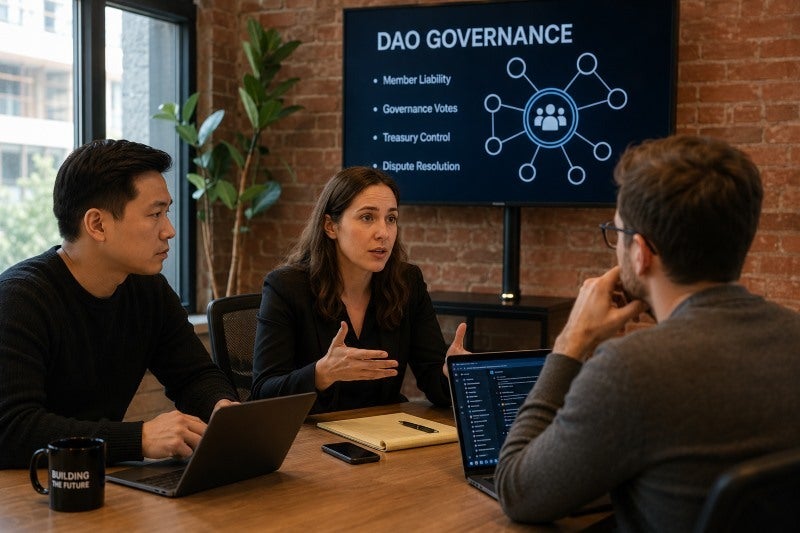
DAO Legal Disputes can move quickly because voting power, treasury access, signer authority, and token ownership may all change before a court or agency ever reviews the facts. For California founders, contributors, investors, token holders, and service providers, the main concern is usually practical: who controls the treasury, who had authority to act, and whether individual members can be exposed to liability for what the DAO did.
A decentralized autonomous organization may look like code, but legal disputes usually involve people, entities, wallets, contracts, messages, votes, and money. When governance breaks down, the dispute may involve breach of contract, fiduciary duty theories, fraud, securities or commodities issues, tax reporting, sanctions screening, employment classification, or emergency court relief to preserve assets.
Why DAO Legal Disputes happen
DAO Legal Disputes often start when the written rules, smart contracts, and community expectations do not line up. A proposal may pass on-chain, but members may argue that the vote was manipulated, the proposal exceeded the DAO's authority, or the signer group acted before the vote became final.
Common triggers include:
- A multisig signer refuses to approve a treasury transaction.
- Governance tokens are borrowed, bought, delegated, or concentrated before a vote.
- A founder or core team member transfers funds without a valid proposal.
- Members disagree over whether a snapshot, quorum rule, or delegation was valid.
- A service provider claims the DAO failed to pay under a contractor agreement.
- A token holder alleges misleading statements, undisclosed conflicts, or misuse of community funds.
- Members cannot determine whether the DAO is an entity, unincorporated association, partnership, nonprofit association, or informal project.
Some disputes also grow out of compensation promises. A contributor who received tokens, stablecoins, NFTs, or vesting rights may have claims that overlap with cryptocurrency compensation and contract risk, especially when the DAO's records do not clearly identify the value, vesting schedule, tax treatment, or payment source.
DAO Legal Disputes and member liability
DAO Legal Disputes can raise difficult member liability questions because a DAO may not have the same liability shield as a corporation or limited liability company. If a DAO has not formed a recognized legal entity, a claimant may argue that the DAO is an unincorporated association, general partnership, joint venture, or other legal relationship. The correct analysis depends on the facts, the governing documents, the jurisdiction, and the claims being asserted.
California law recognizes unincorporated associations in some contexts, but that does not mean every DAO is automatically treated the same way. A claimant may try to identify the people who voted, managed funds, signed contracts, controlled wallets, promoted the project, or personally participated in alleged wrongdoing. A passive token holder may have different risk than a founder, multisig signer, delegate, protocol operator, market maker, paid contributor, or person who personally approved a disputed transaction.
Member exposure may depend on issues such as:
- Whether the DAO formed a legal entity or used a wrapper entity.
- Whether members personally signed contracts or made representations.
- Whether the member voted for, approved, or implemented the disputed act.
- Whether the member controlled wallets, admin keys, governance forums, or treasury assets.
- Whether the claim is based on contract, tort, securities law, tax law, sanctions law, or another theory.
- Whether the claimant can connect the member's conduct to the alleged harm.
Because liability theories are still developing, DAO participants should avoid assuming that decentralization alone prevents lawsuits or personal exposure.
Governance votes, quorum fights, and voting manipulation
Governance fights often turn on the difference between formal voting mechanics and practical control. A DAO may have token voting, delegation, snapshot voting, timelocks, veto rights, emergency committees, multisig approvals, or foundation oversight. When those systems conflict, members may disagree over which authority controls.
Voting manipulation allegations can include vote buying, flash-loan voting, undisclosed delegation arrangements, sybil wallets, insider coordination, governance attacks, or last-minute token transfers. Not every aggressive voting strategy is unlawful, but manipulation allegations can become serious when the vote causes treasury loss, changes token economics, approves insider payments, or benefits a controlling group at the expense of other participants.
Important evidence may include the proposal text, forum posts, Discord or Telegram messages, delegation records, token transfer history, wallet clustering analysis, snapshot records, voting power calculations, multisig transaction history, and communications among core contributors. The earlier these records are preserved, the easier it may be to reconstruct what happened.
When a DAO's governance involves creator royalties, digital collectibles, or marketplace access, a voting dispute may also affect monetization. NFT marketplace account suspension issues can become part of a DAO dispute when treasury assets, creator rights, or project revenue depend on platform access.
Treasury control and multisig signer disputes
Treasury control is often the center of a DAO dispute. The treasury may hold tokens, stablecoins, NFTs, liquidity pool positions, staking rewards, intellectual property revenue, grant funds, or proceeds from token sales. If the signer group is divided, a project can become unable to pay contributors, defend claims, satisfy tax obligations, or execute approved proposals.
Signer disputes often involve questions such as:
- Who has current authority to sign treasury transactions?
- Was a signer removed or replaced under the DAO's rules?
- Did the transaction match the approved proposal?
- Was there a conflict of interest or self-dealing?
- Were emergency powers used properly?
- Did any signer transfer assets to a personal wallet, affiliated entity, or undisclosed exchange account?
If treasury assets include stablecoins, the DAO should document who bears risk from depegs, redemption delays, liquidity issues, or exchange restrictions. stablecoin depeg loss claims may overlap with treasury disputes when members allege that managers, signers, or delegates failed to protect community funds.
DAO treasuries can also be affected by leverage. If tokens are pledged as collateral, a liquidation may happen before members understand the risk. forced crypto collateral sale disputes may arise when treasury assets or founder-controlled assets are liquidated after a disputed loan, margin call, or lending platform decision.
Tax, sanctions, and compliance issues in DAO disputes
DAO disputes are not only private governance fights. They may also create tax, sanctions, and financial compliance problems. A DAO that pays contributors, distributes rewards, swaps assets, earns protocol revenue, or compensates service providers may need records showing income, expenses, fair market value, wallet ownership, and payment recipients.
If tax reporting does not match third-party exchange records or wallet activity, a member, founder, contributor, or related entity may receive a notice later. digital asset tax mismatch notices can become harder to answer when DAO records are scattered across wallets, chats, governance platforms, and pseudonymous contributor accounts.
Sanctions compliance can also be significant. A DAO that sends funds to a blocked wallet, sanctioned person, or high-risk jurisdiction may face legal and reputational problems. OFAC risks for wallets, exchanges, and DeFi should be considered before treasury payments, grants, bridges, or cross-border transfers are approved.
DAO projects that operate like startups may also need onboarding controls. KYC and AML planning for crypto startups can matter when a DAO interacts with customers, investors, contributors, exchanges, launchpads, liquidity providers, or regulated counterparties.
Employment, payroll, and contributor classification
Many DAOs use the language of community contribution, but legal disputes often reveal work arrangements that look more structured. Contributors may be paid monthly, managed by core teams, required to attend meetings, assigned duties, given internal access, or restricted from working for competitors. Those facts can raise employment classification issues under California law.
Payment in tokens or stablecoins does not decide whether a worker is an employee, independent contractor, volunteer, founder, or vendor. Classification depends on the relationship, control, business structure, and applicable legal test. A DAO that pays California contributors should treat payroll and contractor documentation seriously because crypto payroll for California businesses can trigger wage timing, tax withholding, wage statement, and worker classification concerns.
Evidence to preserve in a DAO governance dispute
DAO disputes often depend on evidence that can disappear, change, or become difficult to authenticate. Members, founders, signers, and contributors should preserve records before positions harden or assets move.
- Governance documents, operating agreements, bylaws, foundation documents, and token terms.
- Proposal drafts, final proposals, quorum rules, timelocks, and voting results.
- Snapshot data, wallet addresses, delegation records, and token transfer history.
- Multisig signer lists, transaction approvals, admin key activity, and treasury dashboards.
- Discord, Telegram, Slack, forum, email, and direct message records.
- Contributor agreements, invoices, payroll records, grant agreements, and vesting schedules.
- Exchange records, bridge records, custody records, and tax valuation records.
- Communications showing conflicts of interest, side deals, vote coordination, or undisclosed control.
DAO-related assets may also become relevant in family law, support, or creditor disputes. digital assets in California divorce proceedings can require tracing wallet activity, valuing token holdings, and identifying whether DAO compensation or treasury rights are separate, community, or disputed property. When assets are concealed, hidden cryptocurrency discovery strategies may involve subpoenas, wallet analysis, exchange records, and communications showing beneficial ownership.
Where DAO disputes may be handled in California
A DAO dispute may be handled in different forums depending on the claims, parties, contracts, and relief requested. State-law claims such as breach of contract, fraud, conversion, unfair competition, or fiduciary duty theories may be filed in California Superior Court when jurisdiction and venue are proper. For example, a dispute involving California parties or California conduct may be filed in the Superior Court for the county connected to the transaction, business, or defendant.
Federal claims may be handled in the United States District Court, including the Northern, Central, Eastern, or Southern District of California, depending on the parties and venue. Federal securities, commodities, sanctions, bankruptcy, tax, or interstate disputes may involve federal courts or agencies such as the SEC, CFTC, IRS, Treasury Department, or OFAC. These institutions should be understood as neutral government bodies, not as organizations affiliated with Bulldog Law.
Some DAO agreements include arbitration clauses, forum selection clauses, governing law provisions, or decentralized dispute-resolution language. Those terms may affect where the dispute begins, but courts may still need to decide whether the clause is enforceable, who agreed to it, and whether emergency relief is available to preserve treasury assets.
In urgent cases, a party may seek a temporary restraining order, preliminary injunction, receivership, asset freeze, accounting, or expedited discovery. Whether that relief is available depends on the evidence, legal claims, risk of irreparable harm, and court procedures.
Practical steps when a DAO dispute starts
When a DAO dispute begins, speed and discipline matter. Members and signers should avoid retaliatory transfers, deleting messages, informal threats, or unilateral changes to treasury controls unless counsel has reviewed the risks.
- Preserve governance records, wallet data, chat logs, voting records, and signer communications.
- Identify which legal entity, if any, is connected to the DAO.
- Map the treasury, signer group, admin keys, exchange accounts, and custody arrangements.
- Review voting rules, proposal procedures, quorum requirements, and emergency powers.
- Determine whether any contract, arbitration clause, or forum selection clause applies.
- Document the harm, including treasury loss, token dilution, unpaid compensation, tax exposure, or blocked access.
- Avoid public statements that could affect litigation, regulators, token markets, or settlement leverage.
A careful early response may help narrow the dispute, protect treasury assets, and reduce the risk that governance disagreements become broader personal liability, tax, or regulatory problems.
DAO Legal Disputes lawyers in California
DAO Legal Disputes require legal analysis that accounts for both blockchain mechanics and traditional legal duties. Governance votes, signer authority, treasury control, contributor payment, tax reporting, sanctions screening, and member exposure can all affect the strategy.
Bulldog Law helps California clients evaluate DAO disputes involving treasury misuse, voting manipulation, signer conflicts, contributor claims, token holder exposure, and digital asset records. If a DAO governance fight is developing, early legal review may help preserve evidence, identify responsible parties, and evaluate practical options before assets move or claims escalate.