
Updated September 2026 | The Bulldog Law | California and Federal Criminal Defense
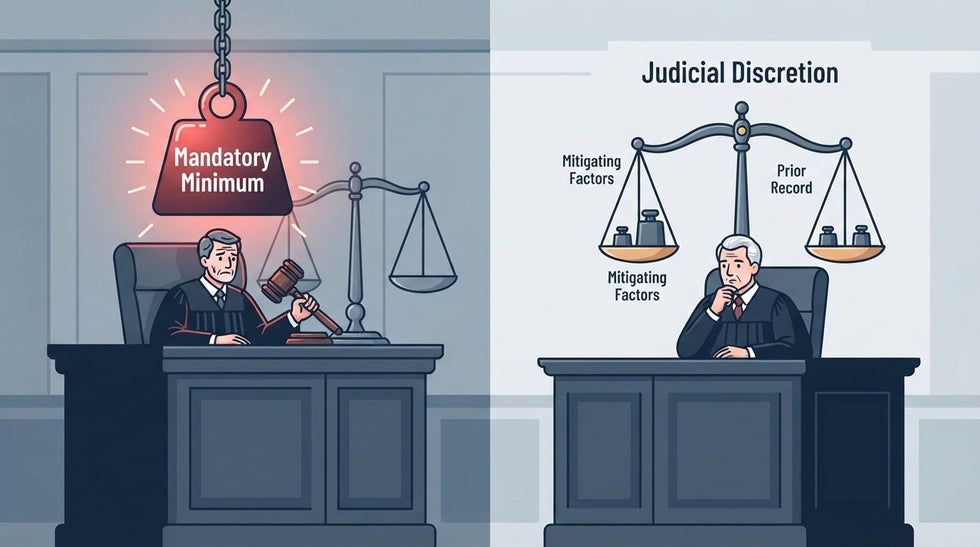
A mandatory minimum sentence is a floor written into a statute that the judge cannot go below, no matter how sympathetic the defendant or how minor their role. Federal law has hundreds of them, concentrated in drug trafficking, firearms, child exploitation, and identity theft. California has far fewer than most people assume: its sentencing system gives judges a choice of three terms for most felonies, probation for most offenses, and, since 2017, the power to strike nearly every enhancement that used to function as a floor. The true California minimums are for murder, the One Strike sex offenses, certain crimes against children, and repeat DUI and domestic violence. In both systems there are statutory doors below the floor, the federal safety valve and substantial assistance, California's Penal Code 1385 and the Romero motion, and knowing which door applies is most of what a sentencing lawyer does.
The Bulldog Law's attorneys spend a great deal of time explaining to clients, and sometimes to prosecutors, that the number on the charging document is not the number the client will serve. A federal drug case that reads ten years to life is, for a first-time courier who qualifies for the safety valve, a guidelines case with no floor. A California gun case that reads ten years for the enhancement is, after the 2018 and 2022 reforms, a case in which the judge can strike the ten years entirely. What follows is what mandatory minimums are, which ones remain in each system, and the mechanisms that get around them. Call (888) 928-1609 or message our team if a minimum is on the table in your case.
What a mandatory minimum is, and what it isn't
Ordinary sentencing gives the judge a range and discretion within it. A mandatory minimum removes the bottom of the range: conviction of the offense requires at least the stated term, and the judge's only discretion is above it. The U.S. Sentencing Commission's data shows the effect: federal defendants convicted of an offense carrying a mandatory minimum and subject to it received an average of 158 months, those who obtained relief from the minimum averaged 74 months, and those convicted of offenses without one averaged 28 months. The floor does not merely set a minimum; it drags the whole sentence up.
Three things get confused with mandatory minimums. A presumptive sentence, which the judge may depart from for stated reasons, is not one. A sentencing enhancement that the judge may strike is not one, and in California most enhancements are now in that category. And a guidelines range in federal court is advisory, not mandatory, since the Supreme Court decided United States v. Booker in 2005; the floors in federal court come from statutes, not the guidelines. Our page on federal sentencing explains how the two interact.
California: fewer than you think, and shrinking
California's determinate sentencing law assigns most felonies a triad, a low, middle, and upper term, and the judge selects one. Probation is available for most offenses, and where it is granted there is no minimum at all. The state's mandatory minimums are therefore a short list, and the enhancements that once operated as floors have been dismantled one by one.
The true minimums that remain
Murder: 25 years to life for first degree, 15 to life for second, life without parole for special-circumstance murder, with no probation and no lower term. The One Strike sex offenses under Penal Code 667.61: 15 or 25 years to life for rape, sodomy, oral copulation, and lewd acts on a child committed with aggravating circumstances such as kidnapping, weapons, or multiple victims. Sexual intercourse or sodomy with a child ten or younger under Penal Code 288.7: 25 years to life. Continuous sexual abuse of a child under Penal Code 288.5: 6, 12, or 16 years, with probation barred. Kidnapping for ransom or robbery: life. And a set of shorter, real minimums in misdemeanor and probation cases: 96 hours for a second DUI within ten years, 120 days for a third, 180 days for a fourth, under Vehicle Code 23540 and following; 48 hours to 30 days for probation violations in domestic violence cases under Penal Code 1203.097; and jail floors for repeat offenses in a few other statutes. Registration under Penal Code 290 and the firearm ban are collateral consequences, not sentences, but they operate as automatically as any minimum.
The enhancements that used to be minimums
For two decades, California's firearm enhancements under Penal Code 12022.53 added ten, twenty, or twenty-five years to life for using a gun, discharging it, or causing injury, and the statute forbade judges from striking them. Senate Bill 620 in 2018 gave judges that power under Penal Code 1385. Senate Bill 1393 the same year did the same for the five-year serious-felony prior enhancement. Senate Bill 136 in 2019 repealed the one-year prior-prison-term enhancement for all but sexually violent priors, and Senate Bill 483 made that repeal retroactive with full resentencing. Senate Bill 81 in 2022 rewrote Penal Code 1385 to direct judges to dismiss enhancements when mitigating circumstances exist, unless dismissal would endanger public safety, and listed the circumstances: multiple enhancements in one case, an enhancement that pushes the sentence over twenty years, an offense connected to mental illness or prior victimization, a defendant who was a juvenile, and others. The Three Strikes law's doubling and 25-to-life provisions remain, but under People v. Superior Court (Romero), decided in 1996, a judge may strike a prior strike in the interest of justice, and the Romero motion is the standard tool in every three strikes case. Our page on ex post facto law and retroactivity explains which of these reforms reach cases already sentenced.
The result is that a California defendant facing what looks like a mandatory floor is usually facing a discretionary one. The judge can still impose it, and in serious cases does, but the decision is made at a hearing where the defense presents mitigation, the character letters and the record of the person, and argues the statutory factors. Where no minimum applies at all, diversion and probation are on the table, and how multiple counts run, concurrent or consecutive, matters more than any floor.
Federal court: where the minimums live
Federal mandatory minimums are numerous, rigid, and drive the federal plea system. The main ones, with their statutes:
Drug trafficking, 21 U.S.C. 841(b): five years for offenses involving 100 grams of heroin, 500 grams of cocaine, 28 grams of crack, 5 grams of methamphetamine, or 100 kilograms of marijuana, among others; ten years for ten times those amounts; each doubled to ten and twenty years with a prior serious drug felony, and to life for a second prior in the ten-year tier, since the First Step Act narrowed the prior-conviction triggers in 2018. Conspiracy under 21 U.S.C. 846 carries the same minimums, and quantity is attributed across the conspiracy, which is why drug couriers face the same floor as the organization.
Firearms, 18 U.S.C. 924(c): five years for using or carrying a firearm during a drug trafficking crime or crime of violence, seven if brandished, ten if discharged, consecutive to any other sentence, and 25 years for a second conviction. Until 2018, a second count in the same indictment triggered the 25-year term; the First Step Act ended that stacking for new cases. Felon in possession with three prior violent felonies or serious drug offenses: fifteen years under the Armed Career Criminal Act, 18 U.S.C. 924(e). Our firearm defense attorneys litigate whether priors qualify, which is where most ACCA cases are won.
Child exploitation: fifteen years for production of child pornography under 18 U.S.C. 2251, five for receipt or distribution under 2252, ten for coercion or enticement of a minor under 2422(b), and ten or fifteen for sex trafficking of minors under 1591. Aggravated identity theft, 18 U.S.C. 1028A: two years, consecutive, added to nearly every federal fraud case involving a real person's identity. Illegal reentry after removal with an aggravated felony, up to twenty years but no minimum; certain immigration offenses and alien smuggling resulting in death carry minimums. Kidnapping, hostage taking, and a range of terrorism and national security offenses carry life or long minimums that rarely arise.
Getting below a federal minimum
The safety valve
18 U.S.C. 3553(f) lets a judge sentence a drug defendant below the mandatory minimum, under the guidelines instead, if five conditions are met: limited criminal history under the point thresholds the First Step Act expanded in 2018; no violence or credible threat, and no firearm or dangerous weapon possessed in connection with the offense; no death or serious bodily injury resulting; no role as an organizer, leader, manager, or supervisor; and a truthful proffer to the government of everything the defendant knows about the offense before sentencing. The proffer requirement is the one that requires judgment: the defendant must tell the government everything, but need not cooperate against anyone, and the information cannot be used against them except in limited ways. Our attorneys evaluate safety valve eligibility in every federal drug case at the first meeting, because it is the difference between a ten-year floor and a range that may include probation, and because a firearm found in the house, or a leadership role inferred from a text message, can take it away.
Substantial assistance
On the government's motion under 18 U.S.C. 3553(e) and guideline 5K1.1, a judge may sentence below any mandatory minimum to reflect the defendant's substantial assistance in the investigation or prosecution of another person. Only the government can make the motion, and it decides what assistance is substantial. After sentencing, Rule 35(b) allows a reduction on the same basis for assistance provided later. Cooperation carries its own risks and its own consequences, and the decision to pursue it is made with counsel, with the safety valve considered first because it requires no testimony against anyone.
Charge bargaining and the elements
Mandatory minimums attach to specific charges and specific facts: a quantity, a weapon, a prior. A plea to a lesser quantity, to a count without the 924(c), or to an offense that does not carry the minimum removes it, and prosecutors trade minimums for pleas routinely, which is why federal indictments are drafted with them. Where no plea is offered, the facts that trigger the minimum, quantity, the connection between the gun and the drug crime, the qualifying nature of a prior, must be proven to the jury beyond a reasonable doubt under Alleyne v. United States, and each is contestable. Our federal defense attorneys try minimum-triggering facts to juries when the government will not deal.
After sentencing
Compassionate release under 18 U.S.C. 3582(c)(1)(A), which the First Step Act opened to prisoner-filed motions, allows a court to reduce any sentence, including one at a mandatory minimum, for extraordinary and compelling reasons, and courts have used it to correct sentences that stacked 924(c) counts before 2018. Executive clemency, described on our commutation page, remains the last resort, and federal commutations have gone disproportionately to people serving drug mandatory minimums.
Why the minimum on the paper is not the end of the story
In our attorneys' experience, three facts decide most mandatory minimum cases before any hearing. Whether the client is in state or federal court, because the same conduct, a gun and an ounce of drugs, is a discretionary enhancement in one and a five-year consecutive floor in the other, and the forum is sometimes negotiable early. Whether the facts that trigger the minimum can be proven, because a quantity based on a cooperator's estimate, a firearm in another room, and a prior conviction from a statute that has since been narrowed are all attacked before they are conceded. And whether the client fits a door: the safety valve, a Romero motion, a 1385 dismissal, a plea to the count without the floor. For non-citizens, a fourth fact runs alongside: the offense and sentence that carry a minimum are almost always the ones that trigger removal, and the plea that avoids the minimum is evaluated for whether it also avoids that.
Frequently asked questions
Can a judge overturn or go below a mandatory minimum sentence?
Not on their own, but there are doors. In federal court a judge can sentence below a drug mandatory minimum through the safety valve under 18 U.S.C. 3553(f), or below any mandatory minimum on a government motion for substantial assistance. In California most so-called mandatory minimums are enhancements and strike consequences that judges can now strike under Penal Code 1385 in the interest of justice, a power the Legislature expanded in 2018 and again in 2022. What a judge cannot do is ignore a true minimum with no statutory escape, such as the 25-to-life term for first-degree murder.
Does California have mandatory minimum sentences?
Fewer than most people think, and fewer every year. California's determinate sentencing law gives judges a choice among three terms for most felonies, and probation is available for most offenses. True mandatory minimums exist for murder, the One Strike sex offenses, certain child sex crimes, repeat DUI, and a handful of others. The enhancements that once functioned as mandatory minimums, gun enhancements, prior-prison-term enhancements, the three strikes doubling, have become discretionary through a series of reforms since 2017.
What crimes have mandatory minimum sentences in federal court?
Drug trafficking above quantity thresholds, five and ten years under 21 U.S.C. 841 and doubled with a prior; using or carrying a firearm during a drug or violent crime, five, seven, or ten years consecutive under 18 U.S.C. 924(c); felon in possession with three prior violent or drug felonies, fifteen years under the Armed Career Criminal Act; aggravated identity theft, two years consecutive; child pornography production, fifteen years, and receipt or distribution, five; sex trafficking of minors, ten or fifteen years; and certain immigration reentry offenses with priors. Together these account for most federal mandatory minimum sentences.
What is the shortest jail sentence you can get?
Zero. In California most misdemeanors and many felonies carry no minimum at all, and a judge can impose probation with no custody or, for infractions, a fine. Where a minimum exists it is often measured in days: 48 hours for a first DUI in some counties, 96 hours for a second, 30 days for a third domestic violence probation violation. The federal system is different: the guidelines almost always recommend some custody, and mandatory minimums, where they apply, start at two years.
Are mandatory minimum sentences still in effect?
Yes, though narrower than a decade ago. Congress reduced federal drug minimums and expanded the safety valve in the First Step Act of 2018 but repealed no minimums outright. California has moved further: since 2017 the Legislature has made gun enhancements, prior-prison enhancements, and drug-quantity enhancements discretionary or repealed them, and Senate Bill 81 in 2022 told judges to strike enhancements in most cases where doing so would not endanger public safety. The remaining true minimums in California are concentrated in homicide and sex offenses.
Related reading from our attorneys
- Federal sentencing and the guidelines
- Concurrent vs. consecutive sentences in California
- Commutation of sentence and clemency
Facing a mandatory minimum? Ask which door applies before you plead
The Bulldog Law's defense attorneys handle federal drug, firearm, and fraud cases carrying mandatory minimums, and California cases involving strikes, enhancements, and the minimums that remain, in courts across the state, with the immigration analysis in-house. Visit our criminal defense page, call (888) 928-1609, or reach us online.