
Updated October 2026 | The Bulldog Law | California Criminal Defense
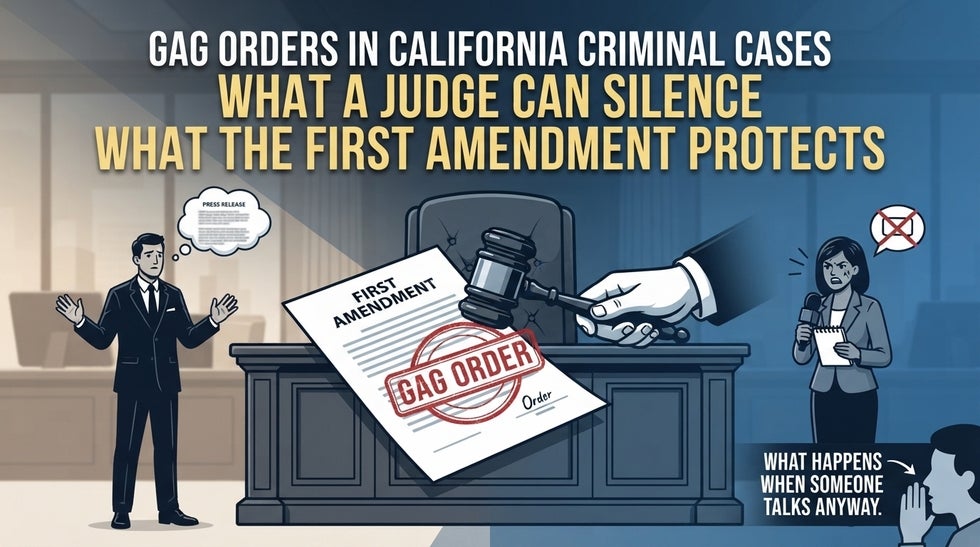
A gag order is a court order restricting what the participants in a case, the attorneys, the defendant, the prosecution, witnesses, and sometimes police, may say about it outside the courtroom. Judges issue them to protect the defendant's Sixth Amendment right to a fair trial by jurors who have not been poisoned by pretrial publicity. A gag order does not and cannot stop the press from reporting; the Supreme Court held in 1976 that a prior restraint on publication is almost never constitutional. It restricts the sources. Violating one is contempt of court under Penal Code 166, a misdemeanor punishable by up to six months in jail, and for a defendant on bail it can mean revocation of release. A gag order is different from a criminal protective order, which restricts contact with a victim or witness rather than speech about the case, and a defendant may be subject to both.
The Bulldog Law's attorneys deal with gag orders from both directions. In cases that attract press, we sometimes ask for one, because a prosecutor's press conference or a detective's quotes to a reporter can make an impartial jury impossible to seat. In other cases we oppose one, because a client who has been publicly accused has a legitimate interest in answering, and because gag orders are frequently drafted more broadly than the Constitution allows. And in every case with a gag order, we explain to the client what it actually forbids, which is usually less than they fear and more than they expect once social media is included. What follows is where gag orders come from, who they can bind, what they cannot do, and how they are enforced. Call (888) 928-1609 or message our team if your case has drawn attention.
Where gag orders come from
The modern gag order traces to Sheppard v. Maxwell, the 1966 Supreme Court decision reversing a murder conviction because of a trial conducted in what the Court called a carnival atmosphere of press coverage. The Court told trial judges that they had both the power and the duty to control publicity by restricting the statements of lawyers, parties, witnesses, and court officials. Ten years later, in Nebraska Press Association v. Stuart, the Court drew the other line: a judge may not forbid the press from publishing information about a case, even to protect a fair trial, except in circumstances so extreme that no court has yet found them. Those two cases define the tool. A judge may gag the participants; a judge may not gag the press.
California applies the same framework through its courts' inherent power to control proceedings and through the rules governing lawyers. A gag order on participants is reviewed as a restriction on speech, and California appellate courts require that the order be supported by findings that there is a substantial probability of prejudice to a fair trial, that the order is narrowly tailored, and that no less restrictive alternative, change of venue, continuance, careful jury selection, jury instructions, sequestration, would protect the trial. Orders that fail those requirements are overturned on writ, and our attorneys have challenged orders that were entered without findings or that reached speech with no connection to the trial.
Who can be bound, and what the order typically says
Attorneys are the usual first target, and for them the gag order overlays a rule that already exists. Rule of Professional Conduct 3.6, upheld in the Supreme Court's Gentile decision, forbids a lawyer in a case from making public statements the lawyer knows or should know will have a substantial likelihood of materially prejudicing the proceeding, with exceptions for stating the claim or defense, information in the public record, scheduling, and a response needed to counter prejudicial publicity started by someone else. A gag order narrows those exceptions and makes a violation contempt as well as a Bar matter.
The parties. A defendant can be ordered not to make public statements about the case, including on social media, and the prosecution's office can be bound the same way. Witnesses can be ordered not to discuss their anticipated testimony publicly, which matters in cases where a witness has been giving interviews. Law enforcement officers and agencies involved in the investigation are frequently included, since police statements about evidence are among the most prejudicial. Jurors are instructed, not gagged, during trial, and are free to speak afterward unless a separate order addresses juror contact, which our page on hung juries touches on.
What the order typically forbids: statements to the press about the evidence, the defendant's character or record, the credibility of witnesses, the possibility of a plea, and opinions about guilt. What it typically allows: statements of what is in the public record, the general nature of the charge and the defense, scheduling, and a request for the public's help in locating evidence or witnesses. Social media counts as public statement in every order written in the last decade, and a client's post, a family member's post that the client shared, and a public comment on a news story have each been treated as violations. Private communications are usually outside the order, but our attorneys' advice in any pending case is the same whether or not an order exists: the facts are discussed with counsel, and jail calls are recorded.
Gag orders versus protective orders
The two are confused constantly, including in press coverage, and they do different things. A criminal protective order under Penal Code 136.2 is issued to protect a victim or witness from harm, dissuasion, or intimidation: it forbids contact, directly or through others, and it can require the defendant to stay away from a residence or workplace. Its purpose is the person, not the trial, and violating it is a separate crime under Penal Code 273.6 and, where the contact was meant to influence testimony, witness intimidation under Penal Code 136.1. A gag order protects the proceeding and forbids public speech about it. A defendant in a domestic violence case with press interest can be subject to both, and the consequences of violating each are different: contempt for the gag order, a new charge for the protective order. Civil and family court restraining orders are a third category, with their own statutes.
A related set of orders restricts speech without being gag orders at all. Sealing orders keep documents out of the public file. Orders under Penal Code 1054.2 forbid defense counsel from disclosing a victim's address and phone number to the defendant. Juvenile proceedings are confidential by statute, as our attorneys explain on our juvenile justice page, and the revenge porn and illegal recording statutes restrict what can be published about specific content. None of those is a gag order, and none requires the fair-trial findings a gag order does.
Enforcement
A gag order is enforced through contempt. Penal Code 166 makes willful disobedience of any lawful court order a misdemeanor punishable by up to six months in county jail and a $1,000 fine; our attorneys cover the statute on our contempt of court page. A judge may also proceed summarily for contempt committed in the court's presence, or through an order to show cause for conduct outside it, with a hearing at which the alleged violator may be heard. The practical sanctions in criminal cases: a warning, a fine, a short jail term, an expanded order, and, for a defendant released on bail or OR, a motion by the prosecution to revoke release on the ground that the defendant has violated a court order. For lawyers, a referral to the State Bar. For a witness, the possibility that the testimony is affected.
Enforcement is uneven. Orders are violated by lawyers in hallway interviews, by family members on social media, and by police spokespeople, and judges respond to some and ignore others. A violation during jury selection or trial, when the risk of tainting the jury is immediate, is treated most seriously. A violation by the prosecution's side, a leak, a press conference, an officer's quote, is the defense's opportunity: it supports a motion to dismiss for prosecutorial misconduct, a change of venue, a continuance, additional voir dire about exposure, and, where the prejudice is severe enough, a mistrial. Our attorneys document every public statement by the other side in a gag-ordered case for exactly that use.
When the defense asks for one, and when it fights one
The defense asks for a gag order when the prosecution or police are shaping the jury pool: a press conference announcing the arrest with details of the evidence, a leaked confession, an officer's statement about the defendant's record. The motion is made early, before the preliminary hearing if the publicity is already running, with the news coverage attached as exhibits and findings proposed. The request is specific: the people to be bound, the categories of statement, the exceptions, and the duration, usually through the verdict.
The defense fights a gag order when it is used to silence a client who has been publicly accused and has something to say, when it is written to cover statements that could not prejudice a trial, or when it is entered without the findings the law requires. A defendant's own speech about their case is protected speech, and an order that forbids a client from declaring innocence, or from responding to a prosecutor's public characterization, is challenged. Our attorneys have also seen gag orders used to prevent a defendant from identifying the weaknesses in the prosecution's case publicly after the prosecution had done the reverse, and the asymmetry is the argument. Where a client has been defamed in coverage, the civil remedy exists alongside the criminal case, and our defamation page covers it; a gag order does not bar a defamation action, and the two proceed on separate tracks.
Frequently asked questions
What is a gag order?
A court order restricting what the people involved in a case may say about it outside the courtroom. In a criminal case it typically binds the lawyers, the parties, witnesses, and sometimes law enforcement, and it is issued to protect the defendant's right to a fair trial by an untainted jury. It is not a ban on reporting; the press may publish what it learns, and the order reaches only the participants the judge names.
Who can a gag order apply to?
Attorneys, the defendant, the prosecution, witnesses, jurors, court staff, and law enforcement officers involved in the case. It cannot apply to the press or the public in the sense of forbidding them from reporting, because a prior restraint on publication is almost never permitted under the First Amendment. The order restricts the sources, not the reporters.
What happens if you violate a gag order?
Contempt of court. Under Penal Code 166, willful disobedience of a lawful court order is a misdemeanor punishable by up to six months in jail and a $1,000 fine, and the judge can also impose sanctions directly: a fine, a brief jail term, or, for a defendant out on bail, revocation of release. For attorneys, a violation is also a State Bar matter under the rule on trial publicity. Orders are enforced inconsistently, but a violation during jury selection or trial is treated seriously.
Is a gag order the same as a protective order?
No. A gag order restricts speech about the case to protect the trial. A criminal protective order under Penal Code 136.2 restricts contact with a victim or witness to protect that person, and a restraining order does the same in civil or family court. A defendant can be subject to both: barred from contacting the complaining witness, and barred from discussing the case publicly. Violating a protective order is a separate crime under Penal Code 273.6, not just contempt.
Can I talk to my family about my case if there is a gag order?
Usually, within limits. Most gag orders restrict statements to the press and public statements, including social media, and do not reach private conversations with family. Read the order; some are broader. Two practical cautions regardless of the order: anything you say to anyone other than your lawyer can be subpoenaed, and jail calls are recorded. The safe rule is to discuss the facts of the case with your attorney and no one else, gag order or not.
Related reading from our attorneys
- Criminal protective orders under Penal Code 136.2
- Contempt of court under Penal Code 166
- Hung juries and mistrials
A case in the news? What is said outside the courtroom shapes what happens inside it
The Bulldog Law's defense attorneys seek, oppose, and enforce gag orders in cases that draw attention across California, and handle the press, the social media, and the fair-trial motions that go with them. Visit our criminal defense page, call (888) 928-1609, or reach us online.