
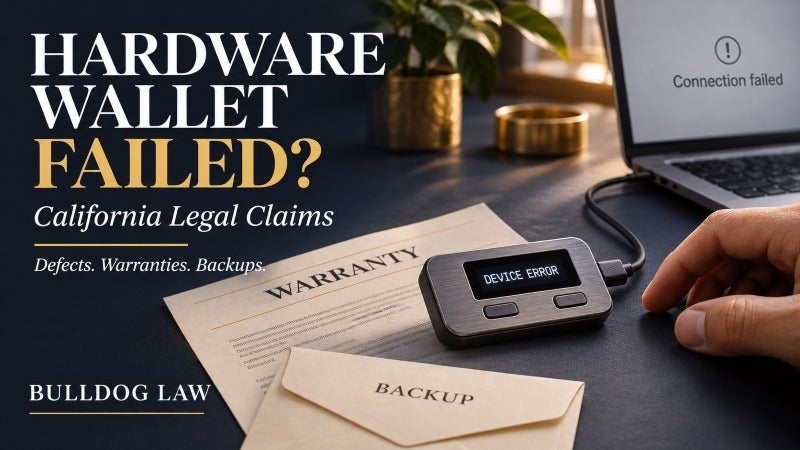
Your hardware wallet stops working after an update, its screen fails, or it no longer signs transactions. Before assuming the manufacturer owes you the value of your cryptocurrency, separate the broken device from the assets it helps you access. Hardware wallet failure legal claims in California depend on the defect, applicable warranties, available backups, and evidence connecting the failure to a recoverable loss.
Quick answer
A defective hardware wallet may support warranty or contractual claims, but device failure does not automatically establish lost cryptocurrency or manufacturer liability. A usable backup may restore access through a compatible wallet. California law also limits certain product-liability claims involving purely financial losses. Preserve the device, purchase records, firmware details, and support communications before attempting repairs or accepting a replacement that could affect the evidence.
First determine what actually failed
A hardware wallet generally manages cryptographic keys and signs transactions; the cryptocurrency itself is recorded on its blockchain. Understanding how private keys provide access to digital assets helps distinguish an unusable device from permanently inaccessible funds.
Possible problems include defective components, a failed display, firmware errors, or incompatibility with the companion application. An incorrect account selection or missing passphrase can also resemble device failure without establishing a product defect.
Document the symptoms and when they started. A failure immediately following an update is relevant, but timing alone does not prove causation. Avoid repeated resets or unofficial repairs before obtaining appropriate guidance.
How backups affect hardware wallet failure legal claims in California
A valid recovery backup may allow access through a compatible replacement. Depending on the setup, recovery may also require a passphrase, sufficient backup shares, or other configuration information. These details are central to protecting access to cryptocurrency.
Consider two owners with identical failed devices. One restores access promptly and incurs replacement expenses. The other has no usable backup and alleges permanent loss. Their potential damages and causation questions are substantially different.
Missing a backup does not automatically defeat every claim. Relevant questions include whether instructions were adequate, whether backup creation worked as represented, and whether the alleged defect affected recovery. Conversely, reasonably available recovery options may limit damages that could have been avoided.
Warranty claims: what was promised?
California Commercial Code section 2313 addresses express warranties created by factual promises, descriptions, or models forming part of the bargain. Save statements about supported assets, backup compatibility, firmware behavior, and replacement coverage. General praise is different from a specific performance promise.
Statements made when selling the device can matter alongside the written warranty. Concerns about inaccurate assurances may overlap with marketing representations by cryptocurrency companies, although a separate misrepresentation claim requires its own supporting facts.
Commercial Code section 2314 addresses merchantability in qualifying sales by merchants. For covered consumer goods sold at retail in California, Civil Code sections 1792 and 1791.1 provide additional implied-warranty protections. Coverage depends on the transaction, product, and use; a business purchase should not automatically be treated as a personal consumer purchase.
Product defects and the economic-loss limitation
A potential defective-product claim may involve manufacturing, design, or warning issues. However, strict product liability does not automatically cover every financial consequence of a malfunction.
California's economic-loss rule generally distinguishes physical injury or damage to other property from damage to the product itself and disappointed commercial expectations. Warranty and contract remedies often become especially important when only the device and financial losses are involved.
Whether inaccessible or lost digital assets support a particular tort theory requires careful analysis. It should not be assumed that cryptocurrency qualifies as recoverable “other property” damage merely because it is separate from the hardware.
Firmware problems also require identifying the responsible entity and relevant obligations. A manufacturer, retailer, or separate software provider may have different roles and defenses.
Can the warranty limit recovery to a replacement?
Some agreements restrict remedies to repair, replacement, or refund and exclude consequential damages. Commercial Code section 2719 addresses these limitations, including circumstances where an exclusive remedy fails of its essential purpose. That does not automatically invalidate every separate damages exclusion.
A lawyer may also evaluate unconscionable contract provisions under Civil Code section 1670.5. The applicable warranty statute, wording, and circumstances matter. A limitation should neither be accepted nor dismissed without review.
Proving the failure caused the claimed loss
A claim needs more than a broken device and a screenshot showing a large balance. Technical evidence should connect the alleged defect to the inability to access or transact with the assets.
Blockchain records used in litigation can help establish holdings and transfers, but they may not explain why signing failed. Device diagnostics, firmware versions, error messages, and qualified technical analysis may supply that missing information.
Separate device costs, reasonable recovery expenses, alleged permanent losses, and missed trading opportunities. Commercial Code section 2715 addresses consequential losses, including foreseeability and reasonable prevention. A claim that you would have sold at the market's highest price needs evidence, not hindsight.
Preserve evidence and notify the seller
Before shipping the wallet for replacement, discuss evidence preservation and security with appropriate advisers. Do not erase the only available diagnostic evidence or disclose recovery secrets in a support ticket.
- Keep receipts, model details, serial numbers, and seller information.
- Save the warranty, product descriptions, and instructions supplied.
- Record firmware and application versions, error messages, and dates.
- Preserve support tickets, repair instructions, and return paperwork.
- Document backup availability without exposing the recovery words.
Prompt written notice matters. Commercial Code section 2607 can require buyers to notify sellers of a breach within a reasonable time. These records also support preparation for cryptocurrency litigation.
Where a claim may proceed
Review the seller's identity, warranty process, governing-law clause, and dispute provisions. An overseas manufacturer can introduce jurisdictional questions. Do not assume every dispute belongs in a California court.
If compensation is offered, examine any release before accepting it. A settlement involving cryptocurrency should identify the assets, valuation, and claims resolved. Separately, review any applicable policy before assuming insurance covers the digital-asset loss.
Frequently asked questions
Is the wallet manufacturer holding my cryptocurrency?
Not necessarily. A self-custody device differs from a custodial service. Identify the arrangement before applying principles from exchange and wallet-provider custody disputes.
Should I give a recovery company my seed phrase?
Do not disclose it merely because someone promises recovery. Wallet recovery scams present a separate risk. Technical assistance should be vetted without casually surrendering control of the assets.
Does a successful recovery eliminate every claim?
No. A covered defect may still support repair, replacement, or other appropriate remedies. However, restored access changes any assertion that the entire cryptocurrency balance was permanently lost.
Hardware wallet failure lawyers in California
Bulldog Law helps evaluate warranty obligations, technical evidence, and claimed digital-asset losses. A focused review can identify potentially responsible parties and distinguish supportable damages from losses the evidence does not establish.