
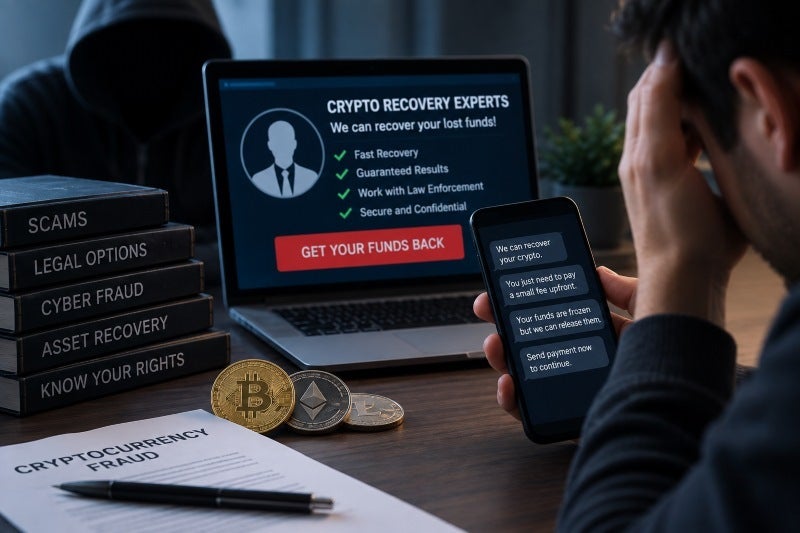
Crypto Wallet Recovery Scams often target people who are already dealing with the shock of stolen Bitcoin, Ethereum, stablecoins, NFTs, exchange account losses, or failed wallet transfers. A person may lose money once to a phishing site, pig butchering scam, fake investment platform, compromised wallet, or fraudulent trading app, then lose more money to someone claiming they can “recover” the assets for an upfront fee. In many cases, the second contact is not real recovery work. It may be another layer of fraud.
The most important first step is to stop sending money until the person or company has been carefully verified. Legitimate recovery is usually difficult, evidence-driven, and time-sensitive. No private “recovery expert” can guarantee that stolen crypto will be returned, force a blockchain transaction to reverse, or issue a government seizure order. Legal options may exist, but they depend on the facts, the payment trail, the identities involved, the exchanges used, the contracts signed, and how quickly evidence is preserved.
How Crypto Wallet Recovery Scams usually work
Crypto Wallet Recovery Scams often begin shortly after the original loss. Scammers may find victims through social media posts, complaint forums, Telegram groups, Discord channels, blockchain explorer comments, fake law firm pages, paid ads, or direct messages. They may claim to be blockchain investigators, hackers, law enforcement contacts, exchange insiders, attorneys, wallet engineers, or “asset recovery specialists.”
Common promises include:
- “We traced your funds and can recover them today.”
- “We work directly with the FBI, SEC, CFTC, or exchange compliance teams.”
- “Pay a release fee, gas fee, court fee, wallet synchronization fee, or tax clearance fee.”
- “Your funds are frozen in a wallet and only need one more payment to unlock.”
- “Do not contact police or a lawyer because it will slow the process.”
- “Install this remote access tool so we can reconnect your wallet.”
Victims of the first scam may be more vulnerable because they are under pressure, embarrassed, and desperate to act quickly. That urgency is exactly what recovery scammers exploit. A person evaluating legal options after stolen cryptocurrency should separate real evidence preservation from false promises of guaranteed recovery.
Crypto Wallet Recovery Scams and red flags
Crypto Wallet Recovery Scams are often recognizable once the payment demand is examined. A legitimate professional may charge for legal work, forensic analysis, expert review, or litigation support, but a scammer often demands repeated payments tied to fake milestones. The labels may change, but the pattern is usually the same: the victim must pay more before seeing any verifiable result.
Warning signs may include:
- Guaranteed recovery or a promise of a specific success rate.
- Claims of secret access to exchanges, law enforcement, or government agencies.
- Pressure to pay only in cryptocurrency, gift cards, wire transfers, or payment apps.
- Refusal to identify the business, licensed professionals, physical address, or written terms.
- Fake screenshots showing recovered funds in a “pending” wallet.
- Requests for seed phrases, private keys, passwords, two-factor codes, or remote access.
- Claims that a victim must pay taxes, customs fees, or blockchain gas fees before funds can be released.
- Instructions not to report the matter to law enforcement, banks, exchanges, or counsel.
Recovery scammers often recycle tactics from other crypto fraud schemes. Victims who were first approached through romance, investment, or social engineering schemes may also need to evaluate pig butchering crypto scam recovery issues, especially if the same group or a related group later contacts them as a supposed recovery service.
Can stolen crypto really be recovered?
Sometimes recovery is possible, but it is rarely simple. Blockchain transactions can often be traced, but tracing is not the same as recovery. A transaction may show where funds moved, whether an exchange address was used, whether assets were bridged across chains, whether mixers or privacy tools were involved, and whether funds remain in a wallet. Turning that information into actual recovery may require exchange cooperation, emergency legal action, subpoenas, restraining orders, freezing requests, insurance claims, criminal reporting, or civil litigation.
Recovery may be more realistic when funds are still on a centralized exchange, the victim has transaction hashes and wallet addresses, the scammer used identifiable accounts, the exchange responds to lawful process, or a court can issue appropriate relief. Recovery becomes harder when assets are converted, mixed, bridged, cashed out overseas, moved through privacy protocols, or controlled by unknown actors in jurisdictions that are difficult to reach.
Victims should also distinguish between a wrong-address mistake and a scam. If crypto was accidentally sent to the wrong wallet, legal options after sending crypto to the wrong wallet may depend on whether the recipient can be identified and whether the transfer involved an exchange, custodian, contract, or known counterparty.
Legal claims that may apply to recovery scammers
When a recovery company takes money through false promises, several civil or criminal theories may be relevant. The correct approach depends on the evidence and who can be identified. Potential civil claims may include fraud, negligent misrepresentation, breach of contract, conversion, unjust enrichment, unfair business practices, false advertising, or claims tied to unauthorized access, impersonation, or identity theft.
In California, theft by false pretenses may be considered when someone obtains money or property by knowingly making a false statement or promise that causes the victim to part with property. Grand theft issues may arise depending on the value involved. Separate computer crime theories may also matter if the scammer used malware, remote access, password theft, or unauthorized wallet access. Victims facing account compromise or device intrusion may benefit from understanding California computer crime issues involving Penal Code 502.
Federal law may also become relevant when communications, wires, interstate transfers, fake websites, or financial institutions are involved. Many crypto recovery scams rely on email, messaging apps, websites, phone calls, payment processors, or exchanges across state or national borders. In those situations, crypto wire fraud investigations may overlap with civil recovery efforts and victim reporting.
Reporting Crypto Wallet Recovery Scams to agencies
Crypto Wallet Recovery Scams should often be reported promptly because timing can affect whether exchanges, investigators, or law enforcement can identify accounts before funds move again. Reports may be submitted to the FBI Internet Crime Complaint Center, commonly known as IC3, and to the Federal Trade Commission. Depending on the facts, a victim may also consider contacting local law enforcement, the California Department of Financial Protection and Innovation, the relevant exchange, the bank or payment provider used to pay the recovery scammer, and any platform where the scammer advertised.
Agency reporting does not guarantee recovery. However, it can create a record, support investigations, help identify repeat offenders, and provide information that may later assist subpoenas, exchange requests, insurance claims, civil lawsuits, or criminal restitution. Government agencies are neutral public institutions and are not affiliated with Bulldog Law.
Victims should be cautious about anyone who claims they have a special private channel to a government agency or that payment is required to activate a law enforcement recovery process. A real report should not require sending cryptocurrency to a private wallet controlled by a supposed recovery agent.
Exchange freezes, subpoenas, and wallet tracing
If stolen funds reached a centralized exchange, quick action may matter. Some exchanges have fraud-reporting channels and may preserve account information or freeze assets when presented with credible evidence or lawful process. The available response varies by exchange, jurisdiction, account status, and whether the funds are still present.
Wallet tracing can help identify transaction paths, but tracing reports should be used carefully. A colorful chart is not enough by itself. Useful analysis should include transaction hashes, wallet addresses, timestamps, token types, network names, exchange indicators, bridge transactions, swaps, mixers, and confidence levels. A victim should preserve the original evidence rather than relying only on a recovery company's summary.
When an exchange freezes an account or refuses to release assets during a fraud review, crypto custody disputes involving exchanges and wallet providers may become important. If the platform suddenly restricts withdrawals or locks access after a fraud report, crypto exchange account freeze disputes may also affect the next steps.
Cross-border problems in recovery scam cases
Many recovery scam operations are international. The website may list a California, New York, London, Dubai, or Singapore address, while the operators use fake names, virtual offices, VPNs, offshore payment accounts, and disposable wallets. Even when the victim lives in California, the scammer may operate from outside the United States.
Cross-border issues can affect service of process, subpoena reach, enforcement of judgments, exchange compliance, choice of law, and whether U.S. agencies have enough information to act. A victim should not assume that a professional-looking website means the company is registered, licensed, insured, or physically present where it claims to be located.
When funds or defendants cross borders, cross-border crypto dispute challenges may shape whether a civil case, exchange request, or law enforcement report is practical.
Evidence to preserve after a recovery scam
Evidence is critical. Recovery scammers often delete accounts, change websites, rotate wallet addresses, and remove chat histories after receiving payment. Victims should preserve records before confronting the scammer again.
- Original scam records, including wallet addresses, transaction hashes, screenshots, and platform names.
- All communications with the recovery company, including emails, texts, chats, social media messages, and voice notes.
- Invoices, engagement letters, receipts, payment instructions, wallet addresses, bank records, and crypto transaction confirmations.
- Website screenshots, domain names, advertisements, fake credentials, testimonials, and claimed office addresses.
- Names, aliases, phone numbers, email addresses, social media handles, Telegram usernames, and Discord IDs.
- Remote access logs, device warnings, seed phrase requests, malware alerts, and password reset notices.
- Reports submitted to exchanges, banks, IC3, the FTC, local police, or other agencies.
Preserving original blockchain and communication evidence can make a major difference in later disputes. Blockchain records used as crypto evidence in court may help connect payments, wallets, accounts, and representations when the record is collected and explained properly.
What victims should avoid after being targeted again
After a second loss, it is common to want to recover everything immediately. That reaction is understandable, but it can create new risk. Victims should avoid sending additional crypto, sharing seed phrases, installing remote access software, deleting chats out of embarrassment, threatening the scammer in a way that alerts them to destroy evidence, or relying on another unverified recovery provider.
Victims should also be cautious about chargeback promises. A bank, credit card company, or payment app may have deadlines and documentation requirements. Crypto payments usually cannot be reversed in the same way as a traditional card transaction. A person who paid the scammer through a bank account, credit card, wire, or payment app should preserve records and contact the provider promptly.
If the scammer's conduct involved threats, blackmail, impersonation, wallet draining, malware, or instructions to move funds through suspicious accounts, the matter may also raise money laundering or cybercrime issues. crypto money laundering red flags can become relevant when funds move through layered wallets, exchange accounts, or nominees.
When businesses, influencers, or insiders may be involved
Some recovery scams are not isolated one-person schemes. They may involve lead generators, call centers, fake law firms, affiliate marketers, crypto influencers, paid testimonial networks, or former insiders from the original scam. In some cases, the “recovery” contact appears shortly after the first fraud because victim data was sold or shared.
If a business promoted the recovery company, hosted its ads, processed payments, provided false testimonials, or helped conceal the scheme, additional claims may need to be evaluated. If an employee, contractor, or consultant reports internal fraud, crypto whistleblower claims involving fraud reporting may overlap with victim recovery efforts.
Victims should preserve any information showing how the recovery company found them. That may include screenshots of ads, referral messages, forum posts, influencer promotions, emails from the first scammer, or suspicious contacts claiming to know exact details of the original loss.
Practical legal options after a recovery scam
Legal options depend on the amount lost, the available evidence, and whether any defendant or exchange account can be identified. A lawyer may help evaluate whether to send preservation letters, prepare agency reports, contact exchanges, request records, pursue civil claims, coordinate with forensic analysts, or seek emergency relief where appropriate.
Possible steps may include:
- Stop all payments to the recovery company and do not provide seed phrases or private keys.
- Secure devices, email accounts, exchange accounts, cloud storage, and password managers.
- Preserve all communications and payment records.
- Record wallet addresses, transaction hashes, networks, and timestamps.
- Report the incident to IC3, the FTC, exchanges, banks, and payment providers when appropriate.
- Evaluate whether subpoenas, civil claims, or emergency court relief are realistic.
- Review whether any insurance, business policy, homeowners policy, cyber policy, or crime policy may apply.
Victims should be especially careful about paying for vague “forensic packages” that produce little more than public blockchain screenshots. A serious evaluation should connect the technical record to a legal strategy. digital asset legal defense and dispute strategies may help determine whether the next move should be reporting, exchange escalation, civil litigation, or preservation of evidence for a broader investigation.
How to vet a recovery professional before paying
Before hiring anyone who claims to recover crypto, victims should ask direct questions and verify the answers independently. A legitimate professional should be able to explain what they can and cannot do, what fees cover, what information is needed, and why recovery may or may not be realistic.
- Is the person a licensed attorney, licensed investigator, forensic analyst, or something else?
- What exact services are being provided?
- Is recovery guaranteed, or is the work limited to tracing, reporting, legal process, or consultation?
- Will they ask for seed phrases, private keys, passwords, or remote access?
- What written agreement governs fees, scope, confidentiality, and limitations?
- Can their business registration, license, address, and professional history be verified?
- Do they claim special government access or demand crypto payments to release funds?
Crypto recovery work should be approached with caution. common cryptocurrency scam warning signs can help victims recognize when a supposed solution is simply another attempt to extract money.
Crypto Wallet Recovery Scams lawyers in California
Crypto Wallet Recovery Scams can leave victims facing two losses: the original stolen digital assets and the additional money paid to fake recovery experts. The legal path forward may involve urgent evidence preservation, exchange communications, blockchain tracing, agency reports, civil claims, subpoenas, fraud analysis, and careful review of whether the recovery company, promoter, payment processor, or related party can be identified.
Bulldog Law helps California clients evaluate crypto wallet recovery scams, stolen digital asset claims, fake recovery company disputes, exchange freeze issues, cross-border wallet tracing problems, and evidence preservation after cryptocurrency fraud. Early legal review may help prevent additional losses, preserve records, and identify practical options before scammers move funds or delete communications.
For cases involving crypto ATMs, kiosk deposits, or recovery scammers who instructed a victim to buy and send digital assets through a machine, cryptocurrency ATM fraud legal issues may also be important.