
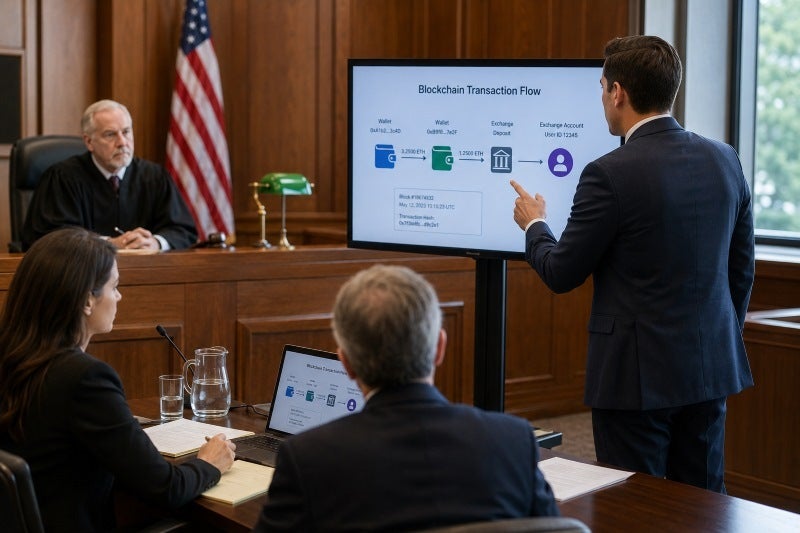
Crypto Evidence in Court can be powerful, but it is rarely as simple as pointing to a blockchain transaction and saying the case is proven. In California civil and criminal cases, blockchain records may help show transfers, timing, wallet activity, token balances, payments, and asset movement. The harder questions are usually admissibility, authentication, wallet attribution, expert testimony, and the limits of chain-analysis tools.
For businesses, investors, spouses, criminal defendants, victims, founders, and digital asset platforms, the key issue is not only what appears on-chain. Courts often need evidence connecting a wallet, transaction, exchange account, device, message, or person to the claim being made. That connection may decide whether crypto evidence helps the case or creates a dispute over speculation, reliability, or missing context.
Why Crypto Evidence in Court matters
Crypto Evidence in Court matters because digital asset cases often turn on records that are technical, fragmented, and easy to misunderstand. A transaction hash can show that assets moved from one address to another, but it may not show who controlled the wallet, why the transfer occurred, whether the assets were held for someone else, or whether the transaction was authorized.
Blockchain records may appear in cases involving:
- Business disputes over project treasuries, founder wallets, or investor funds.
- Divorce, support, and property division involving undisclosed digital assets.
- Criminal cases involving alleged theft, fraud, laundering, sanctions violations, or illegal marketplace activity.
- Employment or contractor disputes involving token compensation.
- Tax disputes involving reported income, gains, losses, or exchange records.
- DAO governance disputes, multisig deadlock, and treasury misuse.
- NFT, stablecoin, lending, custody, and marketplace conflicts.
In many civil cases, the dispute is about who owns or controlled the assets. digital assets in divorce and property division can require wallet tracing, valuation evidence, exchange records, and proof of whether assets were acquired before or during the marriage.
Authentication and admissibility of Crypto Evidence in Court
Authentication is the threshold issue. In California state court, a writing generally must be authenticated before it is received in evidence. Federal courts use a similar practical concept: the party offering the evidence must provide enough support for a finding that the evidence is what the party claims it is. Blockchain records, screenshots, transaction exports, wallet analytics, and exchange statements may all require a foundation.
Authentication can come from different sources depending on the case. A witness with knowledge may explain how a screenshot was captured, how a wallet was accessed, or how an exchange report was generated. A custodian of records may support business records from an exchange or financial platform. An expert may explain blockchain mechanics, wallet clustering, token transfers, smart contract interactions, or chain-analysis methodology.
Admissibility can also involve relevance, hearsay, prejudice, privilege, search and seizure issues, discovery rules, and expert reliability. A blockchain record may be relevant but still disputed if the proponent cannot explain what it means or cannot connect it to a party. A report may look precise but still be challenged if it relies on assumptions that are not disclosed.
When crypto is allegedly hidden, the authentication problem often overlaps with discovery. hidden cryptocurrency discovery strategies may involve subpoenas, exchange records, wallet analysis, device data, and communications showing control or beneficial ownership.
Wallet attribution and proving control
Wallet attribution is often the central fight. A blockchain address is not a legal identity. A party may argue that a wallet belongs to a spouse, founder, employee, investor, defendant, contractor, or company, but the court usually needs supporting facts.
Evidence that may support wallet attribution includes:
- Exchange know-your-customer records tied to the wallet.
- Deposits from or withdrawals to a known account.
- Device forensic evidence, seed phrase records, wallet apps, or browser extensions.
- Admissions in texts, emails, Discord, Telegram, Slack, or recorded statements.
- Consistent use of the wallet for payroll, invoices, treasury transactions, or personal purchases.
- IP logs, access records, two-factor authentication records, or recovery information.
- Timing evidence linking transfers to known events, meetings, trades, or disputes.
Attribution is usually strongest when several independent facts point in the same direction. It is weaker when a party relies only on a label from a blockchain explorer, a public wallet tag, a social media post, or a clustering assumption that has not been tested against the facts of the case.
Wallet attribution also matters when a person claims a payment was compensation rather than an investment, loan, gift, or reimbursement. getting paid in cryptocurrency can raise contract, tax, and classification issues if the parties did not document the value, timing, wallet address, and purpose of the transfer.
Expert testimony and chain-analysis limits
Expert testimony can help judges and juries understand blockchain evidence, but experts are not a substitute for proof. In California, a qualified expert generally needs special knowledge, skill, experience, training, or education, and the opinion must assist the trier of fact on a subject beyond common experience. Federal cases also examine whether expert testimony is reliable and helpful.
Chain-analysis experts may explain transaction flows, address clusters, exchange deposits, mixers, bridges, DeFi protocols, NFT transfers, stablecoin movements, and common laundering typologies. They may also prepare visuals showing how assets moved through wallets over time. Those visuals can be useful, but they can also oversimplify uncertainty.
Important limits include:
- A wallet cluster may suggest common control, but it may not prove who controlled the wallet.
- A deposit to an exchange may show where funds went, but not necessarily who later withdrew them.
- A mixer, bridge, or privacy tool may complicate tracing without proving criminal intent.
- Public wallet labels can be wrong, outdated, or incomplete.
- Smart contract activity can be misread if the analyst does not understand the protocol.
- Market value calculations may differ depending on the exchange, time zone, liquidity, and token used.
These limits can matter in treasury disputes, especially when the alleged misconduct involves governance votes, signer authority, or community funds. DAO legal disputes over votes and treasury control often require both on-chain tracing and off-chain evidence showing authority, intent, and approval.
Crypto evidence in criminal cases
In criminal cases, crypto evidence may be used by prosecutors to show alleged theft, fraud, money laundering, sanctions violations, illegal payments, or proceeds of crime. Defense counsel may challenge the evidence by questioning wallet attribution, expert assumptions, search procedures, chain of custody, missing records, or whether the evidence proves the required mental state.
Criminal crypto cases may involve search warrants for devices, subpoenas to exchanges, blockchain analytics, law enforcement reports, informant communications, marketplace records, or statements by alleged participants. A defendant may have arguments about unlawful searches, overbroad warrants, unreliable expert testimony, hearsay, confrontation rights, or evidence that is more prejudicial than probative.
Sanctions allegations require special care because a wallet address, country connection, or platform interaction may not tell the whole story. OFAC risks involving wallets, exchanges, and DeFi can affect how parties evaluate blocked addresses, cross-border transfers, and compliance records.
Crypto evidence in civil business disputes
Civil crypto disputes often involve ownership, control, valuation, authority, and damages. A business partner may allege that another founder diverted assets. A project may claim that a signer refused to approve a necessary transaction. An investor may allege that treasury funds were misused. A contractor may claim that promised tokens were never delivered.
In these disputes, blockchain evidence may need to be paired with contracts, entity documents, board approvals, investor updates, governance proposals, invoices, payroll records, and messages. The transaction itself may show movement, but the documents may show whether the movement was authorized.
Signer deadlock can create especially urgent evidence issues. multisig wallet disputes involving refused approvals may require proof of signer authority, pending transactions, treasury risk, and the reason a signer refused to act.
For crypto startups, compliance records can become evidence too. KYC and AML requirements for crypto startups may affect whether a company can identify users, counterparties, payment recipients, and high-risk transactions during a dispute.
Valuation, tax records, and damages evidence
Crypto cases often require valuation evidence. The parties may disagree over the date, time, exchange, liquidity, token pair, and method used to calculate value. A transfer worth one amount at the time of transaction may be worth far more or far less by the time of litigation.
Valuation disputes commonly arise in tax, divorce, compensation, lending, and fraud cases. A party may need historical price records, exchange exports, tax forms, wallet statements, accounting workpapers, and expert analysis. If the tax records do not match exchange or third-party reporting, IRS crypto mismatch notice issues can become part of the evidence record.
Damages evidence may also require proof of causation. In a stablecoin loss case, the question may be whether the loss came from a depeg, misrepresentation, exchange restriction, treasury decision, or market movement. stablecoin depeg loss claims often turn on timing, reliance, disclosures, and what the parties could reasonably do when the asset lost its peg.
In lending disputes, valuation timing can decide whether a liquidation was proper or disputed. crypto loan liquidation evidence may include collateral records, margin notices, liquidation timestamps, platform terms, and communications with the lender.
NFTs, payroll, and marketplace evidence
NFT cases can involve ownership, authenticity, royalties, marketplace access, licensing, and damages. Evidence may include minting records, metadata, marketplace listings, royalty settings, platform notices, wallet history, and communications with collectors or creators. If an account is suspended, the timing and reason for the suspension may be central to the dispute. NFT marketplace suspension records can affect claims involving creators, collectors, royalties, and project revenue.
Payroll and employment evidence may also matter. A company that paid workers in tokens or stablecoins should preserve payroll registers, wage statements, valuation records, worker agreements, tax forms, and wallet confirmations. California crypto payroll compliance records can become important if a worker later disputes wages, classification, taxes, or the value of digital compensation.
Where crypto evidence cases are handled in California
Crypto evidence may appear in California Superior Court, federal district court, arbitration, administrative proceedings, or criminal proceedings. State civil and criminal cases are often handled in the Superior Court for the county connected to the parties, conduct, property, or alleged offense. For example, Los Angeles County criminal matters may be heard at the Clara Shortridge Foltz Criminal Justice Center, 210 West Temple Street, Los Angeles, California 90012, depending on the charge and case assignment.
Federal cases may be handled in the United States District Court for the Central, Northern, Eastern, or Southern District of California. In Los Angeles federal matters, proceedings may occur at the Felicitas and Gonzalo Mendez United States Courthouse, 350 West 1st Street, Los Angeles, California 90012, depending on venue and assignment. These courts are neutral public institutions and are not affiliated with Bulldog Law.
In court, crypto evidence may be addressed through pleadings, discovery, subpoenas, preservation letters, motions to compel, motions in limine, expert disclosures, evidentiary hearings, trial testimony, or sentencing proceedings. In criminal cases, suppression motions and discovery disputes may also address how wallet evidence, device evidence, or exchange records were obtained.
Practical steps to preserve crypto evidence
Crypto evidence should be preserved early. Waiting can create problems if exchange records expire, chat messages are deleted, devices are replaced, wallets are drained, or metadata is lost.
- Save transaction hashes, wallet addresses, dates, times, and blockchain explorer records.
- Download exchange statements, tax reports, trade history, withdrawal records, and deposit records.
- Preserve emails, texts, Discord, Telegram, Slack, Signal, and forum posts.
- Keep device evidence intact, including phones, computers, browser extensions, and wallet apps.
- Document valuation using a consistent source and time zone.
- Avoid moving assets unless counsel has evaluated preservation duties and court-order risks.
- Identify potential witnesses who can explain wallet access, business authority, or payment purpose.
- Consider whether an expert is needed to trace funds, explain blockchain mechanics, or rebut chain-analysis assumptions.
The goal is to create a record that a court can understand. Strong crypto evidence is usually not one screenshot or one transaction hash. It is a clear timeline connecting blockchain activity to people, documents, authority, value, and legally relevant events.
Crypto Evidence in Court lawyers in California
Crypto Evidence in Court requires careful handling because blockchain records can be persuasive, incomplete, or misleading depending on how they are authenticated and explained. Wallet attribution, chain-analysis limits, expert testimony, tax records, and court procedures can all affect the outcome.
Bulldog Law helps California clients evaluate crypto evidence in civil and criminal matters involving digital asset tracing, wallet attribution, business disputes, divorce, tax issues, NFT claims, DAO governance, multisig treasury fights, and blockchain analytics. Early legal review may help preserve records, challenge weak assumptions, and present crypto evidence in a way that matches the legal issues in the case.