
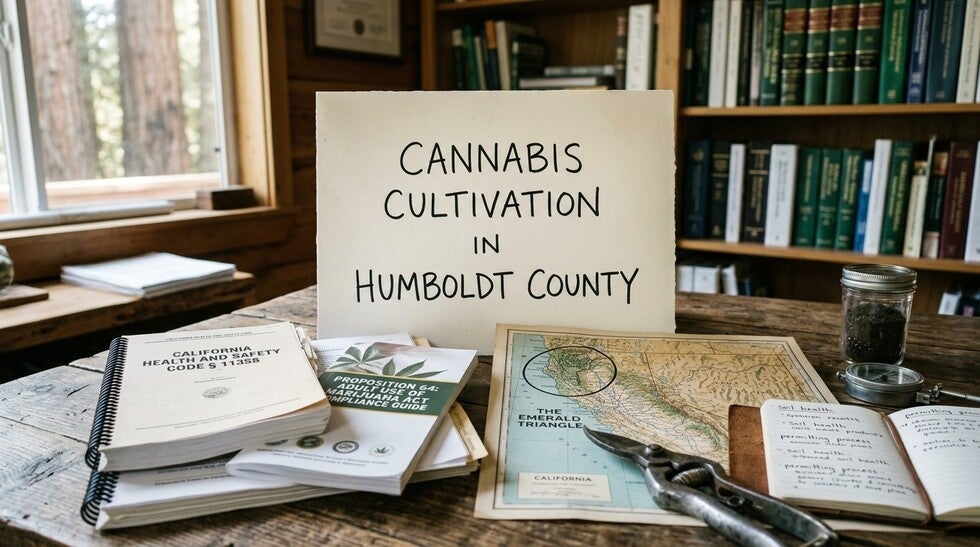
Cannabis cultivation is legal in Humboldt County, but only up to six plants for personal use under Prop 64. Grow more than that without a state license, and you are facing a crime. Do it on federal land or cause environmental damage, and your exposure gets much worse, fast. If you are dealing with a cultivation charge right now, understanding exactly where you stand is the first step.
Humboldt County sits at the heart of the Emerald Triangle, the three-county region including Mendocino and Trinity that has been the center of California cannabis cultivation for generations. Since Proposition 64 legalized recreational cannabis in 2016, the legal landscape has shifted dramatically. But cultivation cases remain among the most common and most serious charges in the county. The questions that shape every case: how many plants, was there a state license, did the grow happen on federal land or involve a trespass grow, and were there environmental violations?
These cases are heard at the Humboldt County Superior Court at 825 Fifth Street in Eureka or, for federal land grows, in the Northern District of California.
How Many Cannabis Plants Are Legal to Grow in Humboldt County?
The short answer: six plants per residence for personal use by adults 21 and over. Anything beyond that requires a state cultivation license.
Under Proposition 64 and HS § 11362.1, any adult 21 or older may grow up to six cannabis plants at their private residence strictly for personal use. That is the legal limit. No selling, no commercial activity, just personal use within that six-plant cap.
Once you go past six plants, or if any amount is grown for sale, you need a state license through the Department of Cannabis Control under the MAUCRSA regulatory framework. You also need local Humboldt County permitting on top of that. Growing beyond six plants without the required license violates HS § 11358.
Honestly, a lot of people are surprised by this. They think because cannabis is "legal" in California, they can grow whatever they want. That is not how it works. The six-plant rule is firm. At The Bulldog Law, we look at the specific plant count, the personal-use context, and the licensing status at the very first consultation in every Humboldt County cultivation case handled at the Eureka courthouse.
What Counts as a "Private Residence" Under Prop 64?
The six-plant limit applies per private residence, not per person. So if two adults live together, they do not get twelve plants. They get six total for the household. The plant must be grown at the residence where the person lives.
Grows happening in separate outbuildings, barns, or on separate parcels get complicated fast. The specific structure, location, and who lives there all matter when determining whether the personal-use exemption applies. These details can be the difference between a clean defense and a felony charge.
Do You Need a Permit for Six Plants or Fewer?
Under state law, adults do not need a permit to grow six plants or fewer for personal use. But some local ordinances in Humboldt County can layer additional rules on top of the state framework. Zoning rules, outdoor vs. indoor grow restrictions, and visible cultivation rules can still create legal exposure even when you are under the six-plant cap.
If you also want to understand how cannabis sales and transport charges under HS § 11360 work alongside cultivation charges, that is a separate but closely related area of law worth knowing.
Is Unlicensed Cannabis Cultivation a Felony or a Misdemeanor in Humboldt County?
For most people, growing more than six plants without a license is a misdemeanor under HS § 11358. But it becomes a felony for specific categories of defendants, and those felony triggers come up more often than people expect.
Proposition 64 changed things dramatically. Before Prop 64, cultivation was almost always a felony. Now, for most adults, growing beyond six plants without a license is a misdemeanor carrying up to six months in county jail and a fine. That is a major shift in how California treats these cases.
However, HS § 11358 cultivation becomes a felony in specific situations:
Defendants with certain prior serious or violent felony convictions face felony exposure. So do defendants who are required to register as sex offenders, and defendants with two or more prior cultivation convictions. Cases involving specified environmental violations, illegal water diversion, illegal pesticide use, discharge of waste into waterways, or violations of Fish and Game Code provisions, also trigger felony charges.
The Environmental Felony Trigger in Emerald Triangle Cases
For Emerald Triangle cultivation cases involving large grows on rural Humboldt County property, the environmental-violation felony trigger is the most common path to felony exposure. Large-scale grows almost always involve water diversion from streams, unpermitted grading, or waste discharge. These acts connect directly to felony charges under HS § 11358.
This is where things get serious and where having solid legal representation really matters. At The Bulldog Law, we challenge every felony trigger, the prior-conviction qualification, the environmental violation evidence, and the licensing status, all at the Eureka courthouse, working to keep the case at the misdemeanor level wherever the evidence allows.
What Happens to Cannabis Grows on Federal Land or Trespass Grows in Humboldt County?
Cannabis grows on federal land, the Six Rivers National Forest, Redwood National Park, BLM land, are prosecuted federally. And in federal court, cannabis remains entirely illegal regardless of what California law says.
Cannabis is still a Schedule I controlled substance under federal law. Proposition 64 has zero effect in federal court. Trespass grows on the Six Rivers National Forest, Redwood National and State Parks, King Range National Conservation Area, BLM land, and other federal and public lands in Humboldt County are prosecuted under federal drug statutes in the Northern District of California. The federal penalties are far more severe than California's misdemeanor framework.
These cases also frequently bring federal environmental charges and public-land damage charges alongside the drug charges. That means a defendant can be looking at multiple serious federal counts coming from a single grow operation.
Why Land Ownership Is the First Question We Ask
The threshold question in every Humboldt County cultivation case arising on or near public land is the precise location and land ownership, federal, state park, BLM, tribal, or private. This single fact determines whether the case proceeds under California's Prop 64 framework or under federal law. The difference in potential penalties is enormous.
We confirm the specific jurisdiction at the first consultation in every applicable case. Do not assume your grow was on private land just because you thought it was. Survey records, satellite data, and land ownership maps can tell a very different story.
If you or someone you know has been arrested for a federal drug charge, it is also worth understanding how federal drug trafficking charges under 21 USC 841 are built and prosecuted.
What Environmental Crimes Are Charged Alongside Cannabis Cultivation in Humboldt County?
Water diversion, stream pollution, illegal grading, and waste discharge, each of these can be charged under the Fish and Game Code and Water Code, and each one can turn a simple misdemeanor grow into a felony.
Large Emerald Triangle grows frequently involve environmental impacts that Humboldt County prosecutors and the California Department of Fish and Wildlife charge alongside the cultivation itself. These include:
Unlawful streambed alteration and water diversion under Fish and Game Code § 1602. Discharge of pollutants or waste into state waters under Fish and Game Code § 5650. Illegal grading, unpermitted well drilling, and Water Code violations. Each of these carries independent penalties and, crucially, serves as the felony trigger for HS § 11358 cultivation.
According to the California Department of Fish and Wildlife, illegal cannabis cultivation remains one of the top sources of environmental damage on California's public and private wildlands, with water theft from streams and illegal grading among the most commonly documented violations.
How We Address Environmental Charges as Part of the Defense
At The Bulldog Law, we treat the cultivation charge and every associated environmental charge as a single, integrated defense. Challenging the environmental violation evidence is not just about those charges, it is also about removing the felony trigger from the cultivation charge itself. Both goals work together.
If you are a California property owner who has been targeted for a Fish and Wildlife inspection or search related to a grow on or near your land, our overview of Fish and Game inspection warrants for California property owners explains your rights in that situation.
For a full discussion of Humboldt County cannabis-related environmental crimes, see our dedicated article on the topic.
Can a Cannabis Cultivation Case Be Resolved Through Licensing or Compliance in Humboldt County?
In some cases, yes. Showing a real pathway to state and local licensing compliance can shape how a case resolves.
For Humboldt County cultivators whose operations could realistically come into compliance with the Department of Cannabis Control state licensing framework and Humboldt County's local permitting requirements, demonstrating a genuine compliance pathway can change the resolution discussion at the Eureka courthouse. This is most useful where the cultivation was an unlicensed operation rather than a trespass grow or an operation that caused serious environmental damage.
Research published by the RAND Drug Policy Research Center has noted that California's cannabis licensing framework remains one of the more complex in the country, with both state and local compliance requirements that can create unintentional violations, a factor that can be relevant to how a case is framed in negotiations.
The compliance approach is not a magic solution. It works best when paired with every other available defense. We develop the licensing and compliance context, alongside all applicable defenses, in every suitable Humboldt County cultivation case.
What the Licensing Pathway Actually Involves
Coming into compliance is not just filling out a form. It means applying for a state cultivation license through the Department of Cannabis Control, meeting Humboldt County's local permitting requirements, addressing any environmental concerns on the property, and demonstrating good faith to the court.
We have seen cases where this pathway, combined with strong legal arguments, has led to outcomes far better than the client expected at the start. That is not a guarantee. Every case is different. But it is a real option worth exploring when the facts support it.
Many people facing these charges also want to know whether they can eventually clear the record. Our overview of Humboldt County expungement under PC 1203.4 explains how that process works once a case resolves.
It is also important to know that even if cultivation involves just possessing cannabis plants, related charges can arise. Understanding 2 ways people in California can break marijuana laws gives useful context about the broader legal risks people often overlook.
The Courthouse
Humboldt County Superior Court
825 Fifth Street, Eureka, CA 95501
(Criminal Division: 421 I Street, Eureka, CA 95501)
What Should You Do After a Cannabis Cultivation Arrest in Humboldt County?
Invoke your right to remain silent immediately. Do not discuss plant counts, the operation, water sources, or licensing without an attorney.
Do not consent to any search of the property, structures, or devices.
Find out the precise land ownership where the grow was located, private, federal, state park, BLM, or tribal.
Preserve any state license, local permit, or compliance documentation you have.
If the grow involved any water source, grading, or structures, contact The Bulldog Law about the associated environmental charge exposure.
Call (888) 928-1609.
Eureka: Eureka office | Arcata: Arcata office | Fortuna: Fortuna office | Ferndale: Ferndale | Trinidad: Trinidad | Rio Dell: Rio Dell | Blue Lake: Blue Lake | Humboldt County: Humboldt County office | (888) 928-1609
Frequently Asked Questions: Cannabis Cultivation in Humboldt County
How many cannabis plants can I legally grow in Humboldt County?
Under Proposition 64 and HS § 11362.1, adults 21 and over may grow up to six cannabis plants per private residence for personal use. Any cultivation beyond six plants, or any cultivation for sale, requires a state license through the Department of Cannabis Control under the MAUCRSA framework, plus local Humboldt County permitting. Cultivation beyond six plants without the required license violates HS § 11358. We establish the specific plant count, the personal-use context, and the licensing status at the first consultation in every Humboldt County cultivation case.
Is unlicensed cannabis cultivation a felony in Humboldt County?
For most adults, growing more than six plants without a license under HS § 11358 is a misdemeanor carrying up to six months in county jail, a major shift from the pre-Prop 64 felony framework. It becomes a felony for specific categories: defendants with prior serious or violent felony convictions, registered sex offenders, defendants with two or more prior cultivation convictions, and cases involving specified environmental violations such as illegal water diversion, pesticide use, or waste discharge. For large Emerald Triangle grows, the environmental-violation trigger is the most common path to felony exposure. We challenge each felony trigger, working to keep the case at the misdemeanor level wherever possible.
What happens if a cannabis grow is on federal land in Humboldt County?
Cannabis remains a Schedule I controlled substance under federal law, and Proposition 64 has no effect in federal court. Trespass grows on the Six Rivers National Forest, Redwood National and State Parks, King Range National Conservation Area, BLM land, and other federal lands are prosecuted under federal drug statutes in the Northern District of California, carrying penalties far more severe than the California misdemeanor framework. These cases frequently also involve federal environmental and public-land damage charges. The first question we ask is always the precise location and land ownership.
What environmental charges can be added to a cannabis cultivation case?
Environmental charges commonly added alongside cultivation charges include unlawful streambed alteration under Fish and Game Code § 1602, discharge of pollutants into state waters under Fish and Game Code § 5650, illegal grading, and Water Code violations. These are not minor additions. Each carries independent penalties, and each can serve as the felony trigger for an HS § 11358 cultivation charge, turning what might have been a misdemeanor into a felony.
Can showing a licensing pathway help resolve a cultivation case in Humboldt County?
Yes, in some cases. Where an operation is capable of coming into compliance with Department of Cannabis Control state licensing requirements and Humboldt County local permitting, demonstrating a genuine compliance pathway can positively shape the resolution discussion at the Eureka courthouse. This is especially relevant where the cultivation was unlicensed but did not involve a trespass grow or significant environmental damage. We develop this context alongside all available defenses in every applicable case.
For more on the Prop 64 six-plant limit, the misdemeanor-versus-felony cultivation line, federal land and trespass grow exposure, associated environmental charges, the state and local licensing pathway, and cannabis cultivation defense at the Humboldt County Superior Court in Eureka, visit The Bulldog Law criminal defense blog.