
Updated October 2026 | The Bulldog Law | California DUI Defense
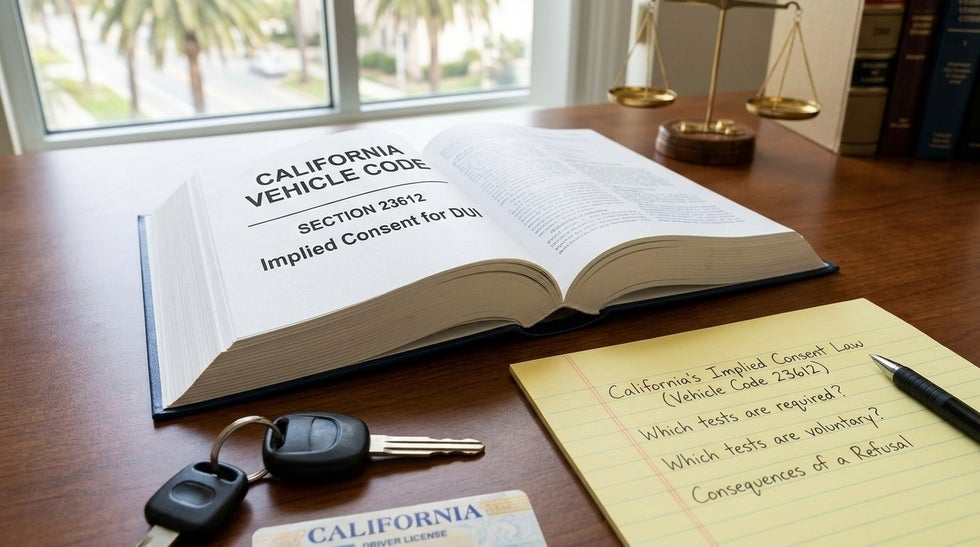
Implied consent means that by driving on a public road you have already agreed to submit to a chemical test of your blood or breath if you are lawfully arrested for driving under the influence. Every state has such a law. California's is Vehicle Code 23612, and it applies only after a lawful DUI arrest: the roadside breath device and the field sobriety tests that come before the arrest are voluntary for most drivers.
A refusal after arrest brings an automatic license suspension of one to three years from the DMV, a mandatory jail and alcohol-program add-on if the DUI is proved, and, in nearly every case, a blood draw under a warrant anyway. The law also requires the officer to tell you those consequences before you decide, and the admonition, the lawfulness of the arrest, and what actually counts as a refusal are the issues our attorneys litigate when a refusal is charged.
The Bulldog Law's DUI attorneys see implied consent from both ends: the client who refused and now faces a suspension with no restricted license, and the client who took the test and wants to know whether it was lawfully obtained. What follows is what the statute covers and what it does not, the choice of tests, the admonition the officer must give, the Supreme Court rules on warrantless testing, the refusal penalties at the DMV and in court, and the defenses. Call (888) 928-1609 or message our team.
What the statute says
Vehicle Code 23612(a)(1)(A) provides that a person who drives a motor vehicle is deemed to have given consent to chemical testing of their blood or breath to determine the alcohol content of their blood, and to a blood test to determine drug content, if lawfully arrested for an offense under Vehicle Code 23140, 23152, or 23153. Three conditions are built into that sentence. The person must have been driving; the arrest must have been lawful, meaning supported by probable cause to believe the person was driving under the influence; and the arrest must be for a DUI offense. Consent is deemed, not asked for, and the test is to be administered at the direction of the arresting officer. The statute then sets out the choice of tests, the admonition the officer must give, and the consequences of refusal, which are enforced by the DMV under Vehicle Code 13353 and by the court under Vehicle Code 23577 and 23578. The same rule applies to commercial drivers, with a lower 0.04 percent threshold under Vehicle Code 23152(d) and a separate one-year commercial disqualification for a refusal.
What implied consent does not cover
The most common misunderstanding is that implied consent requires a driver to cooperate with everything that happens at the roadside. It does not. Field sobriety tests, the walk-and-turn, the one-leg stand, and the eye-tracking test, are voluntary for every driver, and a driver may decline them without any license consequence, though the officer may still arrest on other observations.
The preliminary alcohol screening test, the handheld breath device used before arrest, is voluntary for drivers 21 and older who are not on DUI probation, and Vehicle Code 23612(i) requires the officer to advise the driver that the PAS test is requested to help decide whether to arrest, that it is not a substitute for the post-arrest test, and that the driver may refuse it. Two groups do not have that choice: drivers under 21, who are required by Vehicle Code 23136 to take a PAS test on suspicion of any alcohol, and drivers on probation for a prior DUI, who are required by Vehicle Code 23154 to take one, and each faces a one-year suspension for refusing the PAS test itself. A driver who declines the PAS test and the field sobriety tests, is arrested, and then takes the post-arrest chemical test has not refused anything under the implied consent law.
The choice of tests, and when there is none
After an alcohol DUI arrest the driver has the choice of a breath test or a blood test, and the officer must tell the driver that the choice exists. If one test is unavailable, the driver must take the other; if the driver cannot complete a breath test because of a medical condition, blood is required; and a driver who is unconscious or otherwise unable to refuse is deemed not to have withdrawn consent. If the officer has reasonable cause to believe the driver is under the influence of a drug or a combination of drugs and alcohol, the officer may require a blood test, because breath does not detect drugs, and the driver's choice disappears; urine is used only when blood is unavailable. A driver who chooses breath must be told that the breath sample is not preserved for retesting and may provide a blood sample as well, which is optional. Our page on the DUI charges and defenses covers how the test results are challenged once obtained.
The admonition
Vehicle Code 23612(a)(1)(D) requires the officer to tell the arrested driver that a refusal to submit to or complete the required test will result in a fine, mandatory imprisonment if convicted of DUI, and a suspension of one year, revocation of two years, or revocation of three years depending on priors. The DMV uses a standard admonition form, and the officer must read it in substance. The admonition matters because a refusal suspension can be imposed only if the driver was told the consequences; a driver who was not admonished, who was admonished in a language they did not understand, who was so intoxicated or injured that they could not understand it, or who was told something materially different, has a defense at the DMV hearing. The driver is also not entitled to consult an attorney before deciding, and a request to speak with a lawyer followed by silence is treated as a refusal, but a driver who asks for a lawyer, is told there is no right to one, and then complies has not refused. Our page on chemical test refusal defense covers the hearing issues in depth.
Warrants and forced blood draws after Birchfield
Implied consent laws were long understood to authorize testing without a warrant, and in 2016 the United States Supreme Court drew a line through that understanding in Birchfield v. North Dakota. The Court held that a breath test is a minimal intrusion that may be required without a warrant as a search incident to a lawful DUI arrest, but that a blood draw is a significant bodily intrusion that requires a warrant, consent, or a true emergency, and that a state may not make it a crime to refuse a warrantless blood test. California responded by streamlining electronic warrants, and officers across the state now obtain a blood warrant from an on-call judge by phone or tablet within minutes of a refusal, after which the blood is drawn by a phlebotomist, by force if necessary. The result for a driver is that a refusal rarely prevents the evidence; it adds the refusal penalties on top of the blood result. The lawfulness of the draw, the validity of the warrant, the manner of the draw, and the chain of custody are each contested through a motion to suppress, and a warrantless blood draw without consent or a genuine emergency is suppressible. A driver's consent to a blood test, given after a correct admonition, remains valid consent; a consent obtained by telling the driver that refusal is itself a crime is not.
What a refusal costs
The consequences of a refusal come from two places. The DMV imposes an administrative suspension under Vehicle Code 13353, independent of the court case and triggered by the officer's sworn report; the driver has ten days from the arrest to request a hearing or the suspension takes effect automatically. The court adds a criminal enhancement under Vehicle Code 23577 if the driver is convicted of the DUI and the refusal is pleaded and proved. The table sets out both by prior count, where a prior is a DUI conviction, a wet reckless, or a refusal suspension within the preceding ten years.
|
Priors within 10 years |
DMV action (VC 13353) |
Restricted license? |
Court add-on if convicted (VC 23577) |
|
None |
1-year suspension |
No restricted license during the suspension; ignition interlock restricted license is not available for a refusal |
48 hours jail minimum; 9-month DUI program instead of 3-month |
|
One |
2-year revocation |
No |
96 hours jail minimum |
|
Two |
3-year revocation |
No |
10 days jail minimum |
|
Three or more |
3-year revocation |
No |
18 days jail minimum |
|
Under 21 or on DUI probation, PAS refusal |
1-year suspension (VC 13353.1, 13353.2) |
No |
Separate from any DUI conviction |
|
Commercial driver |
Above, plus 1-year commercial disqualification; lifetime for a second |
No |
Above |
Two features of the table drive the advice our attorneys give. First, a refusal suspension, unlike a suspension for a failed test, cannot be converted to a restricted license with an ignition interlock, so a first-offense refusal means a full year without driving, where a first-offense failed test can mean an interlock-restricted license almost immediately. Second, the refusal is admissible at trial as evidence of consciousness of guilt, so a refusal that was meant to deny the prosecution evidence often supplies it. A refusal also extends the DUI program and the period the case affects the driving record.
Defenses to a refusal
A refusal allegation is defended at the DMV hearing, where the only issues are whether the officer had reasonable cause to believe the driver was driving under the influence, whether the driver was lawfully arrested, whether the driver was told that refusal would result in suspension, and whether the driver refused; and in court, where the enhancement must be proved beyond a reasonable doubt. The defenses track those issues. An arrest without probable cause defeats the suspension and the enhancement. A missing, garbled, or misunderstood admonition defeats the suspension. A driver who was physically unable to complete a breath test and was not offered blood, or who was unconscious, did not refuse. A driver whose conduct was ambiguous, who asked questions, asked for a lawyer, or hesitated, and who then submitted within a reasonable time, did not refuse, though a driver who agreed after the officer had already obtained a warrant and drawn blood generally did. And an officer who misstated the law, by saying that refusal was a crime or that the driver had no choice of tests, undermines both the refusal and any consent that followed. The DMV hearing must be requested within ten days of the arrest, and that deadline is the first thing to handle after any DUI arrest involving a refusal.
Frequently asked questions
What is implied consent?
Implied consent is the rule that by driving on public roads a person has already agreed to submit to a chemical test of their blood or breath if they are lawfully arrested for driving under the influence. Every state has an implied consent law. California's is Vehicle Code 23612, and it means that a driver who refuses the test after a DUI arrest faces an automatic license suspension and an added criminal penalty, even if the DUI charge is later dismissed.
Does implied consent apply before I am arrested?
No. In California, implied consent applies only to the chemical test after a lawful DUI arrest. The handheld breath device officers use at the roadside before arrest, the preliminary alcohol screening or PAS test, is voluntary for most drivers, and the officer must tell you that you can refuse it. The exceptions are drivers under 21 and drivers on DUI probation, who are required to take the PAS test and face a suspension for refusing it. Field sobriety tests are also voluntary for every driver.
What happens if you refuse a breathalyzer in California?
If you refuse the post-arrest chemical test, the DMV suspends your license for one year on a first offense, two years if you have a DUI or refusal within the past ten years, and three years with two such priors, with no restricted license available during a first refusal suspension. If you are convicted of the DUI, the refusal adds a mandatory 48 hours in jail and a nine-month alcohol program on a first offense, and more on repeat offenses. The refusal can also be used against you at trial as evidence of consciousness of guilt, and the police will usually obtain a warrant and take blood anyway.
Can police take my blood without consent?
Yes, with a warrant. The United States Supreme Court held in 2016 that a breath test may be required as a search incident to a DUI arrest without a warrant, but a blood draw is more intrusive and requires either consent or a warrant, except in a true emergency. California officers now obtain electronic warrants for blood within minutes of a refusal, and a forced blood draw under a warrant is lawful. A refusal therefore does not prevent the test; it adds the refusal penalties on top of whatever the blood shows.
Can I choose between a blood test and a breath test?
Usually. Vehicle Code 23612 gives a driver arrested for alcohol DUI the choice of breath or blood, and the officer must offer the choice unless one test is unavailable. If the officer suspects drugs, the officer can require a blood test, because breath does not detect drugs. A driver who cannot complete a breath test for medical reasons must take blood. A driver who chooses breath may be told that the breath sample is not retained and may be asked to give blood as well, which is optional.
Is refusing the test ever a good idea?
Rarely, and the decision cannot be undone. A refusal costs a year of driving with no restricted license, adds jail and program time if convicted, and usually results in a blood draw under a warrant anyway. The refusal defenses that exist, an unlawful arrest, a failure to give the required admonition, an inability to comply for medical reasons, confusion caused by the officer, or a refusal that was really a request for a lawyer followed by compliance, are litigated at the DMV hearing and in court by our attorneys, but they are defenses to a decision already made, not a reason to make it.
Related reading from our attorneys
- DUI chemical test refusal defense and the DMV hearing
- Motions to suppress evidence under Penal Code 1538.5
- How long a DUI stays on your record in California
Refused the test? The ten-day DMV deadline is running
The Bulldog Law's DUI defense attorneys handle refusal suspensions, DMV hearings, warrant blood draws, and the DUI charge itself across California. Call (888) 928-1609 or reach us online before the ten days expire.