
Updated August 2026 | The Bulldog Law | California Criminal Defense
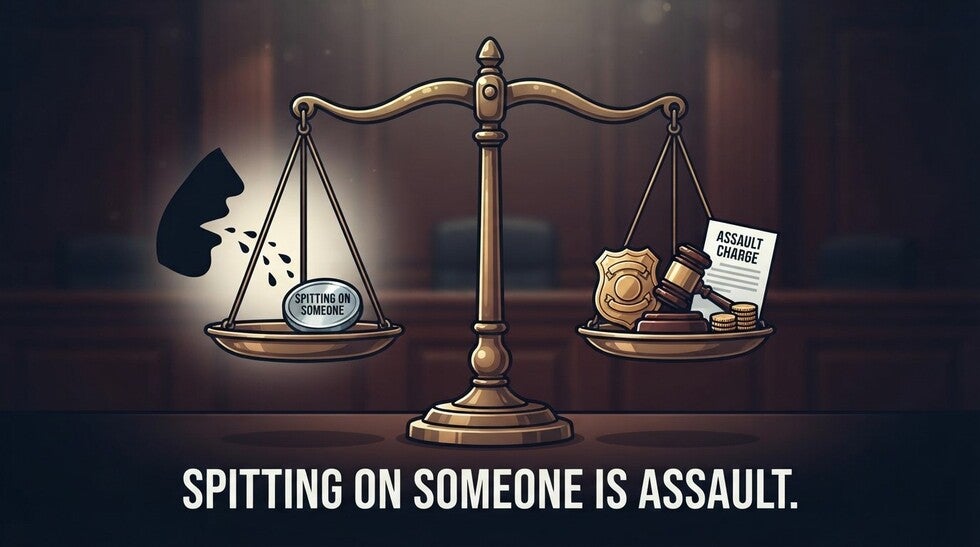
In California, spitting on someone is battery, not assault. Penal Code 242 defines battery as any willful and unlawful use of force on another person, and courts have long held that the force can be slight and does not need to cause pain or injury; an offensive touching is enough, and saliva landing on someone's body or clothing qualifies. Simple battery is a misdemeanor punishable by up to six months in county jail and a $2,000 fine. Spitting on a police officer, firefighter, or emergency worker raises the maximum to one year, and spitting on staff inside a jail or prison is felony gassing under Penal Code 243.9 or 4501.1, punishable by up to four years. Spitting at someone and missing is assault under Penal Code 240.
The question comes up constantly because the answer changes from state to state. In many states, including New York, Texas, and Florida, the word assault covers both the threat and the contact, so spitting is charged as assault. California keeps the two separate. What the penalties look like in practice, the situations that turn a misdemeanor into a felony, the defenses that actually work, and what to do if you have been accused. If a police report or citation already exists, contact The Bulldog Law or call (888) 928-1609.
Why Spitting Is Battery, Not Assault, in California
California's two statutes divide a physical confrontation into the attempt and the contact:
- Assault, Penal Code 240: an unlawful attempt, with the present ability, to commit a violent injury on another person. No contact is required. Swinging and missing is assault; so is spitting toward someone's face and missing.
- Battery, Penal Code 242: any willful and unlawful use of force or violence upon another person. Contact is required, but injury is not.
The jury instruction for battery, CALCRIM 960, tells jurors that the slightest touching can be enough if it is done in a rude or angry way, that making contact with another person's clothing is enough, and that the touching does not have to cause pain or injury. Spitting checks every box: it is willful, it is done in anger or contempt, and it makes contact. California courts have treated spitting as a battery for decades, and prosecutors charge it under Penal Code 242 without hesitation. Our full guide to battery under Penal Code 242 and 243 covers the statute in depth.
Because battery includes assault as a lesser offense, a person charged with battery for spitting can be convicted of assault instead if the jury finds the spit did not land. The distinction matters for the record and for immigration purposes, but the penalties for simple assault and simple battery are similar.
Penalties for Spitting on Someone
Simple battery, Penal Code 242 and 243(a)
A misdemeanor. Up to six months in county jail, a fine of up to $2,000, or both, plus summary probation, anger management or a batterer's program, and restitution for any expenses the victim incurred. A first offense with no injury and no aggravating facts rarely results in jail; the typical outcome is probation with a class requirement, a fine, or diversion. Our page on California judicial diversion explains how many first-time misdemeanor batteries are dismissed after a period of good conduct.
Battery on a protected worker, Penal Code 243(b) and (c)
When the person spat on is a peace officer, custodial officer, firefighter, EMT, lifeguard, process server, traffic officer, animal control officer, code enforcement officer, or a doctor or nurse providing emergency care, and the defendant knew or should have known it, the maximum rises to one year in county jail and a $2,000 fine. If the worker suffers an injury requiring medical treatment, Penal Code 243(c)(2) makes the offense a wobbler with up to three years in custody. Spitting rarely produces that kind of injury, so most spitting-on-an-officer cases stay misdemeanors under 243(b). They are, however, prosecuted aggressively, and body camera footage makes the identity of the person who spat easy to prove.
Gassing in a jail or prison, Penal Code 243.9 and 4501.1
This is where spitting becomes a felony. Penal Code 243.9 makes it a felony for a person confined in a local detention facility to commit battery by gassing on a peace officer or facility employee, punishable by two, three, or four years, served consecutively to any sentence the person is already serving. Gassing means intentionally placing or throwing bodily fluids or substances, including saliva, on another person. Penal Code 4501.1 is the parallel statute for state prison. Our guide to defending aggravated battery by gassing charges covers those cases. The practical warning: spitting on a deputy during booking is a different crime from spitting on the same deputy during the traffic stop an hour earlier.
Domestic battery, Penal Code 243(e)(1)
Spitting on a spouse, partner, ex, co-parent, or someone you are dating is charged as domestic battery: a misdemeanor with up to one year in county jail, a mandatory 52-week batterer's intervention program, a protective order, and a firearm prohibition. It is also a deportable offense for non-citizens. Our guide to domestic battery explains why prosecutors file these cases even when the partner does not want to press charges.
Hate crime enhancement
Spitting on someone because of their race, religion, national origin, disability, gender, or sexual orientation is battery plus a hate crime. Penal Code 422.7 can elevate the misdemeanor to a felony punishable by up to three years, and Penal Code 422.75 adds one to three years to any felony. Words used during the incident are the usual evidence.
Spitting and Contagious Disease
Spitting on someone while claiming to have HIV, hepatitis, COVID-19, or another disease was, for a period, charged as a felony in some jurisdictions. In California that path is mostly closed. Senate Bill 239, effective 2018, repealed the disease-specific felony statutes and replaced them with Health and Safety Code 120290, a misdemeanor that requires proof that the defendant knew they were infected, specifically intended to transmit the disease, engaged in conduct that posed a substantial risk of transmission, and actually transmitted it. Saliva does not transmit HIV, and prosecutions under the statute are rare. The disease claim still matters in two ways: it is evidence of intent to cause fear, which can support a criminal threats charge under Penal Code 422, and it is an aggravating factor at sentencing on the battery.
Related Charges Prosecutors Add or Substitute
- Assault, Penal Code 240: charged when the spit missed, or as the lesser offense in a plea.
- Disturbing the peace, Penal Code 415: fighting or challenging someone to fight in public, or using offensive words likely to provoke a violent reaction. This is the most common plea-down from a spitting battery because it is an infraction or low-level misdemeanor with no batterer's program. See our guide to Penal Code 415.
- Criminal threats, Penal Code 422: if the spitting was accompanied by a threat to kill or seriously injure.
- Resisting arrest, Penal Code 148: routinely added when the spitting happened during an arrest.
- Local anti-spitting ordinances: many California cities prohibit spitting on sidewalks and in public transit as an infraction, which is separate from battery on a person.
The victim of a spitting battery can also sue in civil court for battery and emotional distress. The criminal case and the civil case are independent, and a conviction or plea in the criminal case can be used against the defendant in the civil one, which is one more reason to fight for a dismissal or a 415 resolution rather than pleading to battery.
Defenses to a Spitting Charge
Battery requires a willful act, and spitting cases turn on a few seconds of contested conduct. The defenses that succeed most often:
- It was not willful. Coughing, sneezing, spraying while shouting, or spitting on the ground near someone is not battery. Prosecutors must prove the defendant intended to spit on the person, not that saliva happened to reach them.
- Self-defense or defense of others. A person who reasonably believed they were about to be touched or harmed may use proportionate force, and spitting to make an aggressor back away has been accepted as self-defense in the right facts.
- In crowds, protests, and bar fights, the person who spat is often not the person arrested. Video and witness statements decide these cases.
- The contact did not happen. If the spit missed, the charge is assault at most, and if the target did not perceive an attempt, it may be nothing.
- Provocation and mutual combat. Not a legal defense, but a powerful mitigation argument that regularly converts a battery filing into a 415 plea or a diversion referral.
The signs that make any criminal case weak apply here: no video, a complaining witness who was intoxicated or aggressive, an officer who did not see the act, and a report written hours later. An attorney who raises those issues with the prosecutor before the arraignment can often keep the case from being filed at all.
Record and Immigration Consequences
A simple battery conviction is a misdemeanor on a criminal record that employers and landlords will see. It is generally eligible for dismissal under Penal Code 1203.4 after probation ends; our guide to what expungement means explains the process. For non-citizens, simple battery is usually not a crime involving moral turpitude, but domestic battery under Penal Code 243(e)(1) is a deportable crime of domestic violence, and a hate-crime or gassing felony can be an aggravated felony depending on the sentence. Anyone who is not a U.S. citizen should read about the immigration consequences of a conviction before accepting any plea, including one to a lesser charge.
Frequently Asked Questions
Is spitting on someone assault or battery in California?
Battery. California separates the two: assault (Penal Code 240) is an attempt to use force on someone, and battery (Penal Code 242) is the completed act of touching someone in a harmful or offensive way. Saliva landing on another person is an offensive touching, so it is battery. Spitting at someone and missing is assault. Many other states use the word assault for both, which is why the question is so common.
Can you go to jail for spitting on someone?
Yes, although it is uncommon for a first offense with no other aggravating facts. Simple battery is a misdemeanor punishable by up to six months in county jail and a fine of up to $2,000. Spitting on a police officer, firefighter, EMT, or other protected worker raises the maximum to one year. Spitting on a jail or prison employee can be charged as felony gassing with a prison term of up to four years. Most first-offense simple battery cases resolve with probation, a fine, anger management, or diversion.
Is spitting on a police officer a felony?
Usually a misdemeanor, sometimes a felony. Battery on a peace officer engaged in their duties is a misdemeanor under Penal Code 243(b) with up to one year in jail. It becomes a wobbler under Penal Code 243(c)(2) if the officer is injured, and spitting rarely causes injury. However, if the officer is a custodial officer or the spitting happens inside a jail, Penal Code 243.9 gassing applies, and that is a felony regardless of injury.
Is spitting on someone a felony if you have a contagious disease?
Not automatically. California repealed most of its disease-specific felony statutes in 2018. Under Health and Safety Code 120290, intentionally transmitting an infectious disease is a misdemeanor, and it requires proof that the person knew they were infected, acted with specific intent to transmit, engaged in conduct that posed a substantial risk of transmission, and actually transmitted the disease. Spitting does not transmit HIV and rarely transmits anything else, so the statute is rarely charged. A hate crime enhancement or a gassing charge in custody is a far more likely path to a felony.
What should I do if I have been accused of spitting on someone?
Do not contact the accuser, do not post about it, and do not give a statement to police without a lawyer. Preserve any video of the incident, including your own phone, and write down the names of witnesses. Many spitting cases arise from arguments where both sides were shouting and the physical evidence is a few seconds of shaky video; identity, willfulness, and self-defense are all live issues, and an attorney can often resolve the case before it is filed.
Related Guides
- Battery under Penal Code 242 and 243
- Domestic battery charges and defenses
- Assault and battery defense
Accused of Spitting on Someone? Call The Bulldog Law
A spitting case looks small until it is a battery conviction, a 52-week program, a protective order, or a felony gassing charge. The Bulldog Law defends assault, battery, domestic violence, and in-custody battery cases across California, and we handle the immigration side in-house. Visit our criminal defense page, call (888) 928-1609, or reach us online for a confidential consultation.