
By the The Bulldog Law Criminal Defense Team • Reviewed by a licensed California criminal defense attorney
Penal Code § 415 the “415” you hear on police scanners makes three things a crime: (1) unlawfully FIGHTING, or challenging someone to fight, in a public place; (2) willfully and maliciously disturbing others with LOUD AND UNREASONABLE NOISE; and (3) using OFFENSIVE WORDS in public that are inherently likely to provoke an immediate violent reaction. The punishment is the smallest in this corner of the code: at most 90 days in county jail and a $400 fine, and prosecutors may file it as a mere INFRACTION - a ticket, not a crime.
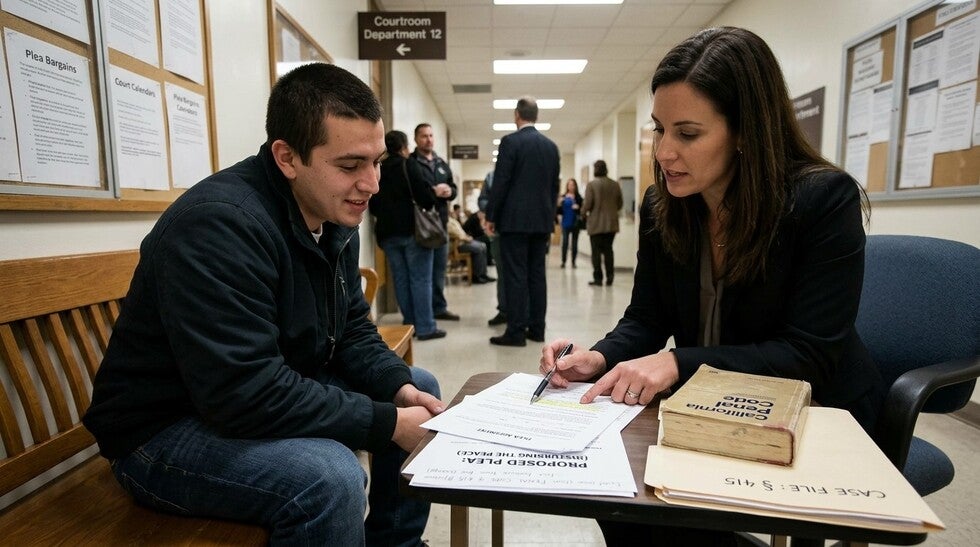
But § 415's real fame inside courthouses is the opposite of its size: it is California's favorite REDUCTION - the charge that domestic-violence counts, battery, and drunk-in-public cases plead DOWN to, because “disturbing the peace” reads like a noise complaint to employers, licensing boards, and immigration officers. This guide from The Bulldog Law's criminal defense team covers what the 415 call means, the three prongs and their defenses, and how the reduction game is actually played.
What Does “415” Mean When Police Say It?
On the radio, “415” is shorthand for a disturbance call a fight, a loud party, a screaming argument, “unknown trouble” taken straight from this Penal Code section, the same convention that gives California its 187s and 211s.What matters for anyone who just heard it used about themselves: a 415 CALL is not a 415 CHARGE. Officers arriving at a disturbance sort the scene into lanes many end in no arrest at all, some end in a § 415 citation, and the volatile ones escalate into battery, assault counts, domestic-violence arrests, or resisting allegations depending on what officers see and who says what.
That sorting moment is why the standard advice applies even to “minor” disturbance calls: be calm, be brief, identify yourself, and explain nothing the difference between walking away, a $400 ticket, and a misdemeanor arrest is frequently the statements people volunteer while adrenaline is doing the talking. The full decoder for booking-sheet numbers lives in our California charge-code index.
The Three Prongs and Where Each One Breaks
- Public fighting or challenging to fight requires an UNLAWFUL fight in a PUBLIC place: mutual-combat scenes outside bars and at parties. It breaks on self-defense (defending yourself is not “unlawful fighting” the full doctrine here), on location (private property changes the analysis), and on the gap between heated words and an actual fight or genuine challenge.
- Loud and unreasonable noise requires WILLFUL AND MALICIOUS disturbance: not volume alone, but noise used to disturb - the revenge subwoofer at 3 a.m., not the birthday party that ran late. It breaks on malice (celebrations, work, ordinary life are not malicious), on “unreasonable” (time, place, duration), and on the constitutional line courts read this prong narrowly where speech and protest are involved: the message's content is protected; only the raw decibel-level disruption is regulable.
- Offensive “fighting words” the narrowest prong by constitutional force: words alone are punishable ONLY when inherently likely to provoke an IMMEDIATE violent reaction from the person addressed face-to-face provocation, not rudeness, not insults from a distance, not offensive opinions. The First Amendment eats most charges filed under this prong, and it should.
The Reduction Game: Why Defense Lawyers Ask FOR a 415
Here is the section other 415 pages don't write. Section 415's highest value is as a DESTINATION: prosecutors resolving shaky or first-offense cases routinely amend battery (§ 242), domestic-battery (§ 243(e)(1)), drunk-in-public (§ 647(f)), and trespass counts down to § 415 - sometimes as a misdemeanor, better still as an INFRACTION.Why it matters so much: a 415 infraction is not a criminal conviction at all; even the misdemeanor version carries no protective-order baggage, no domestic-violence label (with the firearm bans and immigration landmines that label drags along), no 52-week program, and a background-check line that reads like a noise complaint.
For licensed professionals, non-citizens, and anyone employed, the distance between “domestic battery” and “disturbing the peace” on a record is the distance between crisis and inconvenience. Getting there is advocacy: weak-evidence leverage (the standard checklist), first-offense equities, completed classes offered proactively, and civil-compromise-style restitution where anything was damaged. And once obtained, even the 415 itself is cleanable expungement applies to the misdemeanor version, and infractions barely register to begin with. If you're charged with something heavier and a 415 offer appears, understand what's being handed to you; if no offer appears, understand that asking for one with a defense file that justifies it - is precisely what counsel is for.
Frequently Asked Questions
Is a 415 a misdemeanor in California?
It can be either a misdemeanor or an infraction prosecutors choose, and the maximums are modest either way: up to 90 days and $400 as a misdemeanor, a fine-only ticket as an infraction. That flexibility is the statute's superpower in negotiations: the same conduct that supports a battery filing can resolve as a non-criminal infraction under 415. If you were cited, don't ignore it - an unhandled citation grows into a warrant but know that first-offense 415s frequently resolve with minimal consequence, and the misdemeanor version is expungeable after.
What does ‘415' mean on a police call?
A disturbance fight, loud party, argument, general ‘unknown trouble' named for this Penal Code section, the same numbering convention behind 187 (murder) and 211 (robbery). A 415 dispatch is not a charge: officers arriving at disturbance calls resolve most with no arrest, cite some under 415, and escalate the volatile ones into battery, DV, or assault arrests based on what they find and what people say. If police responded to a disturbance involving you, the smartest move is calm brevity identify yourself and volunteer nothing because the statements made in those first minutes are what sort the call into a ticket versus an arrest.
Can a domestic violence or battery charge be reduced to disturbing the peace?
Yes it's the single most common and most valuable reduction in misdemeanor practice. A 415 disposition carries no DV label, no firearm prohibition, no 52-week batterer's program, no protective-order regime, and dramatically less immigration and licensing danger and the infraction version isn't a criminal conviction at all. Prosecutors agree to it when the evidence is shaky (recanting or absent witnesses, mutual-combat facts, no injuries), the record is clean, and the defense presents mitigation proactively. It is negotiated, not granted - which is why DV and battery cases deserve counsel even when they look ‘small': the difference between the labels lasts decades.
Can I be charged for a loud party or loud music?
Only if the noise was willful and MALICIOUS the element that separates crime from citation. Ordinary parties, celebrations, and life-noise draw warnings and municipal-ordinance citations (local noise codes, which are infractions and civil fines), not criminal 415 counts; the criminal prong targets noise deployed to disturb the feud speaker aimed at a neighbor's window at 3 a.m., repeated after warnings. If you were actually charged criminally over noise, malice is the battleground and context is the defense: occasion, hours, warnings received, decibel reality, and the neighbor dispute's history usually tell a story about a feud, not a crime and feuds resolve while convictions linger.
Section 415 is the smallest charge in the code and the biggest word in a negotiation a statute you defend against on Tuesdays and bargain toward on Thursdays. Know which side of it your case is on. The Bulldog Law's criminal defense team handles disturbance charges and the reductions built from them across California. Contact the firm online or call (888) 928-1609.