
Updated September 2026 | The Bulldog Law | California Post-Conviction Defense
A commutation is the Governor's reduction of a sentence that is still being served: shortening a term, advancing a parole eligibility date, or converting life without parole into life with the possibility of parole. It is one of three forms of executive clemency under Article V, Section 8 of the California Constitution. A pardon is the second, forgiveness of a conviction after the sentence is complete. A reprieve is the third, a temporary postponement, which is what the Governor used in 2019 to halt every execution in the state. A commutation does not erase a conviction and rarely opens the prison door by itself; what it usually does is give a person a parole hearing they would otherwise never get. For anyone convicted of felonies in two or more separate cases, the Governor cannot grant it without the written recommendation of four justices of the California Supreme Court.
The Bulldog Law's post-conviction attorneys handle clemency applications for clients who have exhausted the courts, and the first thing we tell families is what a commutation is not. It is not an appeal, not a finding that the conviction was wrong, and not a right; it is a discretionary act of mercy that a Governor grants to a few hundred people out of the tens of thousands who ask. That makes the application a different kind of document from anything filed in court: it argues rehabilitation, not error. What follows is how the process works, who is eligible, what a grant actually does, and what separates the applications that get investigated from the ones that sit in a file. Call (888) 928-1609 or message our team if a commutation is the remaining option in your family's case.
Three kinds of clemency
Article V, Section 8 of the California Constitution gives the Governor the power to grant a reprieve, pardon, and commutation, after sentence, subject to procedures the Legislature sets. The three are constantly confused, and the confusion costs people time.
A commutation reduces the punishment. The conviction stands, the record stands, and the person remains subject to whatever supervision follows release. What changes is the sentence: a determinate term is cut, a parole eligibility date is moved up, or a life-without-parole sentence becomes a life sentence with the possibility of parole. Commutations are granted to people in custody.
A pardon forgives the conviction. It is granted, with rare exceptions, to people who have completed their sentence and lived crime-free for years afterward, typically through the certificate of rehabilitation process our attorneys explain on our certificate of rehabilitation and Governor's pardon page. A full and unconditional pardon restores civil rights, can restore firearm rights, and, for a non-citizen, waives some grounds of deportability, though not drug-related ones. A commutation does none of those things.
A reprieve postpones. It does not reduce or forgive; it delays execution of a sentence, usually to allow something else to happen. California's most consequential reprieve came in March 2019, when the Governor issued an executive order granting a reprieve to every person on death row, more than 700 people, and closed the execution chamber at San Quentin. The death penalty remains on the books; the reprieve is why no one has been executed since.
What a commutation actually does
Because most serious California sentences are indeterminate, life with a minimum term, the most common form of commutation does not release anyone. It makes the person eligible for a parole hearing. A prisoner serving 25 years to life who has served 18 might have the minimum commuted to time served, which means the Board of Parole Hearings will schedule a hearing, and the prisoner then has to persuade the Board, under the standards our attorneys describe on our page about parole for life-sentenced inmates, that they no longer pose an unreasonable risk. A person serving life without the possibility of parole who receives a commutation to 25 to life gets, for the first time, a hearing at all. Governors like this structure because the Board, not the Governor, makes the release decision, and it is why the commutation grant and the actual release are often years apart.
For determinate sentences, a commutation can reduce the term directly, or reduce it to time served, and release follows through CDCR's ordinary process, with parole or post-release supervision afterward as our page on parole versus probation describes. And a commutation can be conditional: the Governor may require completion of a program, participation in a transitional housing plan, or other conditions, and violating them can revoke the grant.
What a commutation never does is touch the conviction. It remains on the record, counts as a prior, carries its registration and firearm consequences, and, for immigration, remains a conviction with a sentence; federal immigration law looks at the sentence originally imposed, not the commuted one, so a commutation does not undo an aggravated felony. Our attorneys address the immigration analysis separately in any clemency case involving a non-citizen, because the pardon route, where available, is the one that helps.
Who is eligible, and the twice-convicted rule
There are no statutory categories of ineligibility. People convicted of murder, people serving life without parole, and people with long records have all received commutations, and the Governor's office has said that the seriousness of the offense is not disqualifying if rehabilitation is demonstrated. The constitutional limit is different: for a person twice convicted of a felony, the Governor may not grant a pardon or commutation except on the written recommendation of a majority of the Supreme Court, at least four of the seven justices. Convictions in the same case count once; convictions in separate cases trigger the rule. The Governor's office sends those applications to the court with a recommendation, the court reviews the record, and the court has refused, publicly, in cases where it found the record did not support clemency. An applicant with two separate felony cases is therefore making two arguments to two audiences, and the application has to be written for both.
Practical eligibility is another matter. Commutations go, overwhelmingly, to people who have served a substantial portion of their sentence, have years of clean disciplinary history, have completed rehabilitative programming, have earned education or vocational certifications, can show insight into the offense, and have a concrete release plan with housing and support. Youth at the time of the offense, an unusually long sentence relative to co-defendants or current law, and post-conviction changes in the law that could not reach the case through the courts, the retroactivity limits our attorneys discuss elsewhere, are the factors that recur in grants. Applications from people who are still litigating their innocence fare poorly, because the Governor is not a court and the process assumes accountability.
The process, step by step
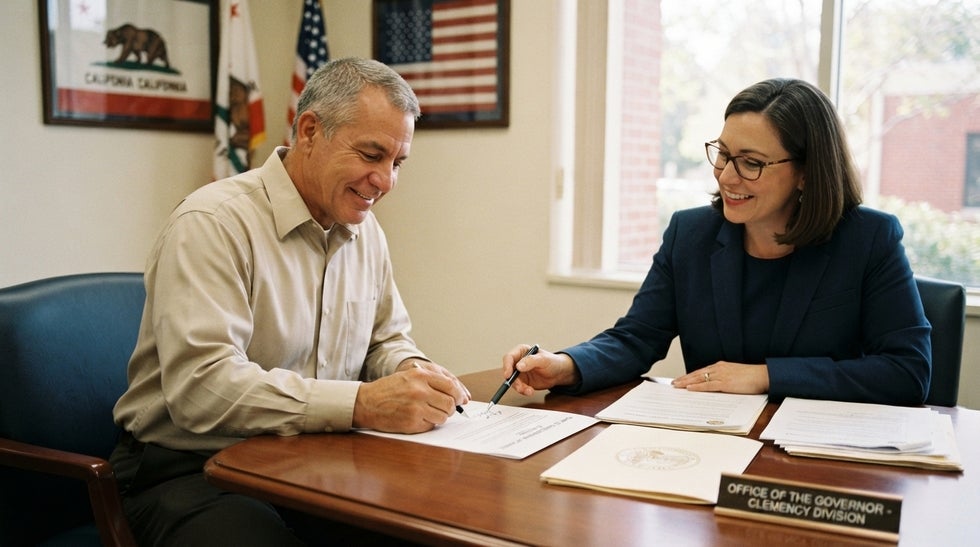
The application is a form published by the Governor's clemency office, submitted with a personal statement, a description of the case, and supporting documents. Penal Code sections 4800 through 4813 govern what happens next. The Governor's legal affairs staff screens the file. Applications that proceed are referred to the Board of Parole Hearings, which conducts an investigation: it pulls the CDCR central file, disciplinary and program records, and psychological evaluations, may interview the applicant, and prepares a report and recommendation. The district attorney of the county of conviction receives notice and may object. Victims and victims' families registered under Marsy's Law are notified and may submit statements. If the applicant is twice-convicted, the file goes to the Supreme Court. The Governor then decides, and is not required to decide at all; the majority of applications receive no answer.
Timing runs in years. Grants have historically been announced in groups, often around holidays, and the current administration has issued several hundred commutations since 2019, a large number by historical standards and a small fraction of the applications received. A denied applicant may reapply, and a new application after additional years of programming is common. There is no fee. There is no requirement of counsel. And there is no substitute for an application that reads like the story of a changed person rather than a list of certificates.
What our attorneys put in the application
The personal statement, which is the document the Governor's staff reads first, and which has to take responsibility for the offense in plain language before it says anything else. A curated record of rehabilitation: not every certificate, but the ones that show a trajectory, with dates. Support letters chosen and edited the way our attorneys choose character letters for sentencing: specific, credible, from people outside the family where possible, including CDCR staff, chaplains, and program facilitators who can speak to conduct inside. A release plan with a named place to live and a named employer or program. Where the sentence is disproportionate, an analysis showing what the same conduct would draw today, with citations to the reforms that couldn't reach the case. And, for twice-convicted applicants, a separate memorandum addressed to the Supreme Court's standard. The file that goes to Sacramento is often over a hundred pages; the form alone is four.
Commutation versus the court remedies
Clemency is the last resort, and our attorneys check the alternatives first, because a court remedy, where one exists, is faster, is a right rather than a favor, and can vacate a conviction rather than merely shorten a sentence. Penal Code 1172.1 lets CDCR, the district attorney, or the Board recommend recall and resentencing, and some district attorneys now review old sentences on their own initiative. Senate Bill 1437 and Penal Code 1172.6 vacate murder convictions obtained on abolished theories. Penal Code 1172.75 requires resentencing for certain repealed enhancements. The elderly parole program and youth offender parole give hearings to people the Governor might otherwise have to commute. And for people who have finished their sentence, expungement, a certificate of rehabilitation, and a pardon are the record-clearing path. Our post-conviction relief page maps all of them. When none applies, or all have been tried, the commutation application is what remains, and it is worth doing well.
Frequently asked questions
What is a commutation of sentence?
A commutation is the Governor's reduction of a sentence that is still being served. It can shorten a fixed term, make a person immediately eligible for a parole hearing, or convert life without parole into life with the possibility of parole. It does not erase the conviction, and it does not by itself release anyone; in most California commutations, the person still has to persuade the Board of Parole Hearings that they're safe to release.
What is the difference between a commutation and a pardon?
Timing and effect. A commutation reduces a sentence while it's being served; the conviction stays. A pardon is granted after the sentence is complete, usually years later, and forgives the conviction: it restores civil rights, can restore firearm rights, and helps with licensing and immigration. Both come from the Governor. A reprieve is the third form of clemency, a temporary postponement of a sentence, most famously the Governor's 2019 moratorium on executions.
How do you apply for a commutation in California?
By submitting the Governor's commutation application, available from the Governor's clemency office, with a personal statement, the record of the case, and evidence of rehabilitation: programs completed, disciplinary history, education, letters of support, a release plan. The Governor's office refers applications to the Board of Parole Hearings for investigation, which includes a review of the file and often an interview. There is no fee and no lawyer is required, but a well-prepared application is a different document from a bare form.
Who cannot get a commutation in California?
Anyone convicted of two or more felonies, in separate cases, needs the recommendation of at least four justices of the California Supreme Court before the Governor can grant clemency, a requirement written into the state Constitution. That is a real hurdle, not a formality, and the court has declined recommendations. Beyond that there are no categorical bars: people serving life without parole, people convicted of murder, and people with violent histories have all received commutations.
How long does a commutation take?
Years, usually. Applications go through the Governor's legal affairs staff, the Board of Parole Hearings investigation, notice to the district attorney and any victims, and, for twice-convicted felons, the Supreme Court. Grants tend to come in batches around holidays. Most applications are never acted on at all; the Governor is not required to respond, and silence is the most common outcome.
Related reading from our attorneys
- Certificate of rehabilitation and Governor's pardon
- Parole for life-sentenced inmates in California
- Expungement and post-conviction relief
Out of court options? A commutation application is a case of its own
The Bulldog Law's post-conviction attorneys prepare commutation and pardon applications, Supreme Court recommendation memoranda for twice-convicted applicants, and the parole hearing that follows a successful grant, for clients in prisons across California. Visit our criminal defense page, call (888) 928-1609, or reach us online. The best applications take months to build; the first conversation takes twenty minutes.