
By the The Bulldog Law Criminal Defense Team • Reviewed by a licensed California criminal defense attorney
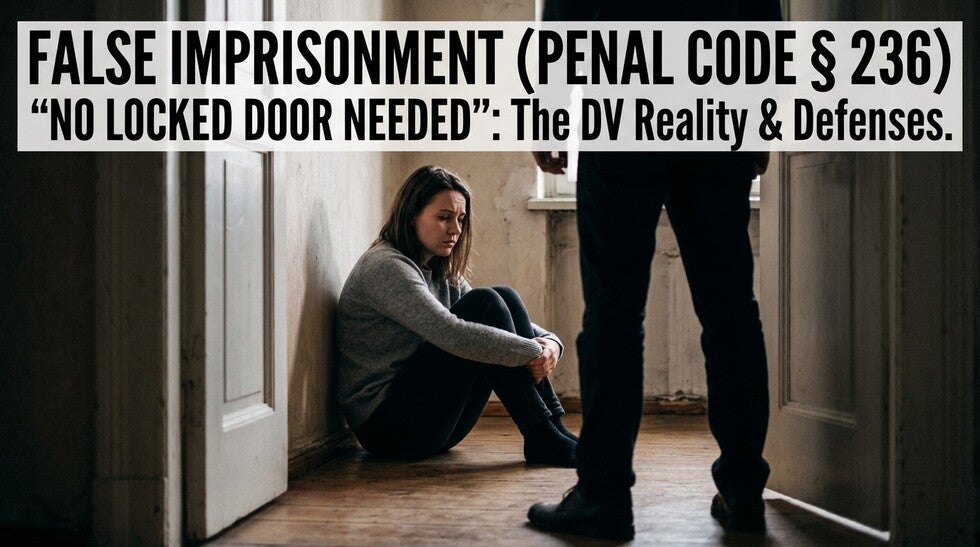
False imprisonment under Penal Code § 236 is the unlawful violation of another person's liberty intentionally restraining, detaining, or confining someone so they must stay or go somewhere against their will and it requires NO locked room, NO movement, and NO minimum time: blocking a doorway for two minutes qualifies.
It's a misdemeanor by default (up to 1 year), but becomes a FELONY carrying 16 months, 2, or 3 years when accomplished by VIOLENCE, MENACE, FRAUD, or DECEIT “menace” meaning an express or implied threat of harm, including simply displaying a weapon. Two realities define how this statute actually gets used: it is one of the most common add-on charges in domestic-violence cases (the “you're not leaving until we finish this” moment, the grabbed keys, the blocked exit), and it is the landing zone for reduced KIDNAPPING counts because false imprisonment is kidnapping's lesser-included offense, minus the movement, minus the strike. This full guide from The Bulldog Law's criminal defense team covers the elements, the misdemeanor-felony line, the store-detention and citizen's-arrest rules, and the defenses that dismantle these cases.
The Elements and How Little “Restraint” It Takes
Four elements: (1) you intentionally and unlawfully restrained, detained, or confined a person; (2) you made them stay or go somewhere against their will; (3) for an appreciable time however brief; and (4) they did not consent.The restraint's form is open-ended: physical holding, blocking exits, taking a phone and keys so leaving becomes impossible, threats that freeze a person in place, fraud or deceit that keeps them somewhere (“the police said you must wait here”), even driving a passenger past their demanded stop.
Duration is measured in moments, not hours minutes suffice and the “against their will” element is where the human mess lives: arguments where both people stayed and shouted, relationships where the door was never actually barred, encounters the complaining witness later re-describes. The FELONY escalators deserve precision because they decide everything.
VIOLENCE means force beyond what mere restraint requires (grabbing an arm to block a door can be misdemeanor restraint; wrenching someone back by the hair is violence); MENACE means threats verbal, implied, or a weapon shown; FRAUD/DECEIT covers confinement by lies. The gap between misdemeanor and felony § 236 is therefore a characterization of the same scene exactly the kind of characterization early defense work re-frames before preliminary hearing.
Where These Cases Actually Come From
-
Domestic violence the #1 source: 236 rides alongside § 273.5 and restraining-order counts whenever an argument involved a blocked door, a taken phone, a car that didn't stop and it's charged from one party's account of a chaotic scene. For non-citizens, a DV-context false-imprisonment conviction is an immigration minefield requiring dual analysis before any plea.
-
Store detentions the SHOPKEEPER'S PRIVILEGE cuts the other way: merchants may detain a suspected shoplifter for a REASONABLE time, in a REASONABLE manner, on probable cause the defense for security staff charged with (or sued for) false imprisonment, and the limit that creates liability when detentions turn into back-room marathons.
-
Citizen's arrests, repo and security work lawful authority defenses exist but have strict edges; exceeding them converts authority into § 236.
-
Elder and dependent-adult settings confinement allegations stack with 368 elder-abuse counts in caregiving disputes.
- The hostage escalator using a detained person as a shield or hostage is its own felony (§ 210.5, 3/5/8) the statute barricade situations get charged under.
False Imprisonment vs. Kidnapping the Most Valuable Line in This Corner of the Code
Kidnapping (§ 207) is false imprisonment PLUS movement: the victim carried or compelled a SUBSTANTIAL distance. Remove the movement or shrink it to triviality and the strike felony with 3-to-8-year (and up to life) exposure collapses into § 236: a non-strike wobbler-grade offense with probation regularly available.
That is why the FI-reduction is the workhorse disposition in kidnapping files: contested asportation (“they moved ten feet inside the same room”), consent-tinged movement (“she got in the car herself”), and incidental movement during other offenses all drive § 207 counts down to § 236 the difference between a strike and a survivable record.
The full movement doctrine lives in the firm's kidnapping guide; the strategic point here: if you or a family member faces a kidnapping count arising from an argument, a relationship, or a chaotic scene, the false-imprisonment lane is usually the realistic battlefield and fighting FOR it early, at charging and prelim, beats discovering it at trial.
Defenses That Win § 236 Cases
- Consent the person stayed, rode along, or remained voluntarily: texts before and after, witnesses, and the complainant's own conduct (no exit attempt, invitations continuing) defeat the against-their-will element the leading defense in relationship cases.
- No actual restraint an unlocked door, an available exit, an argument that FELT confining but wasn't: exaggeration under emotion is human, and the physical scene often contradicts the account.
- Lawful authority shopkeeper's privilege exercised reasonably, lawful citizen's arrest, parents supervising their own minor children (custody-order complications route to the child-abduction statutes, not § 236).
- Escalator attacks conceding at most misdemeanor restraint while dismantling the violence/menace characterization strips the felony and with it, most of the consequences.
- False-accusation dynamics breakup, custody, and leverage patterns mirror the DV playbook; the complete two-way record, motive evidence, and prompt defense investigation do here what they do there. Outcomes track effort: dismissals, civil-compromise-style resolutions in trivial-duration cases, misdemeanor dispositions with expungement after.
Frequently Asked Questions
Is false imprisonment a felony in California?
Default misdemeanor (up to 1 year). It becomes a felony (16 months, 2, or 3 years) when accomplished by violence (force beyond mere restraint), menace (threats or a displayed weapon), fraud, or deceit and the escalator is the whole fight, since the same doorway argument reads as misdemeanor or felony depending on characterization.
Felony § 236 is not a strike, which is precisely why kidnapping counts negotiate down to it. Probation is common at both levels with counsel, and the DV-context version carries protective orders and immigration consequences that need managing from the first hearing.
What's the difference between false imprisonment and kidnapping?
Movement. False imprisonment is restraint making someone stay with no movement required; kidnapping is restraint PLUS carrying or compelling the person a substantial distance by force or fear. The consequences diverge enormously: § 236 tops out at 3 years and no strike; § 207 runs 3/5/8 (higher for children, life for aggravated forms) and is always a strike.
Because FI is a lesser-included offense of kidnapping, contested-movement cases resolve as § 236 constantly the single most important reduction in this family. Our companion kidnapping guide covers the movement doctrine in depth.
Can a store legally detain me for suspected shoplifting?
Yes within limits. The shopkeeper's privilege lets merchants detain a person on probable cause of theft, for a reasonable time, in a reasonable manner, to investigate and await police. Inside those limits, no false imprisonment; outside them hours in a back room, physical abuse, detention on a hunch, demands for on-the-spot ‘civil recovery' payments under threat the privilege dissolves into criminal and civil liability.
If you were detained abusively, document everything (time, names, video) for both defense of any theft allegation and your own claims; if you're security staff charged over a detention, the privilege's reasonableness framework is your defense and its boundaries are the battleground.
I'm charged with false imprisonment from an argument with my partner how serious is it?
Serious and defensible. DV-context § 236 usually arrives stacked with battery or 273.5 counts, a criminal protective order issues at arraignment (obey it absolutely violations become the case), and felony characterization turns on whether ‘violence or menace' gets read into a chaotic scene. The defense runs on completeness: the full two-way message history, the physical layout (was leaving actually prevented?), witnesses, and the relationship's post-incident conduct.
Non-citizens: get immigration-informed counsel before ANY plea DV-adjacent convictions carry removal exposure that outlasts the sentence. Handled early, these cases reduce, divert, and dismiss at high rates; handled by quick plea, they leave permanent marks.
False imprisonment is a statute of characterizations of doorways, arguments, and minutes and characterizations are where defense lawyers work. Whether it's the add-on count in a DV case or the landing zone for a kidnapping reduction, the fight is the framing, and it starts immediately. The Bulldog Law's criminal defense team defends § 236 and every restraint-family charge across California. Contact the firm online or call (888) 928-1609.