
Updated September 2026 | The Bulldog Law | California Criminal Defense
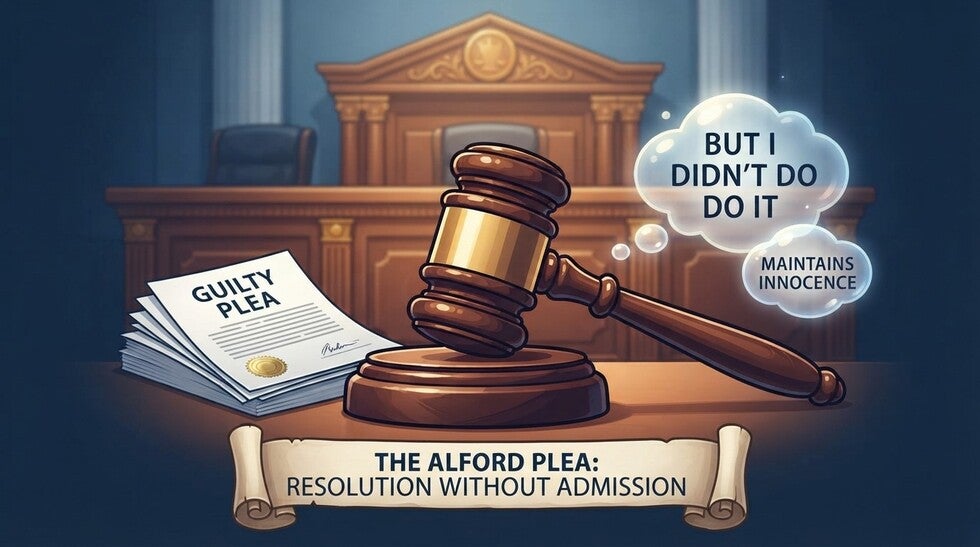
An Alford plea is a guilty plea entered by a defendant who maintains they are innocent, accepted by the court because the prosecution's evidence is strong enough that a rational person might plead to avoid the risk of trial. The U.S. Supreme Court approved it in North Carolina v. Alford in 1970. California has its own version from the same year, the West plea, in which the defendant pleads guilty or, more often, no contest, without admitting the facts, and stipulates that the judge may find a factual basis for the plea in the police report or preliminary hearing transcript. Either way the result is a conviction, with every consequence a conviction carries: sentence, criminal record, immigration exposure, registration if the offense requires it. What the plea protects is narrower than most people hope, and it is worth understanding exactly what before you take one.
The Bulldog Law's attorneys negotiate West pleas regularly, and we also talk clients out of them regularly, because the phrase sounds like a way to plead without really pleading, and it is not. It is a way to plead without saying the words. Sometimes that distinction is worth a great deal, to the client, to a family, to a professional license board that asks about admissions. Sometimes it is worth nothing and costs a better outcome. What follows is how the plea works in a California courtroom, where it helps, where it doesn't, and why some judges and prosecutors refuse it. If you've been offered one, call (888) 928-1609 or message our team before the next court date.
Where the name comes from
Henry Alford was charged with first-degree murder in North Carolina, facing the death penalty if convicted. The evidence was strong. He pleaded guilty to second-degree murder to get thirty years instead of a possible execution, and told the judge, on the record, that he hadn't killed anyone and was pleading only to avoid the gas chamber. He later argued the plea was involuntary because he'd been coerced by the death penalty. In North Carolina v. Alford, the Supreme Court disagreed: a guilty plea accompanied by a protestation of innocence is valid when the defendant intelligently concludes it's in his interest and the record contains strong evidence of guilt. The plea took his name.
California got there on its own. In People v. West, decided in 1970 as well, the state Supreme Court approved plea bargains in which the defendant pleads to an offense that isn't necessarily supported by the facts as charged, a reasonably related lesser offense, in exchange for dismissal of the greater one. A West plea is entered without the defendant admitting the truth of the underlying facts.
Combined with Penal Code 1192.5, which requires the court to find a factual basis for a negotiated plea but lets that basis come from the record rather than the defendant's mouth, you get California's everyday version of the Alford plea: the lawyer says the defendant pleads no contest pursuant to People v. West and stipulates to a factual basis from the police report, the judge says the plea is accepted, and the defendant has said nothing about what happened.
How a West plea actually goes in court
The mechanics matter, because they're where the protection lives. A standard guilty plea in California involves the judge, or the plea form, asking the defendant to admit the elements: on that date, did you willfully do this? A West plea skips the admission. The defense attorney states the plea is entered under People v. West, the defendant enters no contest, and the parties stipulate the court may find a factual basis in a specified document, usually the arrest report or the preliminary hearing transcript. The judge reviews the document, finds a factual basis, and takes the plea.
Nothing in that exchange is an admission by the defendant that the report is true. That is the entire point, and it is also the entire limit. The conviction is entered. Sentencing proceeds. Probation conditions attach. The plea form the defendant signs still waives the right to trial, to confront witnesses, and to remain silent, and still acknowledges the consequences. Our attorneys walk clients through the form line by line, because a West plea is not a soft plea; it is a full plea with the admission removed.
What the plea protects
Honestly, less than the name suggests, but not nothing.
Civil lawsuits. A guilty plea is an admission that can be used against you in a civil case about the same event. Under Penal Code 1016, a no contest plea to a misdemeanor cannot be. A no contest plea to a felony can. For a client facing a civil suit alongside a misdemeanor case, a car crash, a bar fight, a property dispute that became a criminal charge, the West/no contest combination is a real shield, and it is why California defense lawyers reflexively enter West pleas as no contest rather than guilty.
Licensing and employment questions. Some professional license applications and employer forms ask whether you have admitted to conduct, separately from whether you were convicted. A West plea allows a truthful answer that you were convicted but did not admit the facts. The value varies board by board and is often smaller than clients hope, because most forms ask about convictions, and the conviction is there.
Dignity. This sounds sentimental and is not. A parent who will not tell their children they committed a crime they believe they didn't commit, a person whose community will read the court file, a defendant who has maintained innocence for two years and will not reverse that under pressure: the West plea lets them accept a bargain without the words. Our attorneys have watched clients accept an offer they'd refused for months once they understood they wouldn't have to admit anything.
What the plea does not protect
The sentence. A West plea is sentenced like any other conviction. Judges do not give lighter sentences for it, and some, aware the defendant denies the offense, look for less remorse and give more. Whatever the plea bargain promised is what the defendant gets, no better.
The record. It is a conviction. It appears on background checks, DOJ criminal history, and court indexes exactly like a guilty plea. Expungement under Penal Code 1203.4 is available on the same terms as any other plea, which our page on what expungement means explains, and until then the record reads the same.
Immigration. This is where the misunderstanding does the most harm. Federal law defines a conviction as a plea of guilty or nolo contendere, or a finding of guilt, plus some punishment or restraint. Whether the defendant admitted anything is irrelevant. An Alford plea to a deportable offense is a deportable conviction; to an aggravated felony, an aggravated felony. And immigration judges look at the plea colloquy and the documents the court used for the factual basis, so stipulating to a police report as the factual basis can hand the government the very facts the client refused to admit. Before any non-citizen enters a West plea, our immigration attorneys review the consequences of the specific charge and sentence, because that, not the plea's label, decides the outcome.
Registration and other statutory consequences. A West plea to an offense that requires sex offender registration requires registration. One that triggers a firearm ban triggers it. One that counts as a strike counts. Restitution is owed. The plea changes the defendant's words, not the statute.
The treatment program problem
There is a trap our attorneys warn about in every domestic violence and sex offense case where a West plea is on the table. Probation in those cases nearly always requires a treatment program, a 52-week batterer's intervention program or a sex offender treatment program, and those programs are built around acceptance of responsibility. A participant who says, week after week, that he didn't do it can be terminated from the program for failure to participate, and termination is a probation violation. The client then faces the original sentence for refusing to admit what the West plea let him refuse to admit in court. The solution is to know the program's requirements before the plea, choose a provider whose approach is compatible, or, sometimes, to recognize that a West plea and the probation terms attached to it cannot coexist for that client.
Why judges and prosecutors refuse them
A judge is never required to accept a plea, and some will not accept a West plea at all, or not in certain categories. The reasoning is usually that a defendant who maintains innocence has no business being convicted, and should go to trial; or that the factual basis requirement in Penal Code 1192.5 should mean something more than a stipulation to a police report; or, in sex and domestic violence cases, that the treatment problem above makes the plea a setup for failure. Prosecutors in some counties decline to offer them in those same categories, and demand a factual admission as the price of the bargain.
When that happens, the negotiation shifts. Our attorneys look for the charge the client can honestly admit, a related offense with a different factual basis, or a resolution that isn't a plea at all: diversion, a deferred entry of judgment, a civil compromise in a misdemeanor property case. And sometimes the honest answer is that the case should be tried. A client who cannot say they did it, facing a prosecutor who won't take a plea without the admission, with a defense that has the signs of a strong position, is often better served by a jury than by any plea, and a hung jury tends to produce the West plea offer that was refused before.
Withdrawing an Alford plea
Second thoughts are common with West pleas, precisely because the client never admitted anything and feels the conviction as an injustice. The law does not treat them differently from any other plea. Under Penal Code 1018, a plea can be withdrawn before judgment, or within six months after probation is granted, for good cause: mistake, ignorance, inadvertence, or overreaching that overcame the exercise of free judgment. Regret is not good cause. Discovering that the plea has an immigration consequence nobody explained can be. So can a plea entered without a real factual basis, or under advice that turned out to be wrong. The window is short and the standard is real, so a client who wants out should call before sentencing, not after.
Deciding
Our attorneys put the choice to clients this way. A West plea is worth taking when the offer is good, the trial risk is serious, the collateral consequences have been checked and are survivable, the probation terms don't require an admission the client can't give, and what the client actually needs is to not say the words. It is not worth taking when the client believes the plea itself is a lesser conviction, because it isn't; when immigration or registration consequences make the offer a loss regardless; or when the case is winnable and the plea is being offered because the prosecutor knows it. Those conversations happen in our office before every plea, with the character letters and mitigation ready in case the answer is to plead, and the trial file ready in case it isn't.
Frequently asked questions
Does California allow Alford pleas?
Yes, in substance, though you'll rarely hear the name in a California courtroom. The state's version is the West plea, from People v. West, a 1970 California Supreme Court case decided the same year as North Carolina v. Alford. A defendant pleads guilty or no contest to a charge, often a lesser or related one, without admitting the facts, and the judge finds the factual basis in the police report or preliminary hearing transcript instead of in the defendant's own words. Judges have discretion to refuse, and some do in sex and domestic violence cases.
What is the difference between an Alford plea and no contest?
No contest, or nolo contendere, means you don't contest the charge; you neither admit nor deny it. An Alford plea goes further: you plead guilty while affirmatively saying you're innocent. In California the two usually travel together, because a West plea is typically entered as no contest with the defendant stipulating that the court may find a factual basis in the record. Both produce a conviction identical to a guilty plea for sentencing, record, and immigration purposes.
Why would an innocent person take an Alford plea?
Because trial is a gamble, and the offer is certain. A person facing a strike, a mandatory prison term, or a charge that carries lifetime registration may be offered a misdemeanor and probation in exchange for a plea. The Alford structure lets them take that certainty without standing up in court and saying they did something they believe they didn't do. It is a decision our attorneys treat with real seriousness, because the conviction is real even if the admission isn't.
Does an Alford plea help with immigration?
No. Federal immigration law defines a conviction as any plea of guilty or no contest, followed by some form of punishment. Maintaining innocence at the plea changes nothing. If the offense is deportable or an aggravated felony, an Alford plea to it is exactly as dangerous as a guilty plea. What helps is the charge you plead to and the sentence imposed, which is where our immigration attorneys focus before any plea is entered.
Can an Alford plea be used against me in a civil lawsuit?
It depends on how the plea was entered. A guilty plea is generally admissible in a later civil case as an admission. Under Penal Code 1016, a no contest plea to a misdemeanor cannot be used against you in a civil suit arising from the same act; a no contest plea to a felony can be. This is one of the practical reasons California West pleas are almost always entered as no contest rather than guilty.
Related reading from our attorneys
- No contest vs. guilty plea in California
- Plea bargaining in criminal cases
- Wet reckless: the DUI plea bargain
Offered a West plea? Get the full picture first
The Bulldog Law's defense attorneys negotiate pleas across California and, before any client enters one, run the immigration, licensing, registration, and probation analysis that decides whether the offer is a bargain or a mistake. Visit our criminal defense page, call (888) 928-1609, or reach us online. A plea takes five minutes to enter and years to undo.