
Updated October 2026 | The Bulldog Law | California Criminal Defense
Every person charged with a crime in California who cannot afford a lawyer is entitled to one at public expense, under the Sixth Amendment as applied in Gideon v. Wainwright and under Penal Code 987. The appointment happens at the first court appearance, the arraignment, after the judge asks about income and assets, and the lawyer appointed is a deputy public defender from the county's office, or, where that office has a conflict, a lawyer from the alternate defender or a court-appointed panel.
The service is free; California eliminated the fees and most reimbursement in 2022. Public defenders are specialists who try more cases than most private lawyers and know their courthouses well. Their constraint is volume: caseloads that leave little time for any one client before the day in court. A private attorney is retained for a fee, chosen rather than assigned, and can begin before charges are filed, which appointed counsel cannot. A defendant with a public defender may retain private counsel at any time, and may ask the court to replace appointed counsel by Marsden motion, which is granted only on a showing of inadequate representation or a complete breakdown.
The Bulldog Law's attorneys are asked the public-defender question by nearly every person who calls, and the honest answer is that a public defender may be the right choice. We say so when it is true: a first-offense misdemeanor with a standard disposition, a case with no pre-charge window, a client for whom the fee would be a hardship with no corresponding benefit. We also explain what a retained lawyer does in the cases where it matters: the weeks before charges are filed, the investigation that a hundred-case docket cannot support, the immigration analysis, the motion practice, the availability. What follows is how appointment works, who qualifies, what each kind of lawyer can and cannot do, how to change lawyers, and how to decide. Call (888) 928-1609 or message our team and we will tell you which one you need.
The right to appointed counsel
The Supreme Court held in Gideon v. Wainwright in 1963 that the Sixth Amendment requires states to provide counsel to indigent defendants in felony cases, and extended the right to any case in which imprisonment is actually imposed in Argersinger v. Hamlin. California's Penal Code 987 implements it: at arraignment, the court must inform the defendant of the right to counsel and, if the defendant desires and is unable to employ counsel, must assign counsel to defend them. The right applies in every felony and misdemeanor case in which jail is possible, in juvenile delinquency proceedings as our page on juvenile justice explains, and at every critical stage: arraignment, bail hearings, the preliminary hearing, plea negotiations, trial, sentencing, and the first appeal. It does not apply to infractions, which carry no jail.
The appointment. At the arraignment, the defendant states that they cannot afford a lawyer, the judge asks about employment, income, assets, and dependents, sometimes on a financial declaration form, and the court appoints the public defender. The inquiry is brief and the standard is generous: a defendant who could not retain counsel without substantial hardship qualifies, and a defendant who is in custody and cannot work qualifies almost automatically. A defendant who is denied may renew the request with more information or may be found eligible later if circumstances change. Where the public defender's office has a conflict, because it represents a co-defendant or a witness, the court appoints the alternate public defender or a private lawyer from the county's indigent defense panel, who is paid by the county and is otherwise indistinguishable from appointed counsel.
The cost. California once charged a registration fee of up to $50 and allowed courts to order reimbursement from defendants later found able to pay. Legislation in 2021 and 2022 repealed the registration fee and most reimbursement provisions as part of the effort to eliminate criminal justice fees, and the practice of billing defendants for appointed counsel has largely ended. A defendant who was indigent at arraignment and later recovers financially is not ordinarily pursued.
What public defenders do well, and what their caseloads prevent
Public defenders are criminal law specialists. A deputy public defender in a California county tries more jury trials in a year than most private attorneys try in several, appears before the same judges daily, knows which prosecutor will deal and which will not, knows the collaborative courts and diversion programs, and has the office's investigators, social workers, and appellate unit behind them. On the courtroom skills that decide trials, the average public defender is as good as or better than the average private attorney, and the defense bar knows it.
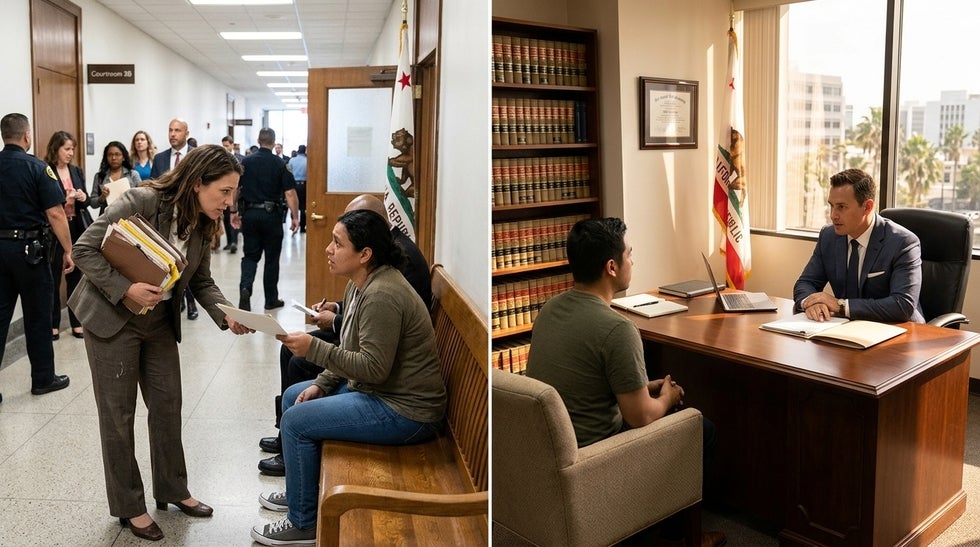
The constraint is arithmetic. National standards recommend no more than 150 felony cases a year per lawyer; many California deputies carry more than that at once, and misdemeanor deputies carry several hundred. The consequence is not incompetence but triage: the time available for any one case is the time that case competes for against every other, and the clients who get the most attention are the ones whose cases are set for trial. For the client whose case is not, the practical effects are familiar: the first substantive conversation with the lawyer happens in the hallway minutes before the hearing; the lawyer has the police report but has not interviewed the witnesses; the investigator has not been assigned; the plea offer is conveyed with a recommendation but without the investigation that would show whether it should be accepted; calls are returned slowly or by a different lawyer; and the lawyer who handled the arraignment is not the one who handles the preliminary hearing or the trial, because the office rotates assignments by courtroom. None of that is a failure of the lawyer. It is the system working as funded.
Two further limits are structural. A public defender cannot be appointed before charges are filed, because there is no case to be appointed to, and the period between an arrest or an investigation and the filing decision, in which a prosecutor can be persuaded not to file or to file less, is one in which the client has no lawyer unless they retain one. And a public defender's office cannot provide the collateral services that a client's case may need, an immigration attorney to analyze the plea, a civil lawyer for the related matter, a licensing specialist, though some offices now have immigration units.
What a private attorney does differently
The honest statement is that a retained attorney sells time and choice. Time: a private lawyer carries a fraction of the caseload, and the hours go into the client's case, the investigation, the witness interviews, the records, the expert, the suppression motion, the alibi, the negotiation conducted from a position of preparation rather than from the file. Choice: the client selects the lawyer, interviews them, reads their record, and can leave; the lawyer who starts the case finishes it. Availability: calls are returned, the client's family is kept informed, and the lawyer is reachable between hearings. The pre-charge period: a retained lawyer can contact the detective or the prosecutor before a filing decision, present the client's side, arrange a surrender, and sometimes end the matter before it begins, which is the single stage at which representation makes the most difference and the one appointed counsel cannot cover. And the collateral analysis, immigration above all, which our firm does in-house.
The cost is real, and our page on what a criminal defense lawyer costs in California explains the fee structures. A retained lawyer is not automatically better; our page on the signs of a bad defense attorney exists because some are not, and a private lawyer who takes too many cases has recreated the public defender's problem without the public defender's skill. The question is whether the case is one in which the time and the choice change the outcome.
Changing lawyers
From a public defender to a private attorney. A defendant may retain private counsel at any stage. The new lawyer files a substitution of attorney, the court relieves the public defender, and the case continues, usually without delay. There is no hearing and no showing required; the right to counsel of choice, for a defendant who can pay, is absolute short of trial-day disruption.
From one appointed lawyer to another: the Marsden motion. A defendant who wants a different appointed lawyer must ask the court, and the procedure comes from People v. Marsden in 1970. The defendant states, in court, that they wish to replace counsel; the judge clears the courtroom of the prosecutor and holds a closed hearing at which the defendant explains the complaints in detail and the lawyer responds; and the judge grants the motion only if the record shows that counsel is not providing adequate representation, or that the defendant and counsel have become embroiled in such an irreconcilable conflict that ineffective representation is likely to result. Disagreements about strategy, whether to file a motion, whether to accept a plea, which witnesses to call, do not meet the standard; the lawyer decides strategy. Failure to communicate, failure to investigate, and a lawyer who has stated they cannot work with the client do. Marsden motions are denied far more often than granted, but the hearing creates a record, and a denial can be reviewed on appeal.
Self-representation. A defendant may waive counsel and represent themselves under Faretta v. California, after the court confirms the waiver is knowing and voluntary. Judges warn against it for good reason; a defendant who wishes to participate more actively is better served by retaining counsel than by discharging it.
How to decide
Take the public defender when the case is a first-offense misdemeanor with a predictable disposition, when charges have already been filed and the pre-charge window has closed, when the fee would be a genuine hardship, and when the case is going to trial and the deputy assigned is experienced, because at trial a good public defender is a good lawyer.
Retain counsel when there is a pre-charge window: an investigation, a detective's call, a target letter, an arrest without a filing yet. When the client is a non-citizen, because the plea that a public defender recommends as the best available may be the one that ends the client's residence. When the case depends on investigation the office will not have time for: witnesses to find, records to subpoena, an expert to retain, a weak case to expose before the preliminary hearing. When the client has a license, a security clearance, a profession, or a custody matter that the resolution affects. When the client is in custody and the bail argument needs to be made with preparation rather than from the file. And when the client needs to reach their lawyer. The Miranda advisement says a lawyer will be provided if you cannot afford one, and that is true; what it does not say is when, and the when is often the whole question. Our attorneys answer it honestly on the first call, including when the answer is that the public defender will do.
Frequently asked questions
How do you get a public defender in California?
Ask for one at your first court appearance, usually the arraignment. The judge will ask about your income, assets, and dependents, sometimes with a short financial declaration, and appoint the public defender's office if you cannot afford to retain counsel. Penal Code 987 requires the court to inform every defendant of the right to counsel and to appoint one for a defendant unable to employ counsel. You do not apply in advance; the appointment happens in court.
Do you have to pay for a public defender?
Not up front, and in most cases not at all. Since 2022, California has eliminated the registration fee and most of the reimbursement provisions that once allowed counties to bill defendants for appointed counsel. A court may still assess a defendant who is later found able to pay, but the practice has largely ended. The public defender's services are free at the point of use.
Are public defenders good lawyers?
Usually, yes. Public defenders in California try more cases than most private attorneys, know the judges and prosecutors in their courthouse, and are specialists in criminal law. Their limitation is caseload: a deputy public defender may carry well over a hundred open cases, which limits the time for investigation, client contact, and motion practice in any one of them. The quality of the lawyer is not the problem; the quantity of the work is.
Can you switch from a public defender to a private attorney?
Yes, at any time. A defendant may retain private counsel, who substitutes in by filing a substitution of attorney, and the public defender is relieved. The reverse, replacing a public defender with a different appointed lawyer, requires a Marsden motion and a showing that the relationship has broken down or that the lawyer is providing inadequate representation, and it is rarely granted.
What is a Marsden motion?
A request by a defendant with appointed counsel to have that lawyer replaced with a different appointed lawyer, named for People v. Marsden, a 1970 California Supreme Court decision. The judge holds a closed hearing, without the prosecutor, at which the defendant explains the complaints and the lawyer responds. The motion is granted only if the lawyer is not providing adequate representation or the conflict is so severe that ineffective representation is likely. Disagreement about strategy is not enough.
Related reading from our attorneys
- How much does a criminal defense lawyer cost in California?
- Five signs of a bad criminal defense attorney
- What happens at arraignment in California
Not sure whether you need a private attorney? Ask one; the first conversation is free
The Bulldog Law's defense attorneys represent clients in California state and federal courts from the pre-charge stage through trial, and tell callers plainly when a public defender will serve them as well. Visit our criminal defense page, call (888) 928-1609, or reach us online.