
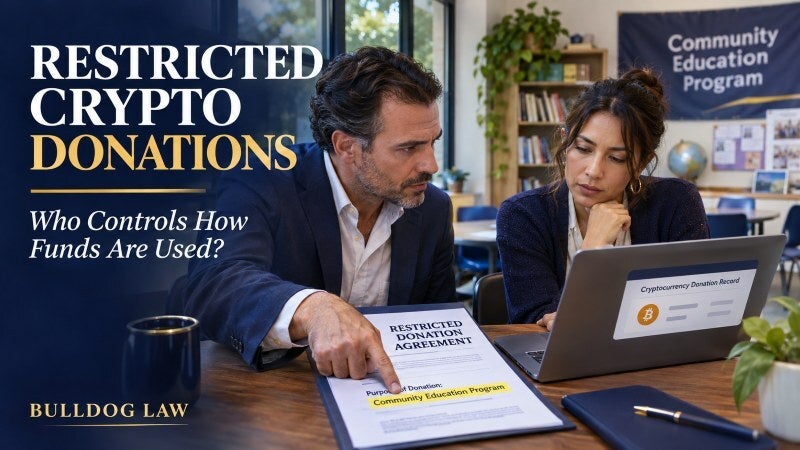
A donor gives cryptocurrency to support a specific charitable program. Later, the organization sells the tokens, transfers the proceeds, or uses some of the money for another project. Has it violated the donor's instructions? A restricted crypto donation in California can raise questions about the gift agreement, the charity's accounting, and who has the right to enforce the restriction.
Quick Answer
A charity that accepts a restricted gift generally must respect the applicable restriction, but the result depends on what was agreed and how the funds were held. Selling donated tokens does not automatically violate a restriction on their charitable purpose. A donor may have an enforceable interest in some circumstances, while the California Attorney General and other authorized parties may also have enforcement roles.
What Makes a Crypto Donation Restricted?
A restricted donation is given for a specified purpose or subject to another limitation accepted by the recipient. For example, a donor might contribute cryptocurrency to fund a particular scholarship program, purchase medical equipment, or support a community clinic.
The restriction may appear in a signed gift agreement, an exchange of messages, a campaign description, or another record. The wording and circumstances matter. A donor's private hope that a charity will use a gift in a certain way is different from a restriction communicated to and accepted by the organization.
Consider a donor who sends ETH after receiving an agreement stating that the contribution will fund a named education program. If the charity later uses the proceeds for an unrelated building project, the agreement and accounting records become central to the dispute.
Some donations are made through a platform or an automated protocol. A smart contract governing a transfer may help show how tokens moved, but the parties should also review the donation terms and communications outside the blockchain.
Can a Charity Convert Restricted Cryptocurrency Into Cash?
Often, the answer depends on the restriction. A gift designated for a program may permit the charity to sell the tokens and use the proceeds for that program. A separate instruction requiring the organization to hold particular tokens, or obtain consent before selling them, presents a different question.
For example, a gift agreement might specify that donated Bitcoin must be converted promptly and the proceeds used for a food distribution program. In that situation, conversion may be consistent with the agreement. If the agreement instead restricts conversion or establishes an endowment, the organization needs to examine those terms before acting.
To understand the transaction, review the date and amount received, the sale price, exchange fees, and where the proceeds went. If a third party held the assets, the relevant custody and exchange records can help explain who instructed the sale and when it occurred.
When Does a Change in Use Become a Legal Problem?
A disagreement can arise when donated funds are moved to a general account, used for overhead, transferred to an affiliated organization, or spent on a different project. Whether a particular use violates the restriction depends on the gift terms and applicable law.
For instance, an agreement to fund a clinic might permit reasonable administration expenses, prohibit them, or say nothing about them. Moving funds through a general bank account also does not by itself prove misuse if the organization can account for the restricted balance and apply it properly. The question is what happened to the funds and whether that treatment complied with the restriction.
Internal controls may be relevant when several people can approve transfers. Records concerning multisignature wallet authority and access held by an employee or officer can help establish who had authority and what instructions were given.
A transfer that appears inconsistent with a gift agreement should be investigated before anyone concludes it was intentional theft. Accounting mistakes, unclear restrictions, and unauthorized conduct can require different responses.
Who Can Enforce a Restricted Crypto Donation in California?
California's Attorney General has primary responsibility for supervising charitable trusts and protecting assets held for charitable purposes. Depending on the organization and claim, other parties may also have authority to act.
For certain actions involving a public benefit corporation and breach of a charitable trust, Corporations Code Section 5142 identifies eligible parties, including the corporation, certain officers and directors, a qualifying person with a reversionary, contractual, or property interest, and the Attorney General. The statute also provides for notice to the Attorney General in actions brought by specified private parties.
A donor should not assume that making a gift always creates a personal right to sue or demand a refund. Standing depends on the type of claim, the gift documents, and the donor's legal interest. California courts have recognized donor enforcement in some circumstances, so the agreement and governing law deserve careful review.
Possible remedies may include an accounting, an order directing proper use of funds, or recovery for the charitable purpose. A return to the donor is not automatic and depends on the governing terms and law. Counsel evaluating blockchain-related litigation can also identify whether a contract claim or another legal theory is available.
Can the Charity Change a Restriction?
A program may close, a project may become impossible, or the original purpose may no longer be practical. The organization should not simply redirect funds because another use seems more convenient.
For covered institutional funds, Probate Code Section 18506 provides specific procedures for releasing or modifying restrictions. Depending on the circumstances, these may involve the donor's consent in a record or a court application with notice to the Attorney General. The statute also provides a limited procedure for certain older, smaller funds when its conditions are met.
Whether those provisions apply depends on the fund and its governing documents. A charity considering a change should document the problem, the proposed use, and the legal basis for the change before moving funds.
What Records Help Resolve the Dispute?
Donors and organizations should preserve both blockchain and conventional records. Useful materials include:
- The gift agreement, campaign language, donor communications, and acceptance records.
- Wallet addresses, transaction hashes, token quantities, and receipt dates.
- Exchange statements showing conversion dates, prices, and fees.
- Accounting entries identifying the restricted fund and its remaining balance.
- Invoices, grants, and other records showing how proceeds were spent.
- Board approvals, transfer authorizations, and communications about changing the purpose.
Blockchain evidence in court can show a transfer, but it may not identify the legal owner of an address or prove why a payment was made. Accounting records and communications provide context.
Preserve records without sharing seed phrases or exposing private keys. Appropriate steps for securing digital assets can protect remaining funds while the organization investigates.
Possible Civil and Criminal Issues
Many disputes concern interpretation, accounting, or correction of a restricted fund. In more serious circumstances, evidence of intentional appropriation may raise questions under California Penal Code Section 503 concerning embezzlement. Criminal liability depends on the required facts and intent; an unfavorable investment result or bookkeeping error alone does not establish it.
A review of embezzlement and misappropriation under PC 503 should be based on evidence, including who controlled the property and what they did with it.
For a potential civil claim, avoid delaying a review while waiting for an internal investigation to finish. Applicable filing deadlines depend on the claim, parties, and facts. Preparing for cryptocurrency litigation can begin with preserving records and identifying the specific restriction.
Frequently Asked Questions
Can a donor demand the original tokens back?
Not automatically. The answer depends on any retained interest, return provision, applicable charitable restrictions, and available remedies.
Does a drop in token value prove misuse?
No. The relevant inquiry may include the gift's holding or conversion terms, the organization's decisions, and the applicable duties. Market losses alone do not prove a breach.
Can the parties settle without a lawsuit?
Possibly, although a private agreement must respect applicable charitable restrictions and any required approvals. A cryptocurrency settlement agreement can address payment method, timing, and releases.
Restricted Crypto Donation Lawyers in California
Bulldog Law helps donors, charities, and other parties evaluate gift terms, transaction histories, and potential enforcement options. A focused review can identify whether the dispute concerns conversion, use of proceeds, accounting, or authority to modify the restriction.