
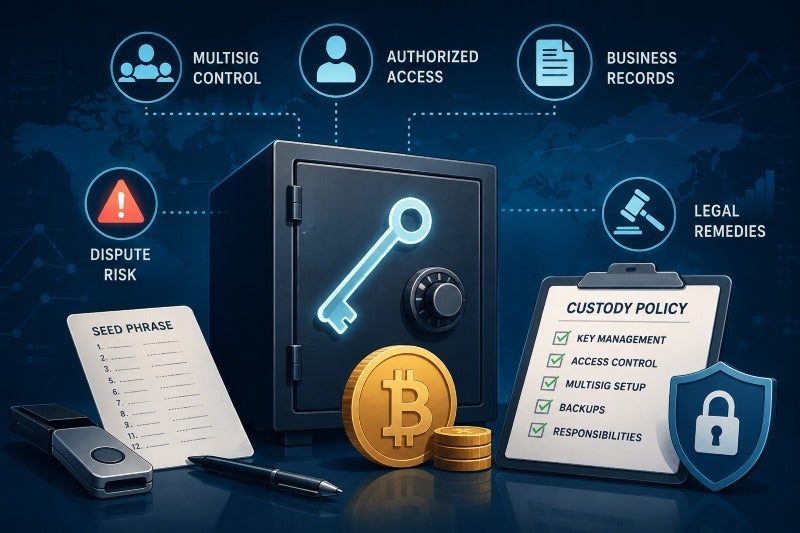
Crypto Private Key Disputes can put an entire business, DAO, investment account, project treasury, or family asset at risk. When one founder, employee, contractor, advisor, agent, or former partner controls the private keys or seed phrase, the legal issue is not only who can move the assets. The dispute may involve ownership, fiduciary duties, access rights, business records, emergency court remedies, and whether the person with technical control is using that control lawfully.
In California, the key question is usually whether the person holding the keys has legal authority to control the wallet. A founder may have access because they set up the account. An employee may hold a seed phrase because they handled treasury operations. An agent may control a wallet for convenience. None of those facts automatically prove ownership. Courts and opposing parties may look at contracts, entity records, communications, accounting records, wallet history, and the purpose of the assets.
Why Crypto Private Key Disputes happen
Crypto Private Key Disputes often happen because digital asset access is created informally. A startup may launch before adopting wallet policies. A founder may create the original wallet and never transfer access to the company. A project may rely on one technical employee to manage wallets, exchanges, staking, or treasury payments. A family member or agent may hold a seed phrase without a written custody agreement.
Common disputes include:
- A founder leaves but keeps access to company wallets.
- An employee is terminated and refuses to return wallet credentials.
- A former advisor claims a wallet contains personal tokens, not company assets.
- A project cannot pay contributors because one person controls the treasury wallet.
- A seed phrase is stored in a personal notebook, phone, password manager, or cloud account.
- A signer blocks transactions until a business or compensation dispute is resolved.
- A spouse, investor, or creditor suspects that digital assets were moved to a private wallet.
When the dispute involves several signers rather than one keyholder, multisig wallet signer deadlock may determine whether the project can move funds, replace signers, or seek emergency relief.
Crypto Private Key Disputes and ownership rights
Crypto Private Key Disputes often turn on the difference between technical control and legal ownership. A person who controls a private key can move assets, but that does not necessarily mean the person owns the assets. The wallet may hold company funds, customer assets, investor proceeds, marital property, escrowed assets, DAO treasury funds, or tokens promised to contributors.
Ownership evidence may include operating agreements, board approvals, cap tables, investor updates, wallet ledgers, invoices, payroll records, tax records, purchase records, token grant documents, and messages showing why the wallet was created. If a wallet was used for both personal and business activity, the analysis can become more difficult because the parties may need to trace deposits, withdrawals, swaps, staking rewards, and transfers between related wallets.
Founder separations create especially difficult private key issues. A wallet that began as a personal founder wallet may later become the project's working treasury. In that situation, crypto business breakup disputes over wallets and project assets may affect whether a departing founder must preserve funds, disclose records, or transfer control.
Seed phrase access, custody policies, and business records
Private key custody should be treated as a business control, not a casual technical detail. A company or project should know who can access each wallet, where seed phrases are stored, who can approve transfers, what backups exist, and what happens when a person leaves the organization.
Useful custody records may include:
- Wallet creation records and purpose statements.
- Lists of authorized keyholders, signers, and backup custodians.
- Written policies for storing seed phrases and hardware wallets.
- Transaction approval procedures and transfer limits.
- Offboarding checklists for founders, employees, contractors, and agents.
- Incident response procedures for lost keys, compromised devices, or suspected theft.
A project that never documented custody may still have legal rights, but poor records can make recovery harder. legal measures to secure cryptocurrency can help reduce future disputes by defining access, approvals, backups, and emergency procedures before a lockout occurs.
Fiduciary duties and misuse of wallet control
A person who controls keys may owe fiduciary duties depending on their role. Founders, officers, directors, LLC managers, partners, trustees, agents, and certain employees may have duties of loyalty, care, confidentiality, or accounting depending on the relationship and governing documents. The title is not always decisive. Courts may examine actual authority, control over funds, and how the person used the wallet.
Potential misconduct may include:
- Moving project funds to a personal wallet without approval.
- Refusing to return access after termination or removal.
- Using private key control to force a buyout or settlement.
- Concealing wallet activity from business partners, investors, or a court.
- Destroying, deleting, or refusing to produce wallet records.
- Using treasury assets to pay personal expenses.
- Failing to account for staking rewards, airdrops, NFTs, or bridged assets.
When wallet control is tied to a community project, DAO governance and treasury control disputes may affect whether a vote, proposal, signer action, or treasury transfer was authorized.
Agents, employees, and contractors who control private keys
Private key disputes often involve people who were given access for practical reasons. A developer may deploy contracts and retain admin keys. A finance employee may hold exchange credentials. A contractor may control a treasury dashboard. An outside agent may store a seed phrase for a client. The legal analysis depends on the agreement, the role, and the purpose of access.
If a contractor refuses to return access after a payment dispute, the case may involve both unpaid invoices and asset control. Web3 contractor disputes over unpaid work can overlap with key custody when developers, designers, moderators, or technical contributors claim payment while the project claims access rights.
Token compensation can also complicate key control. A founder or employee may claim they are holding tokens because they were promised a grant. The company may argue the tokens belong to the treasury until vested or transferred. token vesting disputes over founder or employee grants may determine whether the person holding access has a payment claim, an ownership claim, or simply custody of company assets.
Escrow, OTC trades, and private wallet lockouts
Private key disputes can arise in escrow and OTC transactions. A buyer may send funds to a wallet controlled by an escrow agent. A seller may claim the release conditions were met. The escrow holder may refuse release because the parties disagree about identity, performance, settlement timing, or fraud risk.
When assets are held for release after a condition is satisfied, crypto escrow disputes involving unreleased digital assets may help frame the issue as a breach of escrow instructions, custody failure, or contract dispute. If the wallet lockout arose from a high-value private trade, OTC crypto trade disputes involving failed settlement may also affect claims involving proof of funds, chargebacks, fake buyers, and counterparty fraud.
Blockchain evidence and wallet attribution
Blockchain records can show transfers, timestamps, contract interactions, and wallet balances. They usually do not prove by themselves who controlled a wallet, why a transfer was made, or whether the transfer was authorized. Wallet attribution often requires off-chain evidence.
Useful attribution evidence may include:
- Exchange KYC records connected to deposits or withdrawals.
- Device records, password manager records, and hardware wallet logs.
- Email, Slack, Telegram, Discord, Signal, and text messages.
- Transaction patterns tied to known business events.
- Prior invoices, payroll records, or treasury reports listing the wallet.
- Admissions that a person created, controlled, or moved assets from the wallet.
If a dispute reaches court, blockchain evidence in civil and criminal cases may affect authentication, wallet attribution, expert testimony, and the limits of chain-analysis reports.
Custody platforms, account freezes, and third-party access
Not every key dispute involves self-custody. Some assets are held through exchanges, wallet providers, custodians, or hosted wallet platforms. A former employee may control the login, but the platform may hold the private keys. In other cases, a business may know the wallet address but not have access to the exchange account that controls it.
Third-party custody disputes often require support tickets, subpoenas, account records, identity documents, login history, withdrawal logs, and proof of corporate authority. crypto custody disputes with exchanges and wallet providers may help determine whether a company can demand account access, records, or return of assets from a platform.
Government seizure and forfeiture risks
Private key disputes may also attract law enforcement attention if the wallet is suspected of holding stolen funds, fraud proceeds, money laundering proceeds, or assets tied to a criminal investigation. A private disagreement over access can become more serious if police or federal agents seize devices, wallets, exchange accounts, or cryptocurrency.
If law enforcement seeks to restrain or take control of digital assets, law enforcement cryptocurrency seizure issues may affect access, notice, warrants, and ownership claims. If the government pursues forfeiture, federal asset forfeiture defense may be needed to contest the seizure, prove lawful ownership, or seek return of property.
Where Crypto Private Key Disputes may be handled in California
Crypto private key disputes may be handled through negotiation, mediation, arbitration, California Superior Court, federal court, probate court, family court, bankruptcy court, or criminal proceedings depending on the facts. Civil claims may include breach of contract, conversion, fraud, breach of fiduciary duty, accounting, declaratory relief, unfair competition, trade secret claims, or requests for injunctive relief.
California Superior Court may become involved when a company, investor, spouse, creditor, or business partner seeks emergency relief to preserve digital assets, compel return of records, prevent transfers, or establish who has authority over a wallet. Federal court may be involved if the dispute includes federal claims, diversity jurisdiction, forfeiture, bankruptcy, fraud, or cross-border issues. Courts and agencies are neutral public institutions and are not affiliated with Bulldog Law.
Emergency remedies may be available in appropriate cases, including a temporary restraining order, preliminary injunction, preservation order, accounting, receiver, expedited discovery, or order requiring a person to preserve wallet credentials and records. The court will usually need specific evidence showing the assets at risk, who controls access, why harm may occur without urgent relief, and what order is practical.
Evidence to preserve in Crypto Private Key Disputes
Crypto Private Key Disputes are evidence-heavy. The parties should preserve records before devices are wiped, messages are deleted, or assets move to new wallets.
- Wallet addresses, transaction hashes, exchange records, and custody records.
- Seed phrase storage records, hardware wallet records, password manager entries, and access logs.
- Operating agreements, employment agreements, contractor agreements, agency agreements, and board approvals.
- Emails, texts, Slack, Discord, Telegram, Signal, support tickets, and project management records.
- Invoices, payroll records, tax records, investor updates, and treasury dashboards.
- Records showing who created the wallet, who funded it, who approved transfers, and who benefited.
- Evidence of lockouts, threats, demands, deleted access, unauthorized transfers, or refusal to account.
The goal is to build a timeline that separates ownership from custody. A strong record should show why the wallet existed, whose assets it held, who had authority to move them, and how the dispute affected the business or owner.
Practical steps when someone controls the keys
When a founder, employee, or agent controls private keys, the response should be careful and documented. Practical steps may include:
- Identify all wallets, exchange accounts, hardware wallets, signers, and backup locations.
- Preserve transaction records and communications immediately.
- Review contracts, operating documents, board approvals, and custody policies.
- Ask for an accounting and access return in writing.
- Avoid unauthorized access attempts that could create separate legal exposure.
- Evaluate whether assets are at risk of movement, liquidation, seizure, or loss.
- Consider emergency court relief if the person refuses to preserve assets or records.
For businesses, the best protection is prevention. Written custody policies, multisig controls, offboarding procedures, backup access, and clear records can reduce the risk that one person can lock the company out of its digital assets.
Crypto Private Key Disputes lawyers in California
Crypto Private Key Disputes require legal analysis that connects private key custody, seed phrase access, business records, fiduciary duties, wallet attribution, lockouts, third-party custody, and emergency remedies. A person with technical access may not have legal ownership, and a business without keys may still have enforceable rights.
Bulldog Law helps California clients evaluate private key disputes involving founders, employees, agents, contractors, DAOs, project treasuries, escrow wallets, OTC trades, token grants, custody platforms, government seizure, and asset forfeiture. Early legal review may help preserve evidence, identify responsible parties, and pursue practical remedies before digital assets move or access is lost.