
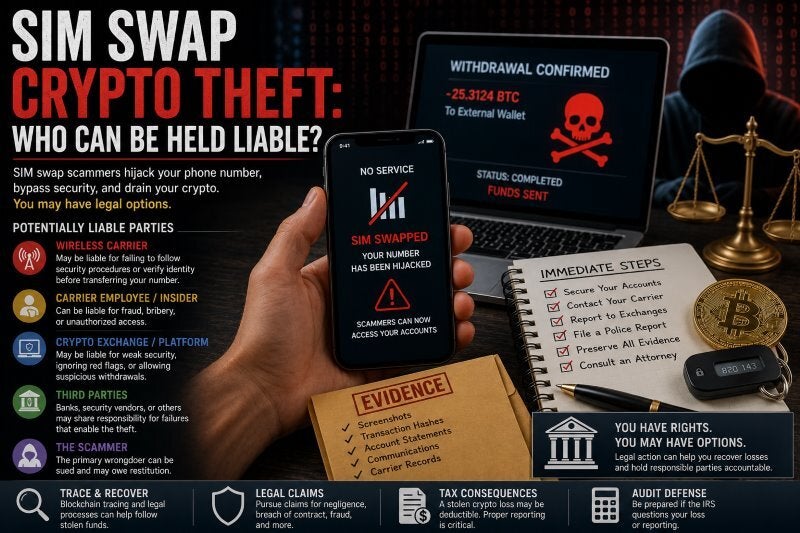
SIM swap crypto theft happens when a criminal hijacks a victim's mobile phone number, uses that number to bypass account security, and then drains cryptocurrency from exchanges, wallets, lending platforms, DeFi accounts, or connected financial accounts. For California victims, the key legal question is not only who stole the crypto, but also whether a wireless carrier, exchange, employee, platform, or other third party may share responsibility for allowing the attack to succeed.
Liability depends on the facts. A successful claim may require proof of account takeover, weak authentication, ignored fraud warnings, employee misconduct, negligent security procedures, breach of contract, privacy violations, or failures to respond after the theft. Recovery is never guaranteed, but quick action can help preserve evidence, identify responsible parties, and improve the chance of freezing or tracing stolen assets.
How SIM swap crypto theft happens
A SIM swap attack usually starts when a criminal persuades a mobile carrier to move the victim's phone number to a SIM card or device controlled by the attacker. The criminal may use stolen personal information, social engineering, forged documents, bribed insiders, or compromised carrier credentials.
Once the attacker controls the phone number, the victim may suddenly lose cellular service. The attacker can then intercept text messages, password reset codes, account recovery messages, and SMS-based two-factor authentication prompts. If the victim's crypto exchange, email account, password manager, or bank account relies on that phone number for recovery, the attacker may gain access quickly.
After access is gained, the criminal may sell tokens, convert assets to stablecoins, withdraw funds, send crypto through multiple wallets, or move assets through decentralized exchanges. Some thefts involve cross-chain transactions or swaps designed to complicate tracing. When funds move through non-custodial transactions, atomic swap compliance and defense issues may become relevant to understanding how assets were transferred, exchanged, or obscured after the account takeover.
Who may be liable for SIM swap crypto theft?
The primary wrongdoer is the person or group that carried out the SIM swap and stole the assets. Claims against the thief may include fraud, conversion, civil theft theories, unjust enrichment, conspiracy, or other remedies depending on the facts. Criminal prosecution may also lead to restitution, forfeiture, or victim compensation procedures.
However, the thief is often unknown, overseas, judgment-proof, or hiding behind false identities. That is why victims frequently look at whether other parties contributed to the loss. Potentially responsible parties may include a wireless carrier, a carrier employee, a mobile virtual network operator, a crypto exchange, a custodial platform, a security vendor, a bank, or a fake recovery company that caused additional harm.
A liability analysis should identify each party's role in the attack. Did the carrier authenticate the wrong person? Did an employee override security controls? Did an exchange ignore obvious signs of takeover? Did a platform allow a new device, password reset, and large withdrawal without meaningful friction? Did a bank or payment processor process suspicious transfers after notice of fraud? Each answer can affect the legal strategy.
Wireless carrier liability after a SIM swap
A wireless carrier may face liability if it failed to follow reasonable authentication procedures before transferring the victim's number, ignored account locks, failed to respond to fraud reports, or allowed unauthorized employees to access customer account information. Federal rules require wireless providers to use secure authentication methods before SIM changes and number port-outs, notify customers about SIM change or port-out requests, and maintain processes for fraud reporting and response.
In a civil case, a victim may assert claims such as negligence, gross negligence, breach of contract, negligent supervision, negligent hiring, privacy-related claims, or unfair business practices depending on the evidence. If a carrier employee helped the attacker or bypassed required procedures, the case may involve both direct misconduct and failures in training, supervision, access controls, and internal security.
Carrier contracts often contain arbitration clauses, class-action waivers, damage limitations, and notice requirements. These provisions can affect where the dispute is filed, what remedies are available, and how quickly a victim must act. A California victim should preserve the wireless contract, account notes, security settings, fraud reports, chat transcripts, call logs, and any written carrier response.
Can a crypto exchange be held liable?
A crypto exchange or custodial platform may be a potential defendant if its own security failures contributed to the loss. The analysis is usually fact-specific. A platform may argue that the account was accessed with valid credentials and that the withdrawal was authorized through the security settings selected by the user. The victim may respond that the platform ignored red flags, failed to enforce withdrawal holds, permitted suspicious device changes, or relied too heavily on SMS authentication despite known SIM swap risks.
Relevant facts may include whether the exchange detected a new device, new IP address, password reset, disabled authenticator, new withdrawal address, unusual trading pattern, or rapid account depletion. A platform's terms of service, customer support communications, security settings, and incident response records may be central to the dispute.
Some platforms are purely custodial, while others are DeFi interfaces, liquidity platforms, or wallet tools. If the stolen assets moved through swaps, yield protocols, liquidity pools, or lending transactions, DeFi tax reporting for complex wallet activity can help align the theft timeline with later reporting, tracing, and basis records.
Insider misconduct and negligent security
Some SIM swap cases involve insider misconduct. A carrier employee, contractor, store representative, or support agent may accept a bribe, improperly access customer information, override account protections, or approve a fraudulent SIM change. When insider misconduct is suspected, the victim should preserve timestamps showing when service was lost, when the number was transferred, when accounts were accessed, and when withdrawals occurred.
Negligent security claims may also arise if a company failed to implement reasonable safeguards for customer information. California privacy law may provide claims in certain data breach situations involving nonencrypted and nonredacted personal information, but the availability of those claims depends on the specific information exposed, the role of the business, the security failure, notice requirements, and damages.
Victims should not assume that every SIM swap automatically creates a privacy claim. The better approach is to identify what information was accessed, who accessed it, whether it was protected, whether the company had reasonable procedures, and whether the unauthorized access caused the crypto loss.
Immediate steps after SIM swap crypto theft
Fast action can make a difference. A victim should contact the mobile carrier immediately, regain control of the phone number, request a fraud ticket, demand preservation of account records, and ask for written confirmation of any SIM change or port-out. The victim should also secure email, exchange accounts, cloud storage, password managers, financial accounts, and any remaining wallets.
Evidence should be preserved before platforms delete logs or scammers erase accounts. Important records include transaction hashes, wallet addresses, exchange withdrawal confirmations, text messages, emails, device notifications, carrier call logs, screenshots, bank records, IP alerts, password reset notices, support tickets, and police reports.
Victims should also report the theft to law enforcement and relevant exchanges. When stolen assets can be traced to a centralized platform, a freeze request or legal process may be possible. A broader strategy for recovering stolen cryptocurrency through legal action may involve blockchain tracing, preservation letters, subpoenas, civil claims, and victim restitution procedures.
When SIM swap theft overlaps with pig butchering scams
Not every SIM swap begins as a technical attack. Some victims are first groomed through fake relationships, investment communities, impersonated support agents, or fraudulent trading platforms. The attacker may persuade the victim to reveal personal information, install remote access tools, share account details, or move funds to a fake platform before the SIM swap occurs.
When emotional manipulation and fake investment platforms are part of the loss, the legal theory may involve both account takeover and investment fraud. Victims should document the full timeline, including the relationship-building phase, fake platform messages, transfer instructions, SIM outage, account access, and withdrawal history. Cases involving pig butchering crypto scam recovery strategies often require both fraud analysis and asset-tracing work.
Tax consequences after SIM swap crypto theft
A stolen crypto loss may affect the victim's tax return. Digital assets are generally treated as property for federal tax purposes, so the tax analysis may involve basis, prior income, later dispositions, and whether a theft-loss position is available. A victim should not simply remove stolen assets from a portfolio without documenting what happened.
Tax treatment depends on whether the loss was personal, investment-related, or connected to a trade or business. Certain theft losses may require proof that the loss resulted from theft under applicable law, that the transaction was entered into for profit, and that there is no reasonable prospect of recovery. A victim should coordinate legal recovery efforts with cryptocurrency loss reporting rules before claiming a deduction or capital loss position.
If the stolen assets included staking rewards, the victim may also need to account for previously recognized income and basis. The tax analysis for staking rewards taxable after receipt may affect the basis of tokens that were later stolen or transferred during the account takeover.
Form 1099-DA and future reporting problems
Information reporting can make SIM swap cases more complicated. A crypto exchange may issue forms showing sales, swaps, or withdrawals, while the tax return must explain that some activity occurred because of theft. A form may not show the victim's full wallet history, recovery efforts, basis records, or theft timeline.
As digital asset broker reporting expands, victims should understand how Form 1099-DA crypto reporting may create IRS matching issues when a platform reports proceeds without the full context of a SIM swap theft.
California investors should also prepare for more detailed recordkeeping expectations. Planning around crypto tax rules for 2026 investors can help victims maintain transaction histories, basis records, wallet labels, and documentation needed to explain stolen assets in later filings.
IRS audits after a SIM swap loss
A SIM swap victim may face IRS questions if an exchange reports sales, transfers, or income that do not match the return. The taxpayer may also have missing basis records, large withdrawals to unknown wallets, prior unreported crypto income, or a claimed theft loss that needs support.
An audit response should be evidence-based. Useful materials include police reports, carrier fraud documentation, exchange records, wallet histories, transaction hashes, valuation data, prior tax returns, screenshots, recovery correspondence, and legal analysis supporting the reported treatment. When the IRS contacts a victim, crypto tax audit defense after theft should address both the numbers and the legal explanation for the loss.
How to strengthen a potential liability claim
A strong SIM swap claim usually depends on clean evidence. Victims should create a timeline showing when phone service stopped, when the SIM change occurred, when email or exchange accounts were accessed, when passwords were reset, when assets were sold or withdrawn, when the carrier was notified, and how each company responded.
Victims should avoid altering devices, deleting messages, or relying only on tax software exports. They should preserve original records and keep copies of all platform communications. If a carrier or exchange refuses to provide records, legal counsel may evaluate preservation letters, subpoenas, arbitration demands, civil complaints, or other legal tools.
Victims should also be cautious about fake recovery companies. Anyone who guarantees recovery, asks for private keys, demands more crypto to unlock funds, or claims to have special access to law enforcement may be attempting a second scam.
SIM swap crypto theft lawyers in California
SIM swap crypto theft cases can involve telecom rules, privacy law, arbitration clauses, exchange security, blockchain tracing, tax reporting, law enforcement, and civil litigation. The liable party may be the thief, but a wireless carrier, employee, exchange, or other third party may also be responsible if their conduct helped cause the loss.
Bulldog Law helps California crypto victims evaluate liability after SIM swaps, phone-number takeovers, exchange account hacks, wallet drains, phishing incidents, and related digital asset theft. The firm does not promise recovery, but it can help preserve evidence, identify potential claims, coordinate tax and legal issues, and pursue practical strategies when a SIM swap leads to stolen cryptocurrency.