
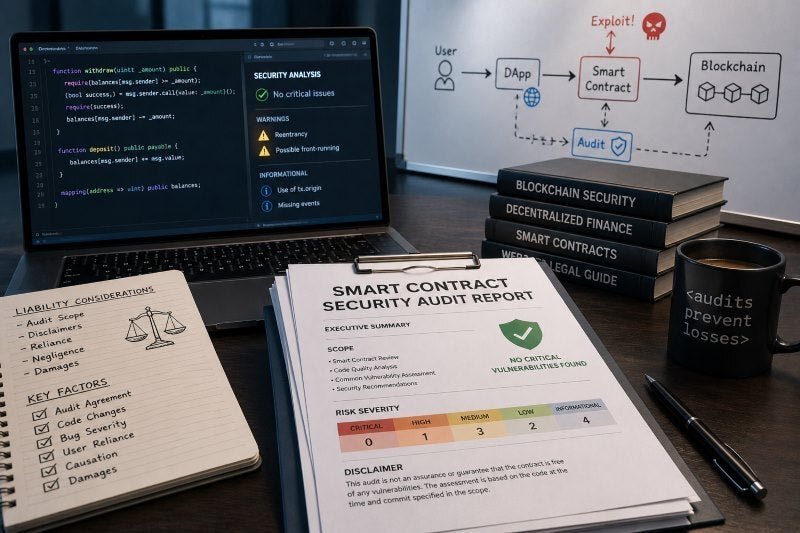
Smart Contract Audit Disputes often begin with a difficult question: if a project paid for a security review and an exploit still happened, who is legally responsible for the loss? In California, the answer usually depends on the audit contract, the scope of work, the audit report, the bug that was missed, post-audit code changes, user disclosures, and whether the project, auditor, founder, developer, or platform acted reasonably under the circumstances.
A smart contract audit is not always a guarantee that code is safe. Many audit reports contain disclaimers, scope limits, severity ratings, assumptions, and warnings that the review was not exhaustive. At the same time, an audit firm, developer, or project team may face legal risk if they made misleading statements, ignored known vulnerabilities, overstated the audit's meaning, or caused users to rely on incomplete security claims.
Why Smart Contract Audit Disputes happen
Smart Contract Audit Disputes usually arise after a hack, exploit, frozen contract, oracle failure, bridge failure, staking issue, NFT mint problem, game economy collapse, or treasury drain. The project may point to the auditor. The auditor may point to scope limitations or later code changes. Users may argue that the project marketed the protocol as audited, safe, or secure when serious risks remained.
Common disputes include:
- An exploit occurs after an audit report listed no critical issues.
- The auditor identified a bug, but the project did not fix it before launch.
- The project changed code after the audit and still promoted the protocol as audited.
- The audit report included disclaimers that users never saw.
- Investors or users relied on audit badges, launch announcements, or security claims.
- The project's multisig, admin key, or upgrade authority caused the loss.
- The exploit triggers tax, criminal, regulatory, or asset recovery issues.
Founders can reduce risk before launch by treating audits as one part of a broader legal and operational program. California crypto startup compliance planning can help align audit scope, user terms, custody controls, launch disclosures, and incident response before users commit funds.
Smart Contract Audit Disputes and the audit contract
Smart Contract Audit Disputes often turn first on the contract between the project and the audit provider. The contract may define what code was reviewed, which commit hash or repository version was in scope, whether formal verification was included, whether economic design was reviewed, and whether the auditor was responsible for retesting fixes.
Important contract terms may include:
- The exact codebase, repository, commit hash, and contracts reviewed.
- Whether the review included smart contract logic, tokenomics, oracle design, admin controls, bridge mechanics, or front-end risks.
- Whether the audit was manual, automated, formal, limited, or comprehensive.
- Limitations of liability, disclaimers, indemnity clauses, and damage caps.
- Confidentiality terms and publication rights for the final report.
- Retesting obligations after the project claims fixes were completed.
- Arbitration, venue, governing law, and notice requirements.
A project may claim the auditor missed a serious vulnerability within the agreed scope. The auditor may respond that the exploit involved code that was not reviewed, an unsupported integration, a later deployment, an economic attack, a compromised admin key, or a risk disclosed in the report. The documents and technical record usually decide which version is stronger.
Audit report disclaimers and user reliance
Audit reports often contain language warning that the audit is not a guarantee, that no review can identify every vulnerability, or that the report is based on a snapshot of code at a specific time. Those disclaimers can matter, but they do not automatically end every dispute.
Liability risk can increase when a project markets an audit in a way that overstates what the report actually said. For example, “audited and secure” may create a different impression than “an independent review identified issues that were addressed as of a specific commit.” If the project knew the audit was limited, incomplete, or outdated, users may argue that public statements were misleading.
Users and investors should preserve the audit report, website copy, token sale materials, Discord announcements, X posts, investor updates, pitch decks, and screenshots showing how the audit was described. Projects should preserve internal communications showing what they understood, what they fixed, and how they decided what to disclose.
When the audit was used to support a token distribution, grant campaign, or reward program, Web3 asset distribution disputes may overlap with claims that users relied on security representations before interacting with the protocol.
Negligence claims, bug severity, and causation
A negligence claim usually requires more than proof that an exploit happened. The claimant may need to show that the auditor or other defendant owed a duty, breached the applicable standard of care, caused the loss, and created damages that can be proven. In smart contract cases, that can require both legal and technical evidence.
Bug severity is important. A missed informational issue is different from a critical vulnerability that allows unrestricted minting, unauthorized withdrawals, reentrancy, oracle manipulation, governance takeover, or theft of user funds. A report that accurately labeled a risk as critical may protect the auditor if the project ignored it. A report that failed to identify a common high-risk issue may create a stronger argument for the claimant, depending on the scope and expert analysis.
Causation can be heavily disputed. The auditor may argue that the project changed the code after the audit, deployed the wrong contract, failed to implement a recommended fix, used unsafe admin keys, or ignored monitoring alerts. The project may argue that the exploit was foreseeable, within scope, and should have been caught during the review.
Post-audit code changes and deployment mistakes
Post-audit code changes are one of the most common defenses in smart contract audit disputes. A project may publish an audit report for one version of the code but later deploy a modified version. Even small changes can matter if they affect access control, upgradeability, price feeds, vault logic, token permissions, staking rewards, or withdrawal mechanics.
Evidence may include GitHub commits, deployment scripts, transaction hashes, internal testing notes, bug bounty reports, pull requests, code review comments, and deployment records. A clear timeline should show what was audited, what was changed, who approved the changes, and what was actually deployed.
Multisig and admin controls can become central. If required signers approved an unsafe upgrade, ignored a pause function, or refused to execute a protective transaction, multisig signer deadlock disputes may affect both liability and emergency response strategy.
DeFi, NFT, gaming, and lending losses after an exploit
The legal issues can vary depending on the product. A DeFi lending exploit may involve oracle design, liquidation logic, collateral valuation, and automated liquidations. If borrowers lost collateral after a protocol failure, crypto loan liquidation disputes may overlap with audit claims, platform terms, and damages analysis.
NFT projects can face different problems. An audit may miss minting bugs, royalty logic problems, marketplace integration issues, metadata vulnerabilities, or admin controls that affect collection value. If platform access is later restricted, NFT marketplace suspension issues may affect damages, creator revenue, and user access.
Web3 gaming and esports projects may involve tournament rewards, tokenized player assets, in-game marketplaces, prize pools, and revenue splits. crypto esports revenue protection issues can become relevant when a smart contract flaw affects players, organizations, sponsors, or tokenized gaming assets.
KYC, AML, sanctions, and incident response after an exploit
After an exploit, a project may need to determine whether funds moved to centralized exchanges, mixers, bridges, sanctioned wallets, or known attacker clusters. That response can involve legal, compliance, and technical teams. A poorly handled response can worsen the loss or create regulatory exposure.
Projects should preserve wallet tracing records, exchange notices, law enforcement reports, user communications, compliance alerts, and decisions about whether to freeze, pause, blacklist, or reimburse users. KYC and AML controls for crypto startups may affect what records exist, how counterparties are identified, and whether the project had a reasonable compliance process before and after the exploit.
Projects should also avoid careless public statements that suggest certainty before the facts are known. Early statements about the attacker, exploit cause, reimbursement plan, or law enforcement involvement may later become evidence in litigation, arbitration, or regulatory proceedings.
Criminal exposure and government seizure issues
Some smart contract exploits remain civil disputes. Others may trigger criminal investigations, government seizure, or forfeiture proceedings. If prosecutors believe the exploit involved deception, unauthorized access, fraudulent communications, or movement of illicit proceeds, the investigation may expand beyond the code.
If the matter involves online statements, investor communications, or electronic transfers, federal crypto wire fraud allegations may become relevant. If the funds are moved through layers of wallets, exchanges, bridges, or mixers, crypto money laundering charge risks may also need to be evaluated.
Government action can affect user recovery and platform strategy. law enforcement cryptocurrency seizure issues may involve warrants, probable cause, forfeiture, and proof of ownership. If recovered Bitcoin or other assets are already held by the government, Bitcoin seizure in a criminal case may require a separate process from a private lawsuit or insurance claim.
Tax records, reimbursement, and investor reporting
Exploit losses and reimbursements can create tax and accounting questions. Users may need records showing what they lost, when the loss occurred, whether any recovery was received, and whether a reimbursement was paid in the same asset, a different token, stablecoin, fiat, or project credit. Projects may need to track compensation programs, treasury movements, and customer reporting issues.
If exchange records, platform statements, or wallet records do not match reported tax positions, IRS crypto CP2000 mismatch issues may arise later. Good records can help users, founders, and platforms explain the timing, value, and nature of the loss or reimbursement.
Exploit-related fallout may also affect contributors. If founders, employees, advisors, or contractors were promised tokens but the project treasury was drained, token vesting disputes over unpaid grants may become part of the broader conflict.
Where smart contract audit disputes may be handled in California
Smart contract audit disputes may be handled in California Superior Court, federal court, arbitration, mediation, insurance proceedings, or private settlement negotiations depending on the contract and claims. Potential claims may include breach of contract, negligence, negligent misrepresentation, fraud, unfair competition, indemnity, contribution, declaratory relief, or breach of fiduciary duty depending on the facts.
Federal court may be involved if the dispute includes federal securities, commodities, wire fraud, money laundering, sanctions, bankruptcy, or diversity issues. A contract may also require arbitration or specify a venue outside California. Courts, law enforcement agencies, regulators, and arbitration providers are neutral institutions and are not affiliated with Bulldog Law.
Because smart contract losses can move quickly, a party may seek emergency relief, preservation orders, expedited discovery, asset freezes, or injunctions. Whether those remedies are available depends on the evidence, jurisdiction, contract terms, and urgency.
Evidence to preserve in Smart Contract Audit Disputes
Smart Contract Audit Disputes are evidence-heavy. The strongest record connects the technical cause of the exploit to the legal duties and representations at issue.
- Audit engagement letters, statements of work, invoices, and limitation-of-liability clauses.
- Draft audit reports, final audit reports, severity ratings, remediation notes, and retesting records.
- Repository history, commit hashes, pull requests, deployment scripts, and production contract addresses.
- Internal communications about vulnerabilities, launch timing, fixes, and user disclosures.
- Public statements, website claims, investor updates, social media posts, and audit badges.
- Wallet records, transaction hashes, attacker wallets, exchange notices, and tracing reports.
- Incident response records, pause decisions, reimbursement plans, tax records, and user notices.
For Web3 companies and affected users, Web3 legal advocacy for decentralized projects often requires aligning blockchain evidence, contracts, compliance records, user communications, and court strategy.
Practical steps after an exploit follows an audit
When an exploit occurs after a security review, the project and affected users should avoid rushing to blame one party before the technical and legal record is complete. Practical steps may include:
- Preserve the audit report, audit contract, repository history, and deployed contract addresses.
- Identify the exploit path and whether the issue was within the audit scope.
- Compare the audited code to the deployed code.
- Review disclaimers, severity ratings, remediation notes, and retesting records.
- Preserve user communications, investor statements, and public security claims.
- Trace lost funds and notify exchanges or custodians when appropriate.
- Evaluate insurance, tax, criminal, regulatory, and civil litigation issues before making public commitments.
A smart contract audit can be important evidence, but it is rarely the whole case. Liability usually depends on what was promised, what was reviewed, what was changed, what users were told, and how the exploit caused the claimed loss.
Smart Contract Audit Disputes lawyers in California
Smart Contract Audit Disputes require legal analysis that connects audit reports, code history, disclaimers, reliance, negligence theories, post-audit changes, exploit tracing, damages, tax records, and incident response. A strong strategy should address both the technical vulnerability and the legal record around it.
Bulldog Law helps California clients evaluate smart contract audit disputes involving DeFi exploits, NFT projects, Web3 gaming platforms, token distributions, multisig controls, criminal investigations, asset seizures, reimbursement plans, and user claims. Early legal review may help preserve evidence, identify responsible parties, and evaluate practical options before records disappear or assets move beyond reach.