
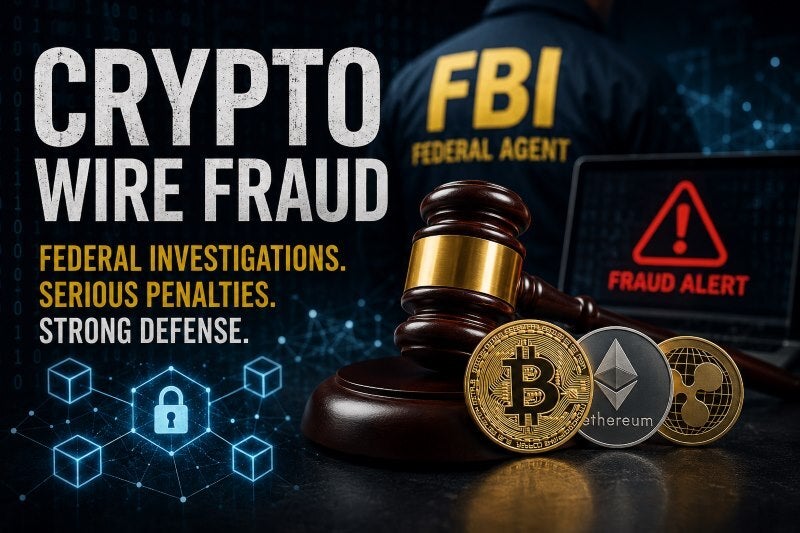
Crypto Wire Fraud Charges can arise when federal prosecutors claim that digital assets, wallets, exchanges, smart contracts, websites, emails, social media messages, investor dashboards, or online transfers were used to carry out a scheme to defraud. These cases often involve Bitcoin, Ethereum, stablecoins, DeFi protocols, staking, fake exchanges, pig butchering scams, SIM swaps, wallet drainers, tax records, money laundering allegations, and asset seizure.
Wire fraud is one of the government's broadest federal fraud tools. In many crypto cases, prosecutors do not need to prove that a token was a security or that a platform was regulated in a specific way. They focus on the alleged scheme, false statements, intent to defraud, interstate or foreign wires, victim loss, wallet attribution, and what happened to the funds after they moved.
Crypto Wire Fraud Charges under federal law
Federal wire fraud under 18 U.S.C. 1343 generally requires proof that the defendant knowingly participated in a scheme to defraud and used, or caused the use of, interstate or foreign wire communications to further that scheme. In a crypto case, the alleged wires may include emails, text messages, exchange logins, websites, blockchain transactions routed through internet infrastructure, app messages, cloud records, phone calls, bank transfers, or platform communications.
A standard wire fraud conviction can carry up to 20 years in federal prison. Exposure can increase in certain cases involving financial institutions or specific emergency-related benefits. Sentencing depends heavily on alleged loss amount, number of victims, role in the offense, sophistication, obstruction, restitution, forfeiture, criminal history, and whether other counts are charged.
Federal prosecutors may also add conspiracy, money laundering, tax offenses, identity theft, computer fraud, unlicensed money transmission, securities fraud, commodities fraud, or forfeiture allegations. That is why a crypto wire fraud defense must evaluate the whole financial and digital record, not just the indictment label.
How prosecutors build Crypto Wire Fraud Charges
Federal digital asset cases are usually built from documents, devices, and transaction records. Agents may combine victim complaints, blockchain tracing, exchange subpoenas, bank records, tax filings, emails, Telegram or Discord chats, social media accounts, website data, domain registrations, cloud backups, phone extractions, IP logs, and statements from cooperating witnesses.
The government often tries to prove a sequence:
- A false investment, recovery, exchange, staking, trading, or wallet-support promise.
- Victim funds moving into wallets, platforms, or bank accounts.
- Digital records linking those wallets or accounts to the accused person.
- Messages or marketing materials showing alleged misrepresentations.
- Post-receipt movement showing cash-out, concealment, or personal use.
- A loss calculation used for plea negotiations and sentencing.
Each step can be challenged. A blockchain record may show movement of funds, but it does not automatically prove who controlled the wallet, who wrote the messages, whether statements were false when made, or whether the accused intended to defraud anyone.
Fraud schemes that often lead to crypto wire fraud investigations
Crypto wire fraud cases often begin with victims reporting stolen digital assets. Legal options for stolen cryptocurrency recovery often involve tracing, exchange notices, law enforcement reports, and wallet analysis, which can later become evidence in a criminal investigation.
Pig butchering cases are common. These schemes may involve long-term grooming, fake investment profits, controlled trading dashboards, withdrawal blocks, and pressure to deposit more crypto. Pig butchering crypto scam recovery strategies show why prosecutors often focus on who recruited victims, who operated accounts, who controlled wallets, and who handled cash-outs.
Fake exchange cases may involve websites or apps that appear legitimate but are designed to trap deposits. Fake crypto exchange scam recovery claims often turn on domain records, backend access, exchange accounts, withdrawal logs, and whether the accused person actually controlled the platform.
SIM swaps, wallet drainers, and malicious smart contracts
Some crypto wire fraud investigations begin with account takeover. A phone number may be hijacked, two-factor authentication may be bypassed, an exchange account may be drained, or a recovery email may be compromised. Prosecutors may then trace funds through swaps, bridges, and exchanges.
When the alleged theft began with a carrier compromise, SIM swap crypto theft liability can help identify whether a hacker, carrier insider, account holder, or third party caused the loss.
Wallet drainer cases can be even more technical. The government may claim that a malicious site or smart contract tricked users into signing approvals that transferred tokens. Wallet drainer legal rights after a malicious smart contract attack can be relevant when prosecutors misunderstand approvals, signatures, contract permissions, or who actually controlled the receiving wallet.
Tax records, staking, and DeFi in wire fraud cases
Tax and accounting records often become part of a crypto fraud case. Prosecutors may compare alleged victim deposits, exchange withdrawals, bank records, business revenue, tax filings, and personal spending to argue that the accused concealed income or lied about the source of funds.
An IRS inquiry can also run parallel to a criminal investigation. Crypto tax audit defense after IRS contact can matter when the government treats missing records, inconsistent basis calculations, or unreported digital asset activity as evidence of intent.
Staking and DeFi create additional complexity. Tax treatment of staking rewards may be relevant when prosecutors or investigators misunderstand wallet inflows as fraud proceeds rather than protocol rewards. DeFi tax reporting for swaps, yield farming, liquidity pools, and lending can help explain why a transaction history may look complicated without being criminal.
Mistaken transfers and secondary recovery scams
Not every unusual crypto transaction reflects fraud. People send assets to the wrong chain, wrong wallet, wrong memo, wrong contract, fake support page, or scam platform. After realizing the mistake, they may move other funds quickly, contact exchanges, pay recovery services, or create records that look confusing later.
When a case begins with a transfer mistake, legal options after sending crypto to the wrong wallet address can explain why a person tried to trace funds, contact third parties, or act quickly without fraudulent intent.
Recovery scams also create risk. A victim may lose crypto once, then pay fake investigators or fake lawyers who promise to retrieve it. Crypto recovery scam warning signs may help distinguish continued victimization from participation in the original scheme.
Wire fraud and money laundering overlap
Wire fraud focuses on the alleged scheme and use of wires. Money laundering focuses on transactions involving criminal proceeds, concealment, promotion, or spending criminally derived property. In crypto cases, prosecutors often charge both.
The government may claim that the same funds were first obtained by wire fraud and then laundered through swaps, bridges, mixers, stablecoins, peer-to-peer trades, foreign exchanges, or bank accounts. Crypto money laundering charges and red flags can become central when prosecutors treat post-receipt wallet movement as concealment.
The defense should separate ordinary crypto behavior from laundering intent. Wallet separation, cold storage, exchange movement, tax planning, DeFi activity, security practices, and business accounting may have legitimate explanations.
Government seizure in Crypto Wire Fraud Charges
Federal crypto wire fraud investigations often include seizure warrants. Agents may seize exchange accounts, hardware wallets, seed phrase backups, phones, laptops, bank accounts, stablecoins, NFTs, and Bitcoin. They may also seek forfeiture of assets they claim are proceeds or property involved in the offense.
When agents take digital assets, police and federal agents seizing cryptocurrency raises issues involving warrants, private keys, custody, valuation, chain of custody, and third-party ownership.
If Bitcoin is seized during a criminal case, government seizure of Bitcoin in a criminal case can affect forfeiture, restitution, liquidation, return of property, and disputes between alleged victims and defendants.
Defenses to Crypto Wire Fraud Charges
Crypto Wire Fraud Charges are defensible when the government cannot prove scheme, intent, material false statement, use of wires, wallet control, victim loss, or the accused person's role. The defense must test the digital record and the legal theory.
- No knowing participation in a scheme to defraud.
- No intent to defraud when statements were made.
- The project failed, but failure was not fraud.
- Statements were predictions, opinions, puffery, or forward-looking plans.
- The accused was a contractor, employee, developer, marketer, translator, or intermediary without criminal intent.
- The wallet or exchange account was misattributed.
- The government's blockchain clustering is speculative or incomplete.
- The alleged loss amount is inflated.
- Tax records are incomplete but not fraudulent.
- The search, seizure, or interrogation violated constitutional rights.
What to do after a federal crypto fraud investigation begins
A person may learn about an investigation through an exchange freeze, grand jury subpoena, IRS contact, search warrant, seizure notice, target letter, FBI visit, Secret Service inquiry, Homeland Security contact, or bank account closure. Early decisions can shape the entire case.
- Do not speak with agents without defense counsel.
- Do not delete wallets, messages, code, tax files, exchange records, or emails.
- Do not move flagged assets without legal advice.
- Preserve transaction histories, wallet labels, KYC records, and support tickets.
- Identify which wallets you controlled and which wallets you did not control.
- Preserve records showing legitimate source of funds, tax reporting, or victim status.
- Do not contact witnesses in a way that could be viewed as pressure.
- Get legal review before making public statements or corrective filings.
Where federal crypto wire fraud cases are handled
Crypto wire fraud cases are usually handled in federal court. In California, venue may fall in the Northern, Eastern, Central, or Southern District of California depending on victims, defendants, servers, exchanges, communications, bank activity, or investigative location.
The process may include investigation, subpoena, search warrant, seizure, arrest, initial appearance, detention hearing, indictment, arraignment, discovery, motion practice, plea negotiations, trial, presentence investigation, sentencing, restitution, forfeiture, and supervised release.
Federal courts, prosecutors, FBI, IRS, Secret Service, Homeland Security Investigations, exchanges, blockchain analytics companies, banks, and regulatory agencies are independent institutions. Bulldog Law is not affiliated, endorsed, partnered, connected, or associated with any court, prosecutor, agency, exchange, analytics company, bank, or government institution.
Crypto Wire Fraud Charges lawyers in California
Bulldog Law defends clients facing Crypto Wire Fraud Charges, federal digital asset investigations, exchange freezes, subpoenas, seizure, forfeiture, blockchain tracing disputes, IRS crypto issues, DeFi allegations, staking-related tax questions, pig butchering accusations, fake exchange investigations, SIM swap cases, wallet drainer claims, and money laundering allegations.
Crypto Wire Fraud Charges require a defense that understands federal fraud law and blockchain evidence. The government must prove more than complicated wallet movement. It must prove a fraudulent scheme, intent, material deception, use of wires, loss, and the defendant's role. The defense should challenge tracing, attribution, tax assumptions, loss calculations, seizure, and any effort to turn a failed crypto project or mistaken transaction into a federal felony.
Comments
There are no comments for this post. Be the first and Add your Comment below.
Leave a Comment