
Updated November 2026 | The Bulldog Law | California Criminal Defense
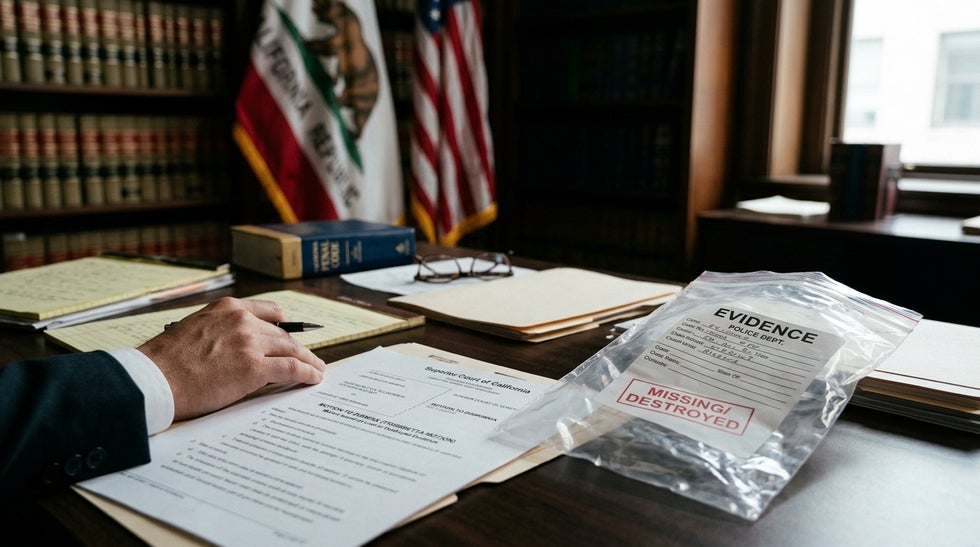
A Trombetta motion asks the court to sanction the prosecution, up to dismissing the case, because the police lost or destroyed evidence the defense needed. The government has a constitutional duty to preserve evidence that might be expected to play a significant role in the defense. To win, the defense must show that the evidence was obviously favorable and cannot be replaced, or, if its value was only potential, that the police acted in bad faith. Outright dismissal is uncommon. Lesser remedies, such as excluding related testimony or instructing the jury about the loss, are granted far more often and can decide a trial.
Evidence disappears for ordinary reasons: retention schedules, overwritten servers, a property room cleanup. Our attorneys assume it will happen and send preservation demands in the first days of a case, because a motion about lost evidence is much stronger when the agency was told in writing to keep it.
The duty to preserve
In California v. Trombetta, drivers charged with DUI argued that police should have kept samples of their breath for independent testing. The Supreme Court ruled against them but defined the duty: the government must preserve evidence that might be expected to play a significant role in the suspect's defense. Four years later, in Arizona v. Youngblood, the Court addressed evidence whose value was unknown because it was never tested, and held that failing to preserve such potentially useful evidence violates due process only if the police acted in bad faith.
California once applied a stricter rule of its own. Since voters adopted the Truth in Evidence provision in 1982, California courts have followed the federal standard.
The test
|
Kind of evidence |
What the defense must show |
Bad faith required? |
|
Apparently exculpatory: its value to the defense was evident before it was destroyed |
The exculpatory value was apparent to the police at the time, and comparable evidence cannot be obtained by other reasonably available means |
No |
|
Potentially useful: it might have helped if tested, examined, or reviewed |
The same two points, plus bad faith on the part of the police |
Yes |
Most disputes fall in the second row, which is why the bad faith question dominates these hearings.
What counts as bad faith
- Destroying evidence after a written preservation request or a court order.
- Departing from the agency's own retention policy or from a statute requiring retention.
- Selective preservation: keeping what helps the prosecution and discarding the rest.
- Destruction soon after the officers learned the defense theory.
- Inconsistent or false explanations for the loss.
Routine destruction under a neutral policy, an honest mistake, or simple carelessness is usually found not to be bad faith. Judges look at what the officers knew when the evidence was lost, which makes the timing of the defense's requests critical.
Comparable evidence
If the defense can make the same point another way, the motion fails. A deleted recording of an interview may be replaceable by the officer's notes and cross-examination; a deleted video of a disputed use of force usually is not.
No duty to collect
The duty is to preserve what the government has, not to investigate on the defendant's behalf. California courts have consistently held that police are not required to gather any particular evidence, run any particular test, or use any particular investigative technique. An officer who never requests a business's surveillance footage has not destroyed it. The defense remedy for an incomplete investigation is to conduct its own, and to argue the gaps to the jury.
Evidence that commonly goes missing
|
Evidence |
How it is lost |
What helps the motion |
|
Body camera and dash camera video |
Not uploaded, mislabeled, or purged after the retention period |
Early written demand; agency policy requiring retention in arrest cases |
|
911 calls, dispatch audio, and logs |
Automatically overwritten, often within months |
Prompt subpoena or demand |
|
Jail, booking, and holding cell video |
Short retention periods |
Demand within days of arrest |
|
Blood and urine samples |
Discarded, or stored so that they degrade |
State regulations requiring retention for retesting |
|
Physical items: clothing, weapons, vehicles |
Released from impound, returned to owners, or disposed of |
Notice that the defense intends to inspect or test |
|
Biological evidence in serious cases |
Lost in storage or destroyed after conviction |
Statutory retention duties |
|
Officer notes and recorded interviews |
Notes discarded after the report is written |
Showing that the report omits material details |
California law adds specific retention duties. Under Penal Code 1417.9, biological material secured in connection with a criminal case must be retained for as long as a person remains incarcerated in connection with that case, unless notice is given and no one objects. In DUI cases, regulations require that blood samples be kept so the defense can have them independently analyzed. A violation of a retention statute is evidence of bad faith and can also support a remedy directly.
Remedies
A judge who finds a violation has broad discretion over the response.
- Dismissal. Appropriate when the lost evidence was central and nothing else can cure the prejudice.
- Exclusion. The prosecution is barred from offering testimony or test results that depend on the missing item. If the blood sample is gone, the lab result may be excluded; if the video is gone, the officer's description of what it showed may be.
- Jury instruction. The jury is told that the evidence was lost or destroyed and that it may consider that fact, and in some cases may infer that the evidence would have been unfavorable to the prosecution.
- Latitude for the defense. Expanded cross-examination and argument about the missing evidence.
Even when the court finds no due process violation, it may give an instruction or allow argument about the loss as a matter of fairness. A partial remedy is frequently enough to change the value of the case.
How the motion is built
- Preservation demands. Letters to the agency, the prosecutor, and any third parties, sent immediately and kept as exhibits.
- Discovery. Requests under the discovery statutes for the item, its chain of custody, and the agency's retention policy.
- A preservation order. Where there is real risk, a court order removes any later claim of innocent mistake.
- The record of destruction. Who destroyed the item, when, under what authority, and what that person knew.
- Proof of value. A declaration, an expert, or other evidence showing what the item would have established.
- The hearing. Testimony from the custodian and the officers; the judge decides apparent value, comparability, and bad faith.
Related issues have their own pages: favorable evidence that still exists and was withheld is a Brady problem; evidence that exists but was mishandled is a chain of custody problem; unlawfully obtained evidence is addressed by a motion to suppress; and the limits of laboratory testing are covered under forensic evidence. Deliberate destruction or alteration of evidence is also a crime; see Penal Code 141.
Why it matters to the outcome
A prosecutor who has lost the recording, the sample, or the item is trying a weaker case and knows it. Missing evidence is one of the signs a case will be dismissed or settled on better terms, whether or not the court formally grants the motion.
Frequently asked questions
What is a Trombetta motion?
A Trombetta motion asks a California court to impose sanctions, up to dismissal of the charges, because the police or prosecution lost or destroyed evidence that was important to the defense. It is based on the due process duty to preserve evidence described in California v. Trombetta, a 1984 United States Supreme Court decision, and it is often called a Trombetta-Youngblood motion.
What does the defense have to prove?
That the evidence had exculpatory value that was apparent before it was destroyed, and that the defense cannot obtain comparable evidence by other reasonably available means. If the evidence was only potentially useful, meaning it might have helped if it had been tested or examined, the defense must also show that the police acted in bad faith in failing to preserve it.
What is bad faith under Arizona v. Youngblood?
Bad faith means the officers knew the evidence could help the defendant and destroyed or discarded it anyway, or acted with a purpose to deprive the defense of it. Negligence, routine purging under a retention policy, and poor record keeping are generally not bad faith. Destroying evidence after a specific preservation request, or contrary to the agency's own rules, is strong evidence of it.
What happens if a Trombetta motion is granted?
The judge chooses a remedy that fits the harm. Options include dismissing the charge, excluding testimony or test results that relate to the missing evidence, and instructing the jury that the evidence was lost and that it may draw an inference in the defendant's favor. Dismissal is reserved for the most serious cases.
Do the police have to collect evidence that could help me?
No. The duty is to preserve evidence the government has collected, not to gather evidence for the defense. If officers never obtained a store's surveillance video, there is no Trombetta violation when the store later erases it. That is why the defense must act quickly to obtain such material itself.
Can a case be dismissed because body camera footage was deleted?
It can, if the footage would have shown something favorable that the defense cannot prove another way and its value was apparent, or if the deletion was in bad faith. Courts more often respond with a jury instruction or by limiting the officer's testimony about the unrecorded events. The existence of a prior written demand to preserve the footage greatly strengthens the motion.
What is the difference between a Trombetta motion and a Brady motion?
Brady concerns favorable evidence the prosecution still has and failed to disclose. Trombetta and Youngblood concern evidence that no longer exists. A Brady violation does not require bad faith. A claim about lost evidence that was only potentially useful does.
How do I make sure evidence is preserved?
Through counsel, send written preservation demands to the police agency and the prosecutor as early as possible, naming the specific items: body camera and dash camera video, 911 and dispatch recordings, jail and booking video, blood or breath samples, and physical items. If there is any doubt, ask the court for a preservation order. Separate letters should go to private businesses that hold video.
Related reading from our attorneys
Worried that video or other evidence will be erased? The demand has to go out now
The Bulldog Law's criminal defense attorneys send preservation demands at the start of every case and litigate lost-evidence motions when agencies fail to comply. Call (888) 928-1609 or reach us online.