
Updated August 2026 | The Bulldog Law | California Criminal and Juvenile Defense
Truancy in California means a student aged 6 to 18 has been absent from school without a valid excuse three full days in one school year, tardy or absent more than 30 minutes three times, or any combination of the two (Education Code 48260). Three truancy reports in a year make the student a habitual truant. Missing 10 percent or more of the school year without excuse makes the student a chronic truant, and that is the point at which a parent of a kindergarten through eighth grade child can be charged with a misdemeanor under Penal Code 270.1, punishable by up to one year in county jail and a $2,000 fine.
Most truancy problems never reach a courtroom. They are handled through attendance letters, parent conferences, and the School Attendance Review Board. But the process is designed to escalate, and parents who ignore it can find themselves cited, fined, or in criminal court. We experts guide explains each level of California truancy law, what happens to the student and the parent at each stage, and how a defense attorney can stop the escalation. If you have already received a district attorney letter or a citation, contact The Bulldog Law or call (888) 928-1609.
What Truancy Means Under California Law
California requires every child between the ages of 6 and 18 to attend full-time school (Education Code 48200). Truancy law enforces that requirement through three escalating definitions:
- Truant (Education Code 48260): absent without a valid excuse for three full days in one school year, or tardy or absent for more than 30 minutes during the school day on three occasions, or any combination. The school must notify the parent in writing the first time the student is classified as truant.
- Habitual truant (Education Code 48262): reported as truant three or more times in one school year, after the district has made a conscientious effort to hold at least one conference with the parent and student.
- Chronic truant (Education Code 48263.6): absent without a valid excuse for 10 percent or more of the school days in one school year, measured from the date of enrollment. On a 180-day calendar, that is 18 unexcused absences.
The full text of the truancy definition is in Education Code 48260. A "truancy officer" in California is usually a district attendance supervisor or a school resource officer acting under the district's attendance program; there is no separate state truancy police force.
What counts as a valid excuse
Education Code 48205 lists the absences a school must excuse: the student's own illness or quarantine, medical, dental, vision, and chiropractic appointments, attending the funeral of an immediate family member, jury duty, religious holidays and ceremonies, mental or behavioral health needs, court appearances, and justifiable personal reasons approved in advance by the principal. Many truancy referrals are built on absences that should have been excused but were never documented. Gathering that documentation is often the first and best defense.
How Truancy Is Enforced: From Attendance Letter to SARB
California's system is built around a series of notices and interventions before anyone is punished. In a typical district the sequence is:
- First truancy notice: a letter under Education Code 48260.5 telling the parent that the student is truant, that the parent is obligated to compel attendance, and that the parent may be guilty of an infraction.
- Second and third notices, with a required parent conference. Districts must document their efforts to meet with the family.
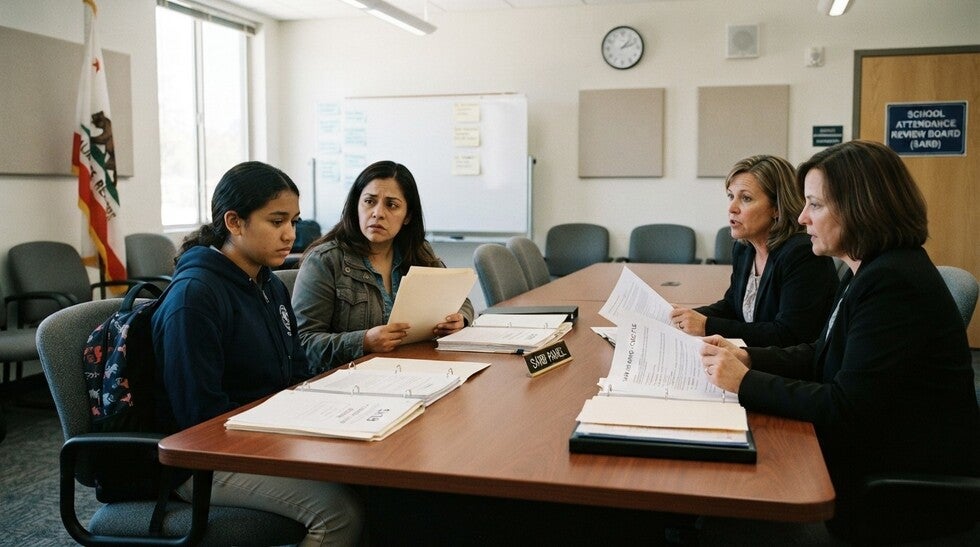
- Referral to the School Attendance Review Board (SARB) under Education Code 48263. SARB is a panel of school, probation, social services, and community representatives that meets with the family, identifies the cause of the absences, and orders a plan.
- SARB contract: an attendance agreement signed by the parent and student. Violating it is what usually triggers the next step.
- Referral to the district attorney or county probation. Many counties run a truancy mediation program at this stage, where a deputy district attorney meets the family in a non-court setting and sets a final deadline before charges are filed.
The SARB hearing is where families most often lose the case without realizing it. Parents show up without records, agree to a contract they cannot realistically satisfy, and then get referred to the district attorney when it falls apart. Treat the SARB hearing as the real hearing.
Consequences for the Student
For the student, truancy is a status offense, meaning conduct that is only unlawful because of the person's age. It is not a crime, and it is handled under Welfare and Institutions Code 601, not the delinquency provisions of section 602 that cover actual offenses. Our overview of juvenile justice in California explains how those two tracks differ.
Education Code 48264.5 sets a graduated ladder of consequences:
- First truancy: a written warning by a peace officer, which the school district keeps on file.
- Second truancy: assignment to an after-school or weekend study program, or, if the district has no such program, a warning that the next step is the juvenile court.
- Third truancy: classification as a habitual truant and referral to a truancy mediation program or to the juvenile court as a ward under Welfare and Institutions Code 601. The court can order community service, a fine, or attendance at a truancy prevention program.
- Fourth truancy: the juvenile court may declare the student a ward and impose the same range of orders.
The consequence that gets teenagers' attention is Vehicle Code 13202.7: a juvenile court that finds a student to be a habitual truant can suspend, restrict, or delay the student's driving privilege for up to one year. A 16-year-old who cannot get a license, or an 18-year-old who cannot renew one, is often the most effective motivator in the entire statute.
A student who is picked up during school hours can also be taken to a truancy center or brought home. If your child has been detained or cited, our guide to juvenile citation and release explains what the paperwork means.
Consequences for the Parent
Education Code 48293: the infraction
The most common charge against a parent is an infraction under Education Code 48293 for failing to compel a child's attendance after the required notices and SARB process. The fines are modest: up to $100 for a first conviction, up to $250 for a second, and up to $500 for a third. Instead of a fine, the court can order the parent to attend a parent education and counseling program. An infraction is not a crime and does not create a criminal record, but a conviction becomes the foundation for a later Penal Code 270.1 filing if the absences continue.
Penal Code 270.1: the misdemeanor
Penal Code 270.1 is California's parental truancy crime. The prosecution must prove all of the following:
- The defendant is the parent or guardian of a pupil who is six years of age or older and enrolled in kindergarten through eighth grade.
- The pupil is a chronic truant as defined in Education Code 48263.6 (10 percent or more unexcused absences).
- The parent failed to reasonably supervise and encourage the pupil's school attendance.
- The parent was offered language-accessible support services to address the truancy before charges were filed.
The penalty is a fine of up to $2,000, up to one year in county jail, or both. In practice, jail is rare and the statute itself points toward a different outcome. Under Penal Code 270.1(b), the court may defer entry of judgment for a parent who pleads guilty, order the parent to complete a program of parenting classes, counseling, or other services, and dismiss the charge when the program is completed and the child's attendance has improved. If the parent does not complete the program, the court enters judgment and sentences the parent.
Prosecutors also sometimes charge parents under Penal Code 272, contributing to the delinquency of a minor, when a parent is accused of actively keeping a child home, or under Penal Code 273a, child endangerment, when truancy is one piece of a broader neglect allegation. Those charges carry heavier consequences and require a different defense strategy.
Defending a Parent Against Truancy Charges
Truancy prosecutions are document cases. The district must prove it sent the required notices, held the required conference, offered support services, and correctly counted the absences. Each of those is a place where cases fall apart. Common defenses include:
- Absences that should have been excused: a chronic illness, a mental health condition, a family death, or an IEP-related issue that the school failed to record as excused. Reclassifying even a handful of absences can drop the student below the 10 percent chronic truancy threshold and eliminate the 270.1 charge entirely.
- Procedural failures by the district: no first truancy notice, no documented conference attempt, no SARB referral, or no offer of support services. Penal Code 270.1 makes the offer of services an element of the crime, not a formality.
- Reasonable supervision: a parent who was calling the school, arranging transportation, seeking medical or counseling help, or dealing with a teenager who left the house and did not arrive at school has not failed to reasonably supervise. Text messages, emails, appointment records, and counselor notes prove it.
- Disability and special education: a student with an undiagnosed or unaccommodated disability who refuses school is a special education issue, and federal law obligates the district to address it. A referral for an IEP evaluation can change the entire posture of the case.
- Homelessness and housing instability: the McKinney-Vento Act requires districts to enroll and transport homeless students, and attendance problems tied to housing loss are not parental neglect.
An attorney can also negotiate directly with the deputy district attorney assigned to truancy cases. Because these prosecutors measure success by improved attendance rather than convictions, a documented plan that gets the student back in school usually ends the case. If the case is filed anyway, the same signs that make any criminal case weak missing paperwork, unreliable records, contradicted timelines apply here, and the arraignment is the place to start raising them.
Immigration and Record Consequences
A Penal Code 270.1 conviction is a misdemeanor, and although it is not a crime involving moral turpitude in most circumstances, any criminal conviction can complicate a green card application, naturalization, or DACA renewal. Parents who are not U.S. citizens should ask about the immigration consequences of a conviction before accepting any plea, including a deferred judgment that requires a guilty plea up front. If a conviction is entered and completed, it is generally eligible for dismissal under Penal Code 1203.4. Our guide to what expungement means covers the process.
For the student, records of a Welfare and Institutions Code 601 proceeding are juvenile records and can be sealed once the case is closed.
Truancy and Students Who Are 18
Compulsory education ends at 18. A student who turns 18 during the school year is no longer subject to the truancy statutes, and a parent cannot be prosecuted under Penal Code 270.1 for an adult child's absences. The school can still drop an 18-year-old for non-attendance under its own policies. For parents of 16 and 17-year-olds, the practical reality is that the juvenile court's authority to restrict driving privileges under Vehicle Code 13202.7 is often the most effective tool available, and a defense attorney can sometimes use a voluntary attendance agreement to avoid the court invoking it.
Frequently Asked Questions
Can parents go to jail for truancy in California?
Yes, but only in the most serious cases. Penal Code 270.1 makes it a misdemeanor, punishable by up to one year in county jail and a $2,000 fine, for a parent of a chronically truant child in kindergarten through eighth grade to fail to reasonably supervise and encourage attendance after being offered support services. Most parents are never charged under 270.1. The far more common path is an Education Code 48293 infraction with a fine, or a School Attendance Review Board contract. Even when 270.1 is filed, the statute lets the court defer judgment while the parent completes a program, and the charge is dismissed on completion.
How many unexcused absences count as truancy in California?
Three. Under Education Code 48260, a student is truant after three unexcused absences, three tardies of more than 30 minutes, or any combination of the three in one school year. A student reported truant three or more times in a year is a habitual truant. A student who misses 10 percent or more of the school year without a valid excuse is a chronic truant, which is the trigger for parent prosecution under Penal Code 270.1.
Does truancy go on a criminal record?
For the student, truancy is handled in juvenile court under Welfare and Institutions Code 601 as a status offense, not a crime, and juvenile records can be sealed. For a parent, an Education Code 48293 infraction is like a traffic ticket and does not create a criminal conviction. A Penal Code 270.1 misdemeanor conviction is a criminal record unless the parent completes the deferred judgment program or later obtains expungement.
What is a SARB letter and do I have to go?
A School Attendance Review Board letter means the school district has escalated your child's attendance problem beyond the school site. Attending the SARB hearing is not optional in any practical sense: if you do not appear, the board can refer the matter directly to the district attorney or county probation. Bring documentation of every absence, any medical or mental health records, and evidence of what you have done to get your child to school.
What counts as an excused absence in California?
Education Code 48205 lists the valid excuses: illness, quarantine, medical, dental, optometry, and chiropractic appointments, attending a funeral of an immediate family member, jury duty, religious observance, mental or behavioral health needs, and justifiable personal reasons approved in advance by the principal. Absences for a child's own medical or mental health care are excused even when the school was not notified in advance, as long as the parent provides documentation.
Related Guides
- Juvenile justice in California: what to expect
- Deferred entry of judgment for juveniles
- Fresno County juvenile crimes and Bakersfield juvenile crimes
Talk to a Defense Attorney Before the SARB Hearing or the DA Letter Deadline
Truancy cases are winnable, and most of them are winnable before charges are ever filed. The Bulldog Law represents parents at School Attendance Review Board hearings, truancy mediation meetings, and in criminal court on Education Code 48293 and Penal Code 270.1 charges throughout California, and we represent students in Welfare and Institutions Code 601 proceedings. Visit our criminal defense page, call (888) 928-1609, or reach us online for a confidential consultation.