
By the The Bulldog Law Criminal Defense Team • Reviewed by a licensed California criminal defense attorney
Probation is California's alternative to custody: instead of (or after a short stay in) jail, you serve your sentence in the community under court-ordered conditions INFORMAL (“summary”) probation for most misdemeanors, reporting only to the court, or FORMAL probation for felonies, supervised by a probation officer. And the single most important modern fact, which most of the internet still gets wrong: since Assembly Bill 1950 (2021), misdemeanor probation is capped at ONE year and most felony probation at TWO down from the three-to-five-year terms courts imposed for decades with exceptions for violent and serious felonies and offenses whose statutes set their own terms (DUI's three-to-five years, domestic violence's minimum conditions among them). This pillar guide from The Bulldog Law's criminal defense team covers the whole lifecycle: what probation is and isn't, the conditions and their limits, travel and jobs, what “absconding” means and how to fix it, violations, early termination and the expungement waiting at the finish line.
Formal vs. Informal Probation: Which One You're On, and Why It Matters
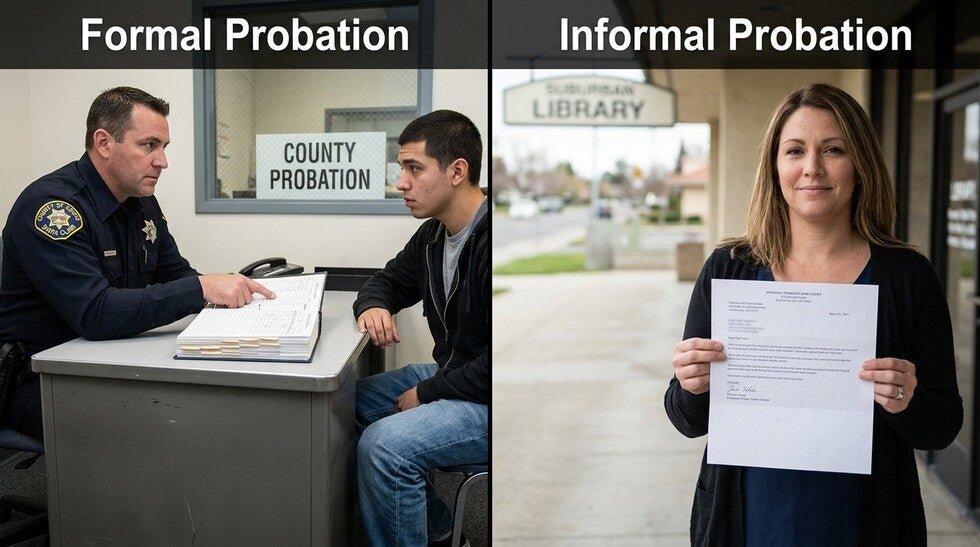
- Informal / summary probation (most misdemeanors) no probation officer: you answer to the COURT, complying with conditions (classes, fines, stay-away orders) and staying crime-free; “reporting” usually means proof-of-completion filings and review dates. Violations are raised directly on the court's calendar.
- Formal probation (felonies and serious misdemeanors) a county probation officer supervises: scheduled report-ins, home and work visits, search terms, drug testing where ordered, travel permission requirements, and fees. The PO's reports drive everything including whether stumbles become violation proceedings.
- What probation is NOT parole (state supervision AFTER prison), PRCS (post-release community supervision under § 3455, with its flash-incarceration rules), or mandatory supervision (the split-sentence tail of 1170(h) realignment terms). The tracks have different rules, different violation systems, and different exits knowing which one you're on is question one.
How Long Does Probation Last? (AB 1950 Changed Everything)
The default caps today: 1 year for misdemeanors, 2 years for felonies and courts CANNOT exceed them except where the law carves out: violent felonies (§ 667.5(c)) and serious felonies aren't covered by the cap; statutes with their own probation schemes control (DUI: 3–5 years under the Vehicle Code; domestic violence: § 1203.097's mandatory terms and 52-week program; certain theft/fraud counts with restitution provisions); and terms already being served got the benefit retroactively in most cases.Two practical consequences follow. First, thousands of people are on probation TODAY under old, longer terms that AB 1950 shortens a motion can end supervision now, and with it the fees, the search terms, and the exposure. Second, the shortened window compresses everything: complete the classes and payments EARLY, because the finish line and the record relief behind it arrives fast for those who front-load compliance. If you or a family member is on a 3-year misdemeanor or 5-year felony term granted before 2021, have counsel audit it this month.
The Conditions: What Courts Can Order and the Limits
Every grant carries standard conditions obey all laws, report as directed, pay fines and victim restitution plus tailored ones that must reasonably relate to the offense or to preventing future crime: treatment and classes (DUI programs, the 52-week batterer's program in DV cases, anger management, theft courses), stay-away and no-contact orders, search-and-seizure waivers (the “fourth waiver” letting officers search you, your car, and home without a warrant), testing, weapons prohibitions, and travel restrictions.
The limits are real and litigable: conditions unrelated to your offense and future criminality can be challenged (the classic Lent test), ability-to-pay matters for fines and fees, and modification motions (§ 1203.3) adjust terms life makes impossible the job requiring travel, the program with no local site. Everyday questions answered: YES you can generally work (employment is favored and often required); travel WITHIN California is usually fine on informal probation and permission-based on formal; leaving the STATE on formal probation requires your PO's (and sometimes the court's) advance approval and undisclosed travel is how routine trips become violations. When in doubt: ask first, in writing. Probation rewards paper.
Absconding From Probation: What It Means and How to Come Back
“Absconding” means withdrawing from supervision stopping reports, moving without notice, becoming unreachable and its consequences arrive automatically: a bench warrant issues, probation is summarily revoked, and (the part nobody knows) the CLOCK STOPS: revocation tolls your probation term, so the two years you fled don't count, and the term resumes with a violation pending whenever you're found.Traffic stops, job background checks, and border crossings all end abscondings involuntarily, in handcuffs, in the worst posture available.
The engineered return is incomparably better: counsel confirms the warrant and the alleged violations, prepares the mitigation file (why you fled fear, addiction, crisis and what's changed: treatment, work, family), and arranges a VOLUNTARY surrender or calendar appearance, often with the warrant recalled and, regularly, with probation reinstated rather than terminated. Judges punish flight found; they respond to return chosen. If you or someone you love has been “off paper” unofficially for months or years: the warrant is not going anywhere, the tolled term is not expiring, and the walk-in with a lawyer is the whole difference between a reinstatement hearing and a remand. The violation hearing itself standards, defenses, outcomes is covered in the firm's complete § 1203.2 guide.
Finishing Early and Finishing Clean
Penal Code § 1203.3 lets courts terminate probation EARLY and with AB 1950's short terms, well-prepared motions after roughly half the term, with everything completed, succeed regularly: all conditions done, restitution PAID (the make-or-break item), no violations, and a reason the court can act on (employment, licensing, immigration posture, military service, or simply demonstrated rehabilitation). The professional move is the combination motion: early termination + reduction of a wobbler felony to a misdemeanor (§ 17(b)) + expungement under § 1203.4 one hearing that ends supervision, shrinks the conviction, and dismisses it, transforming background checks in a single afternoon. Even without early exit, completing probation unlocks the aftermath toolkit: 1203.4 relief as of right in most non-custody cases, record sealing and the Clean Slate laws, and certificate-of-rehabilitation paths for the bigger cleanups. Probation, handled well, is designed to end early, quietly, and with the record repaired behind it.
Frequently Asked Questions
How long does probation last in California?
Under AB 1950: a maximum of 1 year for misdemeanors and 2 years for most felonies the modern caps that replaced the old 3-to-5-year defaults. Exceptions: violent and serious felonies fall outside the cap, and offenses whose statutes set specific terms control DUI probation runs 3 to 5 years, domestic violence carries mandatory minimum conditions, and some financial crimes have restitution-driven terms. Anyone still serving a pre-2021 term longer than the caps should have counsel review it AB 1950 relief has ended supervision early for thousands, often with expungement filed the same day.
What's the difference between formal and informal probation?
Supervision. Informal (summary) probation the misdemeanor norm has no probation officer: you comply with conditions and answer to the court, typically by filing proof and appearing at review dates. Formal probation the felony norm assigns a county probation officer: report-ins, home visits, search terms, testing, travel permissions, and fees, with the PO's reports driving any violation proceedings. The practical difference is friction and exposure: formal probation's constant contact creates more ways to stumble and more paper to build the compliance record that wins early termination.
Can I travel or move while on probation?
Usually yes with the right permissions. Informal probation rarely restricts in-state travel; formal probation typically requires PO approval to leave the county or state, and moving requires advance notice and transfer arrangements (courtesy supervision in the new county). The violations here are almost never the travel itself they're the silence: the unannounced move, the trip discovered later. The rule that keeps probation boring: request permission in writing before, not forgiveness after. And if a job, family emergency, or opportunity conflicts with your terms, a § 1203.3 modification motion exists precisely to adjust them lawfully.
What happens if you abscond from probation?
A bench warrant issues, probation is summarily revoked and the term STOPS RUNNING: tolling means the years you're gone don't count, so absconding never runs out the clock, it only pauses it with a violation waiting. You'll be found eventually traffic stops and background checks end most abscondings involuntarily and the posture of your return decides everything. The engineered comeback (counsel, mitigation file, voluntary surrender, warrant-recall request) routinely ends in reinstatement; the traffic-stop version starts in custody. If you've been off supervision unofficially: call a lawyer before the system calls you.
Can probation end early?
Yes § 1203.3 motions for early termination succeed regularly when the file is right: roughly half the term served, ALL conditions completed, restitution paid in full, and a concrete reason (employment, licensing, immigration, or plain demonstrated rehabilitation). The best practice pairs it with § 17(b) felony reduction and § 1203.4 expungement in one combined motion ending supervision and cleaning the record in a single hearing. Start building toward it from day one: front-load the classes, document everything, pay restitution on schedule the early-termination motion is written by your first six months' conduct.
Probation is a sentence you can shorten, shape, and clean up after or one that quietly grows teeth through silence and drift. The difference is management: know your track, paper your compliance, fix problems through motions instead of avoidance, and aim at the finish line from the start. The Bulldog Law's criminal defense team handles every stage grants, modifications, violations, AB 1950 audits, early terminations, and expungements statewide. Contact the firm online or call (888) 928-1609.