
Updated October 2026 | The Bulldog Law | California Theft and Property Crimes Defense
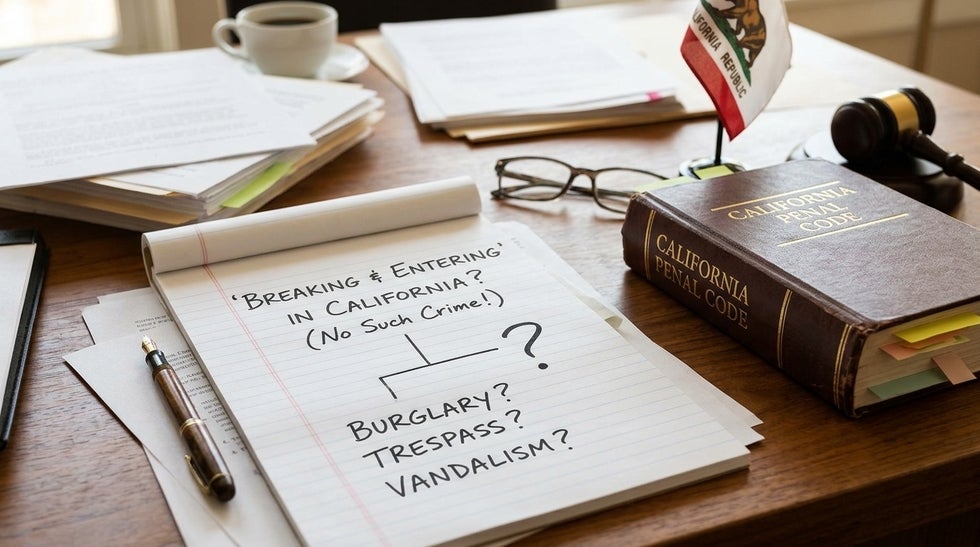
California's Penal Code contains no offense called breaking and entering. The conduct people mean by it, forcing a way into a building, a car, or a fenced property, is charged under one of three statutes depending on what the person intended when they entered. If the intent was to steal or to commit any felony inside, it is burglary under Penal Code 459, which requires no breaking at all: walking through an unlocked door with that intent is burglary, and residential burglary is a felony and a strike. If there was no such intent, the forced entry is trespass under Penal Code 602 or 603, a misdemeanor, and the damage done getting in is vandalism under Penal Code 594, a misdemeanor under $400 and a wobbler above it. Breaking into a locked car with intent to steal is second-degree burglary. The breaking is evidence; the intent is the crime.
The Bulldog Law's attorneys defend cases that arrive labeled breaking and entering by the arresting officer, the news, or the client, and the first task is to determine what the prosecution has actually charged and what it can prove about intent, because the difference between a strike felony and a misdemeanor trespass is a mental state the defendant had at a doorway. A person who climbed through a window to sleep in a vacant house, to retrieve belongings from an ex-partner's apartment, to get into their own home after losing a key, or to confront someone has entered without permission and may have broken something, but has not committed burglary. What follows is how California divides the conduct, the penalties under each statute, the vehicle and commercial rules, and the defenses. Call (888) 928-1609 or message our team.
Where the phrase comes from, and why California dropped it
At common law, burglary was breaking and entering the dwelling house of another at night with intent to commit a felony. Each element was litigated: whether opening an unlocked door was a breaking, whether dusk was night, whether a barn was a dwelling. California's Penal Code of 1872 rewrote the offense, and the modern Penal Code 459 keeps only the entry and the intent: every person who enters any house, room, apartment, shop, warehouse, store, mill, barn, other building, tent, vessel, railroad car, locked vehicle, aircraft, or mine, with intent to commit grand or petit larceny or any felony, is guilty of burglary. No breaking, no night, no dwelling requirement, no requirement that anything be taken. Several states still use breaking and entering as the name of a lesser offense; in California the phrase is a description, and the question is always which statute the facts fit.
Which crime it is: a decision table
|
What happened |
Intent at entry |
Charge |
Level |
|
Forced or unforced entry into a home, business, or other structure |
To steal, or to commit any felony inside |
Burglary, PC 459 |
Residential: felony, 2-4-6 years, strike. Commercial: wobbler, up to 3 years |
|
Forced entry into a building, no intent to steal or commit a felony |
Something else: shelter, retrieving property, confrontation, curiosity |
Trespass by forced entry, PC 603, or unauthorized entry, PC 602(m) |
Misdemeanor, up to 6 months |
|
Damage done to a door, window, lock, or fence to get in |
Any |
Vandalism, PC 594, charged with the above |
Under $400: misdemeanor. Over $400: wobbler |
|
Entry into a locked vehicle |
To steal or commit a felony |
Vehicle burglary, PC 459 (second degree) |
Wobbler, up to 3 years |
|
Entry into an unlocked vehicle and theft |
To steal |
Petty or grand theft, PC 484/487, not burglary |
Misdemeanor under $950; wobbler above |
|
Entry into an open store during business hours to steal under $950 |
To steal |
Shoplifting, PC 459.5, not burglary |
Misdemeanor |
|
Entry into a home while someone is inside |
To steal or commit a felony |
First-degree burglary, PC 460, occupied |
Felony, violent felony, strike, 85 percent |
|
Entering fenced or posted land, or refusing to leave |
Any |
Trespass, PC 602 |
Misdemeanor or infraction |
The intent is proven circumstantially, and the circumstances the prosecution relies on are the ones a jury would expect: the hour, the tools, gloves, a mask, a bag, a smashed rather than opened window, flight from the scene, the absence of any relationship to the property, and what was found on the person. The defense answers with the circumstances on the other side: a connection to the property, a reason to be there, nothing taken, nothing disturbed, no tools, and a statement, where one exists, consistent with a non-theft purpose. Our pages on burglary under Penal Code 459 and the degrees under Penal Code 460 cover the elements in detail, and our page on theft, burglary, and robbery places burglary among its neighbors.
Burglary: when the entry carried the intent
First-degree burglary is burglary of an inhabited dwelling, a place where someone lives, whether or not anyone was present. It is a felony with two, four, or six years in state prison, a serious felony and a strike, and, if another person was present during the burglary, a violent felony with custody credits limited to 15 percent. Our page on home invasion covers the occupied-dwelling cases. Second-degree burglary is burglary of everything else, commercial buildings, storage units, locked vehicles, outbuildings, and is a wobbler: a misdemeanor with up to a year, or a felony with 16 months, two, or three years, served in county jail under realignment. The list of California felonies shows where each sits.
Three refinements matter in breaking-and-entering cases. First, since Proposition 47, entering a commercial establishment during business hours with intent to steal $950 or less is shoplifting under Penal Code 459.5, a misdemeanor, and cannot be charged as burglary; a break-in after hours, or an entry intending to steal more, remains burglary. Second, vehicle burglary requires that the vehicle was locked; the prosecution must prove it, and a car left unlocked, or a trunk opened with a release inside an unlocked cabin, defeats the charge, which is why car break-in cases are frequently reduced to theft and vandalism. Third, Penal Code 466 separately punishes possession of burglary tools, picks, slim jims, pry bars, with intent to use them for a burglary, a misdemeanor that prosecutors add when the entry itself cannot be proven.
Trespass and vandalism: when it did not
Penal Code 603 makes it a misdemeanor to enter a dwelling house, cabin, or other building without the consent of the owner by forcibly breaking a door, window, or other part of it, and to damage property inside. It is the closest California comes to a breaking-and-entering statute, it requires no intent beyond the entry, and it is punishable by up to six months. Penal Code 602 lists dozens of trespass variants, including entering and occupying a building without consent under subdivision (m), refusing to leave, and entering posted land, most of them misdemeanors; our page on trespass under Penal Code 602 covers them, and aggravated trespass under Penal Code 601, entering a home after making a credible threat, is the felony version.
The damage is charged separately. Vandalism under Penal Code 594 covers the broken window, the kicked-in door, and the cut fence: a misdemeanor with up to a year where the damage is under $400, a wobbler with up to three years above it, and restitution for the repair in every case. A forced entry with no theft intent is therefore typically two misdemeanors, 603 and 594, and the realistic outcome for a first offense is probation, restitution, and a stay-away order, with diversion available.
During a declared emergency, the analysis changes: burglary and vandalism committed during a state of emergency are charged as looting under Penal Code 463 with mandatory jail minimums, and the emergency declaration is the added element.
Defenses
No intent to steal or commit a felony. The defense to burglary, and the one that converts a strike into a misdemeanor. The person who entered to sleep, to shelter, to retrieve property they believed was theirs, to find someone, or because they were intoxicated and mistaken about the address has not committed burglary. The prosecution's circumstantial case is answered with the defendant's connection to the place and the absence of theft indicators.
Claim of right. A person who entered to take property they honestly believed belonged to them, even mistakenly, did not intend to steal, and the claim-of-right defense negates the theft intent. It is the defense in the ex-partner's apartment, the former roommate's house, and the dispute over who owns what.
Consent. Entry with the owner's permission is not burglary and not trespass, and a person who had been given a key, had lived there, or was invited is not an intruder. Consent obtained by fraud, or exceeding the scope of a limited consent, is argued case by case.
Identity. Break-ins are usually discovered after the fact, and the identification rests on surveillance footage, a neighbor's description, fingerprints, or property found later. Each is contestable.
The locked-vehicle rule, the business-hours rule, and the dollar thresholds. In vehicle and commercial cases, the facts that convert burglary into theft or shoplifting are the first thing our attorneys check.
How these cases resolve
A first-degree burglary charge on a forced entry into an occupied home is a prison case defended on intent and identity. A second-degree burglary on a commercial or vehicle entry with a weak intent case is frequently resolved as trespass, vandalism, or petty theft, which removes the felony and, where the charge was residential, the strike. A trespass and vandalism filing on a first offense resolves with probation and restitution, and a conviction is eligible for expungement after probation. For non-citizens, burglary of a dwelling with a sentence of a year or more is an aggravated felony, and even a commercial burglary can be a crime involving moral turpitude depending on the intended offense, so the immigration analysis drives the plea toward trespass, which generally carries no immigration consequence. The question that decides the case is the one in the first sentence of the statute, and it is the question our attorneys build the defense around: not how the person got in, but why.
Frequently asked questions
Is breaking and entering a crime in California?
The conduct is, but not under that name. California has no statute called breaking and entering. Entering a building with the intent to commit theft or a felony inside is burglary under Penal Code 459, which requires no breaking at all. Breaking into a building without that intent is charged as trespass under Penal Code 602 or 603, or as vandalism under Penal Code 594 for the damage done getting in. Which statute applies depends on what the person intended when they entered, and that is the whole case.
Is breaking and entering a felony?
It depends on which crime it actually is. Burglary of a home is always a felony, two, four, or six years, and a strike. Burglary of a business or other structure is a wobbler, chargeable as a felony with up to three years or as a misdemeanor. Trespass by forced entry under Penal Code 603 is a misdemeanor. Vandalism is a misdemeanor under $400 in damage and a wobbler above it. Someone who pried open a door and took nothing, intending nothing, faces misdemeanors; someone who did the same intending to steal faces a felony even if they left empty-handed.
What is the difference between breaking and entering and burglary?
At common law, burglary required breaking into a dwelling at night. California abolished the breaking requirement and the nighttime requirement: burglary under Penal Code 459 is simply entering a structure with intent to commit theft or any felony, through an open door or a smashed window alike. So breaking and entering is not a lesser version of burglary; it is a description of a method. The breaking itself matters only as evidence of intent and as a separate vandalism charge.
Can you be charged with burglary if you didn't take anything?
Yes. Burglary is complete the moment a person enters with the required intent. A person who broke in meaning to steal, was scared off, and took nothing has committed burglary. The prosecution proves intent from the circumstances: the time, the tools, the method of entry, flight, statements, and what the person did inside. A person who entered for a reason other than theft or a felony, to sleep, to retrieve their own property, to look around, has not committed burglary, however they got in.
What is the sentence for breaking into a car in California?
Entering a locked vehicle with intent to steal is second-degree burglary under Penal Code 459, a wobbler: up to a year in jail as a misdemeanor or 16 months, two, or three years as a felony. The vehicle must have been locked, and the entry must have been with intent to commit theft or a felony. Breaking a window to grab something from an unlocked car is petty theft and vandalism rather than burglary, a distinction prosecutors in high-break-in counties have asked the Legislature to change.
Related reading from our attorneys
Charged after a forced entry? The charge depends on intent, and intent is argued
The Bulldog Law's theft and property crimes defense attorneys handle burglary, trespass, and vandalism cases across California, with the intent element contested from the first appearance and the charging ladder used to keep felonies and strikes off the record. Visit our criminal defense page, call (888) 928-1609, or reach us online.