
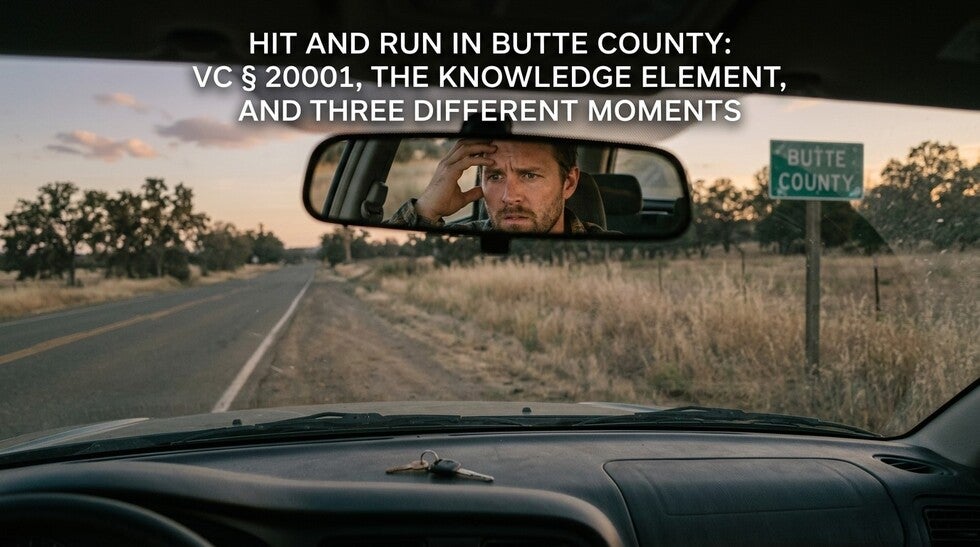
Hit and Run in Butte County can come from very different moments: a Highway 99 collision in tule fog, a parking-lot scrape in Gridley, a serious injury crash near Chico or Oroville, or a confusing vehicle incident involving someone who panicked and left. The charge may look simple, but California hit and run law depends heavily on what the driver actually knew, what the accident caused, and whether the driver willfully failed to perform required duties.
Under California law, hit and run is not mainly about who caused the crash. A driver can face charges even if they were not at fault for the collision. The legal focus is whether the driver was involved in an accident, knew or reasonably understood from the circumstances that injury or property damage occurred, and failed to stop, identify themselves, and provide required assistance or notice.
Hit and Run in Butte County under VC § 20001 and VC § 20002
Vehicle Code section 20001 applies when an accident results in injury or death to another person. The driver must immediately stop at the scene and fulfill the duties required by California law, including providing identifying information and reasonable assistance to injured people. If the accident involves death, additional notice duties may apply.
VC § 20001 can be charged as a misdemeanor or felony in many injury cases. If the accident results in death or permanent, serious injury, the felony exposure can be two, three, or four years, and misdemeanor punishment can include a mandatory minimum jail term unless the court reduces or eliminates it in the interests of justice. Fines can also apply.
Vehicle Code section 20002 applies when the accident results only in property damage. It is a misdemeanor punishable by up to six months in county jail, a fine of up to one thousand dollars, or both. A property-only case may still affect employment, licensing, immigration, insurance, and driving privileges.
Hit and run defense differs by county and local facts. A case involving Kern County VC § 20001 allegations may involve different roadway conditions, agency practices, and courthouse procedures than a Butte County case on Highway 99, Highway 70, Oroville Dam Boulevard, or a Chico surface street.
Hit and Run in Butte County and the knowledge element
The knowledge element is often the center of the case. For VC § 20001, the prosecution generally must prove the driver knew they were involved in an accident that injured another person, or knew from the nature of the accident that injury was probable. For VC § 20002, the prosecution must prove the driver knew they were involved in an accident that caused property damage, although knowledge may be inferred from the circumstances.
This is where the facts matter. A major impact, deployed airbags, obvious body damage, a person on the ground, or a loud collision may support an inference of knowledge. A minor scrape, thick fog, road noise, heavy traffic, music, vehicle vibration, or poor visibility may create a real dispute about whether the driver knew an accident occurred.
Important evidence can include:
- Vehicle damage and whether it would have been noticeable to the driver.
- Dashcam, surveillance, and body-camera video.
- Road surface, weather, lighting, and visibility.
- 911 calls, witness statements, and timing.
- Vehicle data, GPS records, and phone location evidence.
- Statements about what the driver heard, felt, or saw.
- Repair records and photographs before repairs were made.
Highway 99 tule fog and actual awareness
Highway 99 through Butte County can involve seasonal tule fog, wet pavement, low visibility, commuter traffic, agricultural vehicles, and noise from worn road surfaces. In those conditions, a driver may feel something ambiguous and not understand that a collision occurred.
A knowledge defense in a tule fog case should be built from facts, not general weather complaints. The defense may examine visibility at the exact time and location, CHP observations, traffic speed, the type of contact, whether the driver's vehicle showed obvious damage, and whether the driver acted consistently with someone who did not realize an accident occurred.
The prosecution may argue that any driver would have known. The defense may respond with accident reconstruction, weather documentation, vehicle inspection, and testimony showing the contact was not objectively obvious under the actual conditions.
Gridley, H-2A workers, immigration fear, and willfulness
Some Butte County hit and run cases involve agricultural workers, H-2A workers, non-citizens, or people with mixed immigration concerns. In a Gridley parking-lot case or rural roadway incident, a driver may leave because contact with law enforcement triggers fear about immigration status, job loss, family support, or future visa consequences.
Immigration fear is not a complete defense to hit and run. The law still requires drivers to stop and perform their duties after an accident. But fear may be relevant to how the defense explains willfulness, panic, delay, later reporting, and whether the driver's conduct showed consciousness of guilt about causing the accident.
Non-citizens should not enter a plea without immigration-informed advice. A conviction can affect visas, admissibility, removal risk, background checks, and future applications depending on the final charge, sentence, facts, and record of conviction.
Property-only hit and run and civil compromise
In a VC § 20002 property-only case, civil compromise may be an important option. California Penal Code sections 1377 and 1378 allow certain misdemeanors to be compromised when the injured person has a civil remedy, compensation is made, and the court approves the compromise. This is not automatic, and exceptions apply.
When available, civil compromise can be valuable because it may lead to dismissal without a conviction. The defense should evaluate the property owner's loss, insurance status, restitution, whether any exclusion applies, and whether the prosecution or court is likely to object.
For students, nurses, CDL workers, non-citizens, and people whose background checks matter, avoiding a conviction in an eligible property-damage case can be a major priority. But any payment or apology should be handled carefully so it does not create admissions in a related civil, insurance, or criminal matter.
Serious injury, DUI, and fatal crash risks
A hit and run case becomes much more serious when the accident involves injury, death, intoxication, or prior DUI history. If alcohol or drugs are alleged, the case may include DUI charges, refusal issues, enhanced sentencing exposure, or even homicide theories in fatal cases.
Vehicular manslaughter while intoxicated is separate from hit and run. It focuses on causing death while driving under the influence and committing an unlawful act or negligent act. Bulldog Law's article on vehicular manslaughter while intoxicated under PC § 191.5 explains why fatal DUI-related crashes require a different defense analysis.
Prior DUI convictions can also change exposure. In DUI injury cases, VC § 23560 DUI injury with prior convictions may become relevant if prosecutors allege both injury and qualifying DUI history.
Even when the final case is resolved without prison, DUI-related probation terms can be strict. DUI sentencing and probation under VC § 23600 may affect counseling, license, alcohol program, search terms, and custody alternatives when DUI and hit and run allegations overlap.
Vehicle impoundment, license issues, and related charges
After a hit and run arrest or investigation, the vehicle may be towed, searched, photographed, inspected, or held as evidence. A person should not repair the vehicle before consulting counsel, because damage patterns can become central to the knowledge defense.
Impound issues can also affect transportation, employment, and ability to attend court. Bulldog Law's overview of vehicle impoundment after DUI and driving offenses is relevant when the accused needs to recover a car while preserving evidence.
Some cases include allegations about false identity, a suspended license, or invalid documents. If police claim a driver used altered or false license information after a collision, fraudulent driver's license defense under VC § 14610 may need to be addressed separately from the hit and run charge.
Moving vehicles, venue, and Butte County courthouse process
Hit and run cases in Butte County are handled in the Superior Court of California, County of Butte. The Butte County Courthouse is located at One Court Street, Oroville, CA 95965-3303. The North Butte County Courthouse is located at 1775 Concord Avenue, Chico, CA 95928. These are public court facilities, and Bulldog Law has no affiliation, endorsement, partnership, or special access with the court.
Cases may involve arraignment, release conditions, discovery, DMV issues, insurance records, accident reconstruction, restitution, civil compromise, pretrial negotiations, motion practice, and trial. Felony VC § 20001 cases can involve a preliminary hearing, while misdemeanor property-only cases may move faster.
Venue can matter when a vehicle moves across city or county lines before stopping, reporting, or being located. California has specific rules for offenses committed in transit, and venue for moving vehicle crimes under Penal Code § 783 may be relevant if the route crossed multiple jurisdictions.
Autonomous vehicles, vehicle theft, and unusual accident settings
Not every modern vehicle case involves a traditional driver sitting behind the wheel. Automated systems, driver-assistance features, rideshare fleets, delivery vehicles, commercial vehicles, and remote data can complicate the investigation. California has emergency-response requirements for autonomous vehicles, and VC § 38751 autonomous vehicle emergency response rules may matter in unusual crash investigations involving automated technology.
Sometimes a hit and run investigation overlaps with vehicle theft or unauthorized use allegations. If police claim the vehicle was stolen, entered unlawfully, or connected to theft from a vehicle, California SB 905 vehicle theft changes may be part of the broader defense discussion.
Other vehicle-based allegations can also arise from the same traffic stop or welfare check. For example, animal confinement in a vehicle under PC § 597.7 is a separate issue, but it can appear if officers discover an animal in the car after a collision investigation.
Feather River and Lake Oroville vessel incidents
A boating collision is not the same as a Vehicle Code hit and run. California vessel operators have duties under the Harbors and Navigation Code, including duties to provide practicable and necessary assistance when involved in a vessel collision, accident, or casualty, so long as doing so does not create serious danger to the vessel, crew, or passengers.
Boating accidents can also trigger reporting duties depending on injury, death, disappearance, property damage amount, or vessel loss. A Feather River or Lake Oroville boat collision should be analyzed under boating law, not automatically charged or described as VC § 20001 or VC § 20002.
Still, similar factual questions may matter: what did the operator know, what was visible, what was the current, what contact occurred, whether anyone was injured, and whether the operator provided assistance or identifying information when required.
Comparing Butte County with other California hit and run cases
California uses the same statewide hit and run statutes, but local facts shape the defense. Butte County cases may involve tule fog, rural roads, agricultural workers, Highway 99, Highway 70, Chico student traffic, Oroville recreation travel, and courthouse assignment between Chico and Oroville.
Other counties can present different patterns. A defense for Yuba County hit and run under VC § 20001 may involve different roadway evidence and local enforcement practices. Yolo County hit and run defense may focus on university traffic, agricultural corridors, or Interstate routes. Riverside County VC § 20001 cases may involve higher-volume freeway and desert-region conditions.
What to do after a hit and run arrest in Butte County
Do not discuss what you felt, heard, saw, or believed without legal advice. Those details go directly to the knowledge element. A statement meant to sound helpful can become the prosecution's strongest evidence.
After a hit and run arrest or investigation, consider these steps:
- Do not repair, sell, wash, or alter the vehicle until counsel reviews evidence issues.
- Preserve dashcam, GPS, telematics, phone, and vehicle data immediately.
- Save insurance notices, tow paperwork, citations, and court documents.
- Write a private timeline for your lawyer, including weather, route, stops, and visibility.
- Identify witnesses who saw the vehicle before or after the alleged collision.
- Do not contact alleged victims without legal guidance.
- If you are a non-citizen or CDL holder, tell your lawyer immediately.
- If the case is property-only, ask whether civil compromise may be available.
Hit and Run in Butte County lawyers in California
Bulldog Law helps clients facing Hit and Run in Butte County, including VC § 20001 injury allegations, VC § 20002 property-damage cases, Highway 99 tule fog knowledge defenses, Gridley and rural worker issues, civil compromise, DUI-related collisions, fatal crash exposure, vehicle impoundment, license issues, and courthouse proceedings in Chico and Oroville.
No lawyer can promise dismissal, reduction, civil compromise, or a specific outcome. What Bulldog Law can do is review the evidence, preserve vehicle data, challenge the knowledge element, evaluate willfulness, address collateral consequences, and build a defense focused on the facts prosecutors must prove.