
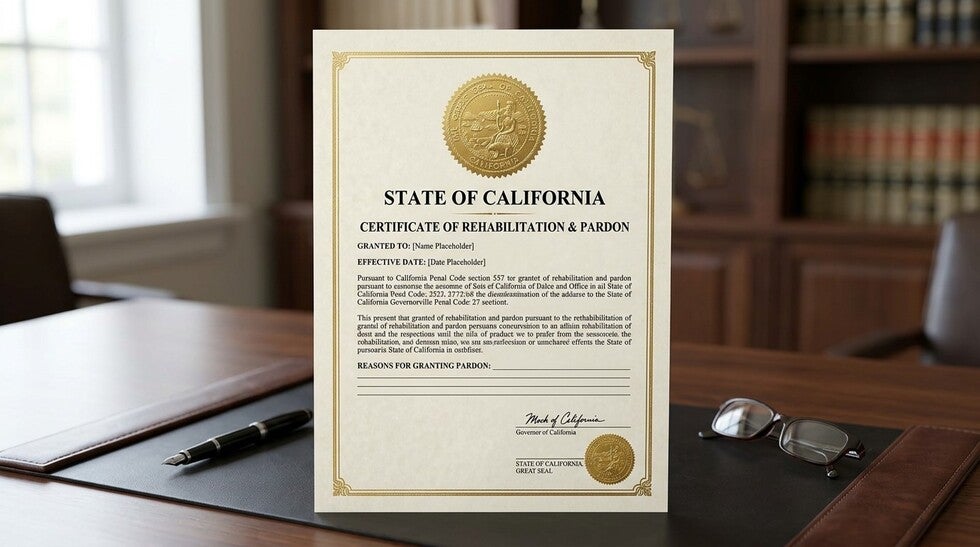
A Certificate of Rehabilitation is a California court order declaring that a person convicted of a felony has been rehabilitated. It becomes available roughly 7 to 10 years after release, depending on the offense, and once granted, it automatically becomes an application for a Governor's pardon, the state's highest act of forgiveness, which can restore firearm rights, strengthen professional licensing, and even help with immigration consequences.
These are the top rungs of California's post-conviction ladder, the remedies for people whose goals go beyond what expungement and record sealing deliver. Many people spend years cleaning up their record only to find that a job application, a licensing board, or an immigration filing still asks about the old conviction. That is exactly where these two remedies come in. This guide from The Bulldog Law's expungement and post-conviction relief practice explains what each remedy does, who qualifies, how the process works, and how to pick the right rung for your goal.
What Is a Certificate of Rehabilitation?
A Certificate of Rehabilitation (Penal Code §§ 4852.01–4852.21) is a superior court's formal finding, after a noticed hearing, that you have lived an honest and upright life since your conviction and are rehabilitated. Unlike expungement, which is largely a paperwork remedy, a CoR is earned in a courtroom: a judge reviews years of your post-conviction life, including employment, family, community involvement, sobriety, and letters of support, before signing an order that says, in the state's own voice, this person has changed.
Two things make it uniquely powerful. First, it is the only court order of its kind that licensing boards, employers, and courts treat as affirmative evidence of rehabilitation. Second, by statute, the granted certificate is automatically transmitted to the Governor as an application for a pardon, so no separate application is needed.
According to the California Courts Self-Help Guide, once a judge grants a Certificate of Rehabilitation, it is sent directly to the Governor's Office, the Board of Parole Hearings, and the California Supreme Court, and the petitioner does not need to file anything further unless the Governor's Office reaches out. That single fact is why so many attorneys, including our team, push clients toward the CoR route whenever they qualify. It saves a separate filing and it puts a judge's signature behind the request before it even reaches the Governor's desk.
I have sat across from clients who assumed a pardon was something they had to beg for out of thin air, with no help from the court. Learning that the certificate itself does the asking is often the moment their shoulders finally drop.
Who Qualifies for a Certificate of Rehabilitation?
Broadly, California residents convicted of a felony who have finished their sentence, stayed out of trouble, and completed a rehabilitation period of about 7 to 10 years since release may qualify. The working checklist:
-
A qualifying conviction. A California felony (people sentenced to prison, or probationers whose conviction was first dismissed under PC § 1203.4 expungement), plus certain specified sex misdemeanors. Federal and out-of-state convictions do not qualify. Those cases route to the direct pardon application instead.
-
Sentence fully completed. Custody, parole, probation, and supervision must all be discharged, with no new offenses and no pending cases.
-
California residency. You must live in California and have lived here continuously for the years immediately before filing. The petition is filed in your county of residence.
-
The rehabilitation period. A base of five years of California residence after release, plus additional years set by the offense, commonly two more (seven total) for most felonies, and four or five more (nine or ten total) for the most serious categories, including offenses involving life terms and specified sex crimes.
-
Not an excluded offense. A short list of serious sex offenses is statutorily ineligible for a CoR, and people serving mandatory life parole or under sentence in other states are excluded. Ineligibility here does not end the road; it redirects it to the direct pardon route below.
Honestly, the residency and timing rules trip up more people than the underlying conviction ever does. Someone who moved out of state for a few years to be near family, then came back, often has to restart the clock. If your situation is anything but simple, it is worth having someone check the math before you file, because a rejected petition wastes months you cannot get back.
What Does a Certificate of Rehabilitation Do and Not Do?
A CoR is proof, a pathway, and for some registrants, relief: it certifies rehabilitation for licensing and employment, it automatically applies for your pardon, and for certain offenses, it can end sex-offender registration.
What it delivers:
-
State licensing boards must consider it as evidence of rehabilitation, often the decisive exhibit in nursing, contracting, real-estate, and similar license fights.
-
The automatic pardon application starts the Governor's process without more paperwork.
-
Under § 290.5, people convicted of specified registrable offenses can be relieved of the duty to register upon obtaining a CoR. This is offense-specific, so eligibility needs case-by-case analysis.
What it does not do:
-
It does not erase, dismiss, or seal the conviction. That is the job of expungement and the Clean Slate sealing system.
-
It does not restore firearm rights by itself.
-
It does not bind the Governor. It only recommends.
Think of a Certificate of Rehabilitation like a strong letter of recommendation attached to a job application. It carries real weight, and it opens the right door, but someone else still makes the final call. That is exactly the relationship between the CoR and the pardon.
How Do You Get a Certificate of Rehabilitation?
You petition the superior court in your county of residence, serve the district attorneys, build the rehabilitation record, and win a hearing. Because the process leans on evidence more than paperwork, it rewards people who prepare early and thoroughly.
Building Your Case Before You File
The sequence starts well before you walk into a courthouse. First, confirm eligibility and compute the rehabilitation period precisely, since miscounting is the most common fatal error in these petitions. For probation cases, you need the § 1203.4 dismissal first. Then you file the petition in the county where you live, with notice to the DA there and the DA of the county of conviction.
Next comes the part that actually decides the outcome: assembling the evidence. That means employment history, tax records, community and volunteer work, treatment or sobriety documentation, and letters from people who know the arc of your life, not just the highlight reel. I always tell clients that a stack of generic character letters rarely moves a judge. A letter from a supervisor who watched you show up on time for five straight years, or a pastor who has seen you mentor younger members of the church, tends to carry more weight.
What Happens at the Hearing
At the hearing itself, the DA may support the petition, stay silent, or oppose it. Judges grant these to petitioners who show a genuinely changed life, which is why the preparation, not the form, decides the outcome. If you need help pulling together a petition like this, contact The Bulldog Law. We can walk through your record with you and help build the strongest possible file before you ever step in front of a judge.
Verify what the state's file says before filing. The guide to what's in your California criminal record shows how to pull and audit it, and it can save you from an awkward surprise at the hearing.
What Is a Governor's Pardon and How Do You Apply?
A pardon is the Governor's formal forgiveness of a California conviction, reached by two roads: the automatic route through a Certificate of Rehabilitation, or a direct application for those the CoR cannot serve.
Route one is the CoR. Once granted, the certificate itself is the pardon application, forwarded by the court. Route two is the traditional direct application to the Governor's office, the path for people ineligible for a CoR, including those who now live outside California and those with excluded offenses.
Either way, the Governor's Office explains that the Board of Parole Hearings typically investigates the applicant's criminal history, court and police records, and prison record if any, and then reports its findings to the Governor. The decision is discretionary and there is no set timeline, so pardons are measured in years, not months, and the office itself notes there is no fee and no lawyer is required to apply.
One constitutional wrinkle: an applicant with two or more felony convictions can be pardoned only with the recommendation of a majority of the California Supreme Court, an extra step, not a wall.
What Does a Pardon Actually Do?
A pardon restores civil rights, can restore firearm rights, and transforms licensing and immigration postures, but it does not erase the conviction. The record afterward shows a conviction that was pardoned.
The concrete effects:
-
Firearm rights are restored by a full and unconditional pardon, unless the conviction involved the use of a dangerous weapon. The mechanics and the weapon exception are detailed in the firm's guide to restoring firearm rights after a Governor's pardon (PC § 4854).
-
Licensing boards treat a pardon as the strongest rehabilitation evidence that exists.
-
Jury and other civil capacities are cleared of the conviction's cloud. The California Courts Self-Help Guide confirms a pardon can allow someone convicted of a felony to serve on a jury and can help with a professional license from a state board.
-
For non-citizens, a full and unconditional pardon can eliminate certain conviction-based immigration consequences, a narrow, technical, sometimes life-changing effect that must be analyzed with immigration counsel, as explained in the firm's guide to deportation consequences of criminal convictions.
What no pardon does: delete history. Even the state's own self-help materials are blunt about it, noting that a pardon cannot let you say you have no criminal record. The honest frame is this: a pardon does not say it never happened. It says the State of California forgives it.
A client once told me he thought a pardon would let him check "no" on the criminal history box forever. I had to walk that back gently. It still stings a little to deliver that news, but going in with the right expectations makes the whole process feel like a win instead of a letdown.
The Post-Conviction Ladder: Which Relief Do You Actually Need?
California's remedies stack, and the right one depends on your goal, not your guilt. The ladder, bottom to top:
-
17(b) reduction. Converts a wobbler felony to a misdemeanor, the foundation move, explained in the firm's 17(b) guide.
-
Expungement (§ 1203.4). Dismisses the conviction for most employment purposes after probation.
-
Sealing. Removes records from public background checks, automatically under SB 731's Clean Slate system, and by petition for arrests without convictions under PC § 851.91.
-
Certificate of Rehabilitation. The court's rehabilitation finding, useful for licensing fights, § 290.5 registration relief where eligible, and the automatic pardon application.
-
Governor's pardon. The summit: firearm restoration (subject to the weapon exception), maximum licensing weight, and potential immigration relief.
Goal-mapping in one line each: job applications call for expungement plus sealing; a professional license means adding the CoR; gun rights or immigration exposure means the pardon. Most clients need two or three rungs in sequence, built in the right order, and each one makes the next easier. That is the craft of the broader post-conviction practice covered in the firm's criminal defense services.
If you are not sure which rung fits your goal, that is a completely normal place to be. Most people are not supposed to know California's post-conviction statutes by heart. That is what a consultation is for.
Frequently Asked Questions
How long do you have to wait for a Certificate of Rehabilitation?
Roughly 7 to 10 years after release, depending on the offense. The statute requires a rehabilitation period of five years of continuous California residence after release from custody or supervision, plus additional years keyed to the conviction, commonly two more (seven total) for most felonies, and four or five more (nine or ten total) for the most serious categories. The clock runs on clean living, and new offenses restart the analysis. Because miscounting the period is the most common reason petitions fail, computing it precisely with the actual discharge dates is step one.
Does a Governor's pardon restore gun rights in California?
Usually, yes. A full and unconditional pardon restores the right to own and possess firearms, unless the underlying conviction involved the use of a dangerous weapon, in which case the firearm prohibition survives the pardon under PC § 4854. This is the only California remedy that restores gun rights lost to a felony. Expungement, sealing, and the Certificate of Rehabilitation all leave firearm prohibitions untouched. Federal law adds its own layer for some histories, so a firearms-motivated pardon strategy should be mapped with counsel before filing anything.
Does a pardon clear your criminal record?
No. A pardon forgives the conviction; it does not erase it. After a pardon, the record shows the conviction and the pardon together, which is precisely its power for licensing boards and immigration analysis, where official forgiveness matters more than invisibility. If the goal is a clean background check, the tools are expungement under PC § 1203.4 and sealing under the Clean Slate system, and the strongest position of all is the full stack: conviction dismissed, record sealed, rehabilitation certified, pardon granted.
Can you get a California pardon if you live out of state?
Yes, through the direct application route. The Certificate of Rehabilitation requires current California residency, so former Californians cannot use the CoR path. Instead, they apply directly to the Governor's office with a traditional pardon application, which the Board of Parole Hearings investigates the same way. The conviction itself must be a California conviction; federal and other states' convictions are pardoned, if at all, by their own sovereigns. Out-of-state applicants win pardons regularly. The file just has to make the rehabilitation case without the court's certificate.
Do you need a lawyer to apply for a Certificate of Rehabilitation or a pardon?
No, neither the court nor the Governor's Office requires a lawyer for either filing. That said, both processes reward careful preparation, correct date calculations, and a well-organized record, and a single miscalculated date or missing piece of evidence can cost you months. If you would rather not navigate this alone, contact The Bulldog Law and we can help you figure out where you stand.
The Certificate of Rehabilitation and the pardon exist for people who did the hard part years ago, the living, and now need the law to say so. The paperwork is winnable, and the preparation is everything. The Bulldog Law's criminal defense team builds the full post-conviction ladder from 17(b) to the Governor's desk for clients across California. Contact the firm online or call (888) 928-1609 for a free consultation.