
Updated October 2026 | The Bulldog Law | California and Federal Criminal Defense
Civil asset forfeiture is the process by which the government takes property it claims is connected to a crime, by filing a case against the property rather than the person. The owner is not a defendant; the cash, car, or house is, and the owner has to come forward, file a claim by a deadline, and contest the taking, or lose it by default. California reformed its system in 2017: under Senate Bill 443, the state cannot forfeit cash under $40,000, or vehicles, real estate, or other property, without an underlying criminal conviction, and it cannot hand a seizure to federal agencies to avoid that rule unless the cash exceeds $40,000. Federal forfeiture, which applies to seizures by the DEA, FBI, Customs, and federal task forces, still requires no conviction and no charge. In both systems, the claim deadline is the whole case: 30 days from notice in California, typically 35 days in federal court, and a missed deadline forfeits the property without a hearing.
The Bulldog Law's attorneys handle forfeiture cases that begin three ways: a traffic stop in which an officer found cash and took it, an airport encounter with a DEA task force officer who asked about the money in a carry-on, and a drug or fraud case in which the seizure of accounts, vehicles, and a home was the first the client learned of the investigation. In each, the client is told that getting the property back requires proving it was innocent, which is backwards in California and only partly true in federal court, and that it is not worth the fight, which is what the agencies that keep the proceeds count on. What follows is how forfeiture works in each system, what the 2017 reform requires, the procedure and the deadlines, the defenses, and the common seizure scenarios. Call (888) 928-1609 or message our team the day you receive a notice of seizure, because the deadline has already started.
Civil forfeiture versus criminal forfeiture
Criminal forfeiture is part of a sentence: a defendant convicted of a crime forfeits the proceeds and instrumentalities of that crime, in the same case, after the conviction, under statutes such as 21 U.S.C. 853 for drugs and 18 U.S.C. 982 for money laundering. The defendant has every protection a criminal case provides, and the forfeiture rises or falls with the conviction. Our attorneys address it as part of the defense of the federal and money laundering cases in which it arises.
Civil forfeiture is a separate action, in rem, against the property itself. The government alleges that the property was used to commit a crime or represents its proceeds; the owner intervenes as a claimant; and the government's burden is civil, a preponderance in federal court, clear and convincing evidence in California. No conviction is required in federal court, and no charge against the owner is required either. The procedure was built for the 1980s drug war, it generates revenue for the agencies that seize, and it is the reason a person who has never been charged with anything can lose a car, a bank account, or the cash in a suitcase.
California: Health and Safety Code 11470 and the SB 443 reforms
California's forfeiture statute, Health and Safety Code 11470 and the sections through 11489, authorizes forfeiture of controlled substances, the equipment and vehicles used to manufacture or transport them, money and property furnished or intended to be furnished in exchange for them, and proceeds traceable to drug offenses. Vehicles are forfeitable only where the underlying offense involved specified quantities, and a family's only residence is protected in most circumstances. The procedure under Health and Safety Code 11488 and following: the seizing agency serves a notice of seizure and intended forfeiture on every person known to have an interest, the agency may proceed administratively for cash under $25,000 if no claim is filed, and a claimant who files a verified claim within 30 days of service forces the matter into superior court, where the prosecutor must file a petition and prove the case.
Senate Bill 443, effective January 1, 2017, added the conviction requirement that distinguishes California from most states. Under Health and Safety Code 11488.4(i), the state may not forfeit cash or negotiable instruments of less than $40,000, or any vehicle, boat, airplane, real property, or other personal property, unless a defendant has been convicted of an underlying offense in a criminal proceeding, and the forfeiture is then proven beyond a reasonable doubt. Cash of $40,000 or more may still be forfeited civilly, by clear and convincing evidence, without a conviction. The law also closed the adoption loophole: a state or local agency may not transfer seized property to a federal agency for forfeiture under federal law, and may not receive an equitable share of a federal forfeiture, unless the property is cash over $40,000 or a conviction has been obtained, with an exception for seizures made as part of a joint federal task force investigation. The practical effect is that a California police officer who takes $9,000 from a car cannot keep it unless someone is convicted, and cannot route it through the DEA to get around that.
The exceptions and the tactics that remain. Joint task force seizures, where local officers are deputized federally, proceed under federal law and the state rule does not apply; agencies have expanded task force participation for this reason. Cash over $40,000 proceeds civilly. And a conviction of anyone for an underlying offense, not necessarily the owner, satisfies the requirement, so that a passenger's plea to possession can support forfeiture of the driver's cash. Our attorneys read the seizure notice first for which agency seized and under which law, because the answer determines everything that follows.
Federal: the Civil Asset Forfeiture Reform Act
Federal civil forfeiture is governed by 18 U.S.C. 981 and 983 and the Civil Asset Forfeiture Reform Act of 2000, which set the procedure that applies to DEA, FBI, Customs, IRS, and task force seizures. After a seizure the agency sends a written notice to interested parties, generally within 60 days, stating the deadline to file a claim, which must be at least 35 days from the notice. A person who files a claim, a sworn statement of interest in the property, forces the government to file a judicial forfeiture complaint within 90 days or return the property. A person who does not file a claim, or who files a petition for remission instead, which asks the agency for mercy rather than contesting the forfeiture, loses the property administratively, with no judge involved. The notice is sent to the address the agency has, it is easy to miss, and the deadline is enforced strictly.
In court, the government must prove by a preponderance of the evidence that the property is subject to forfeiture, meaning connected to the alleged offense, and where the theory is that the property facilitated a crime, that the connection was substantial. The claimant may then assert the innocent owner defense under 18 U.S.C. 983(d), proving by a preponderance that they did not know of the conduct or, on learning of it, did what reasonably could be expected to stop it. The claimant may also challenge the seizure itself: property seized in an unconstitutional search is suppressible in the forfeiture case as in a criminal one, and the stop and search analysis our attorneys describe on our reasonable suspicion and motion to suppress pages applies. A claimant who substantially prevails recovers attorney's fees under CAFRA, which is why agencies settle contested cases with a lawful source of funds.
The common seizures
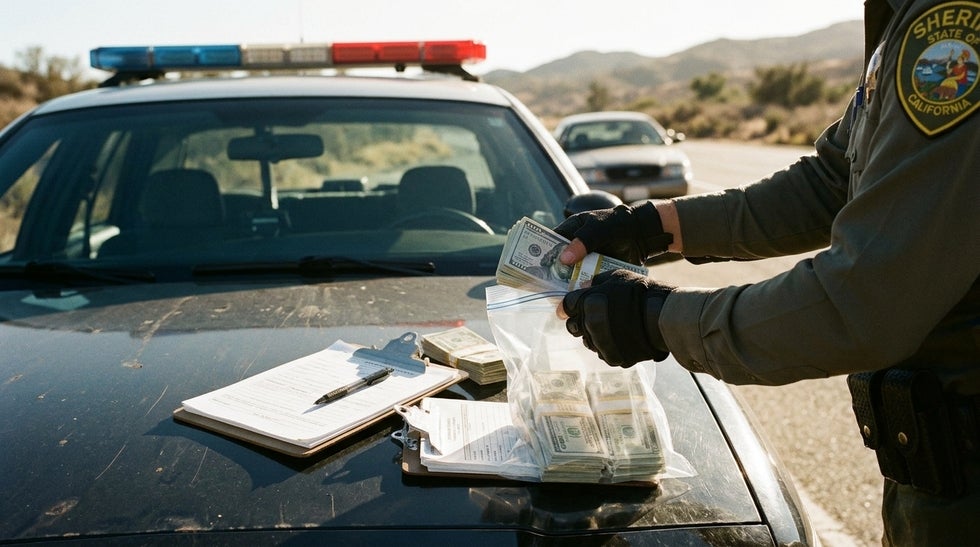
Cash in a car. The traffic stop, the tint or lane violation, the question about where the driver is going, the consent search or the dog, and the cash in the console or the trunk. The officer seizes it on the theory that cash in that amount, packaged that way, on that highway, is drug proceeds, and the driver is not charged. In California, under SB 443, the agency cannot keep cash under $40,000 without a conviction, and a driver who was not charged has a strong claim. In a task force seizure or a federal highway interdiction, the claim is filed in the federal process. The driver's statements at the roadside about the money are the government's evidence of its source, and the right to remain silent applies to questions about cash as to anything else.
Cash at the airport. DEA task force officers at California airports question travelers identified by ticket data, cash-paid tickets, one-way travel, and the TSA screeners who report cash. The traveler is asked about the money, the money is seized, a receipt is given, and the notice arrives weeks later. These are federal seizures, no conviction is required, and the claim must be filed. Travelers with a documented lawful source, a business, a sale, a withdrawal, recover the money in most contested cases, because the government's evidence is usually the amount and the dog. Customs seizures at international arrivals for failure to declare over $10,000 are a separate statute with a separate process and a penalty structure that often permits return of most of the funds.
Accounts and property in an investigation. In fraud, structuring, money laundering, and RICO cases, the seizure warrant for bank accounts, vehicles, and real estate is often served before or with the arrest, and the property is held through the criminal case. The forfeiture is then litigated alongside the prosecution, criminal forfeiture if there is a conviction and civil forfeiture if there is not, and the defense of the forfeiture is the defense of the case. A seized account that the family needs for living expenses or legal fees is addressed by motion, and the law on releasing funds for counsel is narrow but real.
Vehicles and homes in drug cases. California's statute reaches vehicles used to transport specified quantities and real property used to manufacture or store, with the residence protection, and SB 443 requires a conviction. Federal forfeiture of a home used for a cannabis grow or a drug sale requires only the facilitation showing, and the innocent owner defense for a co-owner who did not know is the usual contest. Our drug defense attorneys handle the forfeiture with the case.
Defending a forfeiture
File the claim. It is the only step that matters at the start. The verified claim, within 30 days in California or by the federal notice deadline, is what converts an administrative taking into a court case with a judge, a burden, and discovery. Our attorneys file it the day a client calls, because the deadline is counted from service or mailing, not from when the client read the notice.
Make the government prove the connection. In California under $40,000, that means a conviction, and a case in which no one is convicted ends with the return of the property. Above $40,000 and in federal court, the government proves the connection by evidence, and the evidence is frequently the amount of cash and an officer's opinion about how drug money is packaged; a lawful source, documented, is the answer.
Assert innocent ownership. For the co-owner, the lender, the parent, the spouse, the landlord. In California the government must prove the owner's knowledge and consent; in federal court the owner proves the lack of it. Either way the facts are the same, and the documents that show the owner's separate interest and separate knowledge are gathered first.
Challenge the seizure. An unlawful stop, a search without consent or probable cause, or a seizure without the probable cause the statute requires taints the forfeiture as it would a prosecution, and the suppression motion is available in the forfeiture case.
Negotiate. Contested forfeitures settle, because the government's evidence is thin in many cash cases, because CAFRA fees expose federal agencies to paying the claimant's lawyer, and because a conviction requirement in California changes the agency's calculation entirely. A claimant with a lawful source and a lawyer recovers most or all of the property in the ordinary case. The person who hears that the fight is not worth it, and does not file, recovers nothing, which is the outcome the system produces most often and the reason the reform was passed. After a criminal case ends, property held as evidence is returned through the process our attorneys describe on our seized funds page, and for non-citizens the forfeiture record is reviewed for its immigration effect, since a forfeiture is not a conviction but is used as evidence in discretionary decisions. A prosecution that depends on the cash and cannot explain it has one of the markers of a weak case, and the forfeiture claim is often where the weakness is exposed first.
Frequently asked questions
What is civil asset forfeiture?
A legal process by which the government takes property it claims is connected to a crime, without having to convict, or in the federal system even charge, the owner. The case is filed against the property itself, which is why the captions read like United States v. $42,000 in U.S. Currency. The government's burden is lower than in a criminal case, the owner has to come forward and file a claim to contest it, and if no one does, the property is forfeited by default. Cash, vehicles, and real estate are the usual targets.
Can police seize cash in California without charging me?
They can seize it on probable cause that it is connected to drug activity, but under California law they generally cannot keep it without a conviction. Since Senate Bill 443 took effect in 2017, state forfeiture of cash under $40,000 requires an underlying criminal conviction, and the state cannot hand the seizure to federal agencies to avoid that rule unless the amount exceeds $40,000. Above $40,000 the state may proceed civilly, by clear and convincing evidence, without a conviction.
How do I get seized money back?
By filing a claim within the deadline and forcing the government to prove its case. In a California seizure, the agency must serve a notice, and you have 30 days from service to file a verified claim with the superior court; in a federal seizure, the agency sends a notice with a deadline, usually 35 days, to file a claim that forces the matter into court. Miss the deadline and the property is forfeited administratively with no hearing. File it, and the government has to prove the connection to crime, which it often cannot.
What is the innocent owner defense?
The defense available to an owner who did not know about, or did not consent to, the illegal use of the property. A parent whose car was used by an adult child to sell drugs, a landlord whose tenant grew cannabis, a spouse whose joint account received a deposit from the other spouse's scheme, can each contest forfeiture on the ground that they had no knowledge. In California the government must prove the owner's knowledge; in federal court the owner must prove innocence by a preponderance of the evidence.
Can my cash be seized at the airport?
Yes, and it is one of the most common seizures. There is no limit on carrying cash domestically, and carrying more than $10,000 internationally is lawful if declared, but DEA task force officers and Customs and Border Protection seize cash from travelers on the theory that the amount, the packaging, a drug-dog alert, or the traveler's answers suggest drug proceeds. The traveler receives a receipt and, weeks later, a notice of seizure with a claim deadline. The claim is the only way to get it back, and most travelers who file one and have a lawful source for the money recover it.
Related reading from our attorneys
- Money laundering charges: state and federal
- Structuring cash deposits: 31 U.S.C. 5324
- Claiming seized funds under Penal Code 1422
Received a notice of seizure? The deadline is running, and the claim is the case
The Bulldog Law's defense attorneys file forfeiture claims and litigate the return of seized cash, vehicles, accounts, and property in California superior courts and federal district courts across the state, alongside the criminal cases that accompany them. Visit our criminal defense page, call (888) 928-1609, or reach us online.