
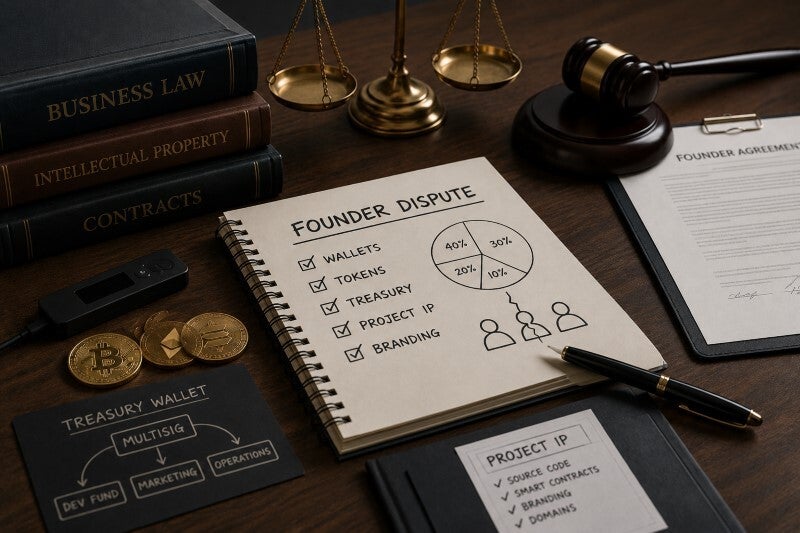
Crypto Business Breakups can be especially difficult because the most valuable assets may not sit in a bank account or a traditional company file. A founder dispute may involve wallets, tokens, smart contracts, multisig control, project code, brand assets, domain names, social accounts, investor records, Discord access, and treasury funds that can move quickly if control is not preserved.
For California founders, investors, advisors, and project teams, the main questions are usually practical: who owns the wallets, who controls the treasury, who is entitled to tokens, and who can continue using the project's code, branding, and intellectual property. The answers depend on the entity documents, written agreements, wallet records, contribution history, fiduciary duties, tax records, and any emergency court remedies that may be available.
Why Crypto Business Breakups are different from ordinary founder disputes
Crypto Business Breakups often combine traditional startup issues with digital asset issues. A normal founder split may involve stock, IP, customer lists, bank accounts, and confidential information. A crypto founder split may also involve private keys, token supply, smart contract admin rights, staking rewards, NFT collections, protocol fees, token unlocks, DAO votes, and anonymous or pseudonymous wallets.
Common breakup scenarios include:
- One founder leaves and claims a share of the project treasury.
- The remaining team tries to cancel or reduce a founder's token allocation.
- Signers refuse to approve transactions from a multisig wallet.
- A founder transfers tokens, stablecoins, or NFTs to a personal wallet.
- Project code, trademarks, domain names, and social media accounts are controlled by different people.
- Investors or contributors demand records showing how treasury funds were used.
- One side claims the other side used confidential information to launch a competing project.
When a breakup involves unpaid token grants, cliffs, lockups, or forfeiture language, token vesting contract disputes may become central to deciding what a founder, advisor, or employee is still owed.
Crypto Business Breakups and treasury control
Crypto Business Breakups often become urgent when treasury control is unclear. A project treasury may hold Bitcoin, Ether, governance tokens, stablecoins, NFTs, protocol revenue, liquidity pool tokens, staking rewards, or grant funds. If one founder controls the wallet or required signer keys, the other side may worry that assets will be moved before ownership is resolved.
Treasury control should be separated from treasury ownership. A person may have technical access to a wallet but not legal authority to use the funds for personal benefit. Likewise, a founder may own part of the company but not have unilateral authority to transfer project assets. Courts, arbitrators, and opposing parties may look beyond who holds the private key and evaluate who had authority under the operating agreement, shareholder agreement, partnership agreement, board approval, DAO proposal, or course of dealing.
Signer disputes are especially common when projects use shared wallets. If the wallet requires multiple approvals and one signer refuses to cooperate, the project may be unable to pay vendors, contributors, taxes, or settlement obligations. multisig wallet signer deadlock can turn a founder separation into an emergency dispute over access, authority, and asset preservation.
Founder token allocations, lockups, and forfeiture
Token allocations are often the emotional center of a crypto founder breakup. A founder may believe the token allocation reflects years of work, early risk, community building, engineering, fundraising, or brand development. The company may argue that unvested tokens were forfeited, that the founder failed to meet milestones, or that securities, tax, or compliance restrictions prevent transfer.
Important questions include:
- Was the token allocation written down in a signed agreement?
- Did the allocation apply to total supply, circulating supply, or a fixed number of tokens?
- Was there a cliff, lockup, vesting schedule, or acceleration clause?
- What happens after resignation, removal, termination for cause, or termination without cause?
- Did the project change tokenomics after the promise was made?
- Were the tokens ever minted, reserved, transferred, or held in treasury?
- Who had authority to approve or cancel the allocation?
Token compensation can also create tax and employment issues. If founders, employees, or contractors were paid in tokens, stablecoins, or other digital assets, cryptocurrency compensation and contract risks may affect valuation, reporting, withholding, and the legal characterization of the payment.
Ownership of code, branding, and project IP
Project IP can be as important as the treasury. A crypto startup may rely on source code, smart contracts, front-end interfaces, APIs, tokenomics documents, designs, logos, brand names, domain names, GitHub repositories, documentation, customer lists, pitch decks, and community content.
In a founder breakup, ownership can be disputed if the founders never signed IP assignment agreements or if contractors built key parts of the project without clear written transfers. In general, paying someone to write code or design branding does not always mean the company owns all intellectual property rights unless the legal paperwork supports that result. Employee-created work, contractor-created work, open-source code, commissioned designs, and preexisting founder materials can each raise different ownership questions.
Practical IP questions include:
- Who owned the code before the company was formed?
- Did each founder sign an invention assignment or IP assignment agreement?
- Did contractors assign copyrights, designs, and related rights in writing?
- Does the project use open-source code with license obligations?
- Who controls the domain, GitHub repository, app store account, social accounts, and trademarks?
- Was the project name or logo registered, licensed, or only informally used?
- Did a departing founder take confidential information or launch a competing project?
If the disputed business includes an NFT collection or creator royalty stream, NFT marketplace account disputes may affect whether the project can sell assets, collect revenue, or maintain access to its collector base.
Fiduciary duties in Crypto Business Breakups
Crypto Business Breakups can involve fiduciary duty claims when founders, partners, managers, officers, directors, or controlling participants allegedly misuse project assets. The duties involved depend on the business structure. A partnership, LLC, corporation, DAO wrapper, or informal venture may create different obligations.
Potential fiduciary-duty issues include self-dealing, diversion of business opportunities, secret wallets, undisclosed token sales, conflicts of interest, competing projects, misuse of confidential information, and failure to account for company assets. A founder who controls a treasury wallet should be cautious about making unilateral transfers during a dispute, even if that founder believes the other side acted wrongfully.
A fiduciary-duty claim is not automatic. The party asserting the claim must identify the duty, the conduct that allegedly breached it, causation, and damages. In crypto matters, those facts often require both on-chain records and off-chain evidence such as agreements, messages, accounting files, investor updates, governance votes, and wallet access logs.
DAO governance and community treasury disputes
Some founder breakups happen after a project has already introduced DAO governance. That can make authority harder to evaluate. The founders may disagree, tokenholders may vote, a foundation may hold assets, and multisig signers may still control execution. A vote may appear decisive to the community but still conflict with entity documents, investor rights, securities restrictions, or contractual obligations.
When governance procedures affect treasury use, token allocations, founder removal, or IP licensing, DAO governance fights over treasury control may determine whether a proposal was valid, whether signers had authority, and whether members or core contributors face exposure.
Founders should preserve proposal drafts, vote results, quorum data, delegation records, signer approvals, forum discussions, Discord messages, and treasury dashboards. These records may show whether the dispute is a business breakup, a governance dispute, a tokenholder dispute, or several disputes at once.
Tax, payroll, KYC, and sanctions issues after a founder split
Founder breakups can create tax and compliance problems long after the relationship ends. A project may need to determine who received tokens, who controlled wallets, whether gains or losses were realized, whether payroll or contractor forms were issued, and whether treasury payments were properly documented.
For companies paying workers or founders in digital assets, California crypto payroll compliance may affect wage timing, worker classification, withholding, tax reporting, and contractor documentation. A founder who was treated as an employee, advisor, consultant, or contractor may have different claims depending on the facts.
Tax notices may also arise if exchange records, wallet transactions, and reported income do not match. Form 1099-DA crypto reporting rules may increase the importance of accurate transaction records, wallet attribution, and basis calculations for digital asset activity. Broader planning around crypto taxes in 2026 can also matter when founders unwind holdings, distribute tokens, or report income from project activity.
If the breakup involves hacked wallets, scam proceeds, or missing treasury funds, the parties should document whether losses may be claimed and how they were discovered. reporting cryptocurrency losses may require careful evidence of theft, abandonment, sale, worthlessness, or other tax treatment. If the IRS later questions crypto reporting, crypto tax audit defense may depend on preserved exchange records, wallet histories, valuations, and communications.
Compliance issues can also affect whether funds may be transferred after the breakup. Projects with users, investors, contractors, or contributors may need KYC and AML controls for crypto startups before distributing funds or onboarding counterparties. Cross-border transfers, privacy tools, sanctioned wallets, and DeFi interactions may raise crypto sanctions compliance risks that should be evaluated before assets move.
Fraud, theft, scams, and asset recovery concerns
Not every breakup is only a disagreement over ownership. Sometimes one founder alleges that the other founder stole assets, used a fake exchange, transferred treasury funds to a personal account, changed wallet credentials, or sent project funds to a scammer. When digital assets move quickly, early preservation and tracing can matter.
If funds were stolen from a project wallet, legal options to recover stolen cryptocurrency may include blockchain tracing, exchange notices, preservation letters, subpoenas, civil claims, criminal reports, and emergency court relief depending on the facts. If a founder or investor was lured into sending treasury funds to a fraudulent investment platform, pig butchering crypto scam recovery strategies may help identify wallets, exchanges, and communications tied to the fraud.
Account takeover can also be part of a founder dispute. If a SIM swap or phone compromise allowed someone to access wallets, email, exchange accounts, or authenticator apps, SIM swap crypto theft liability may involve carriers, exchanges, account holders, attackers, or other responsible parties. If the project interacted with a fraudulent trading venue, fake crypto exchange scam claims may overlap with founder negligence, investor loss, or treasury misuse allegations.
Victims should also be cautious after a loss. Secondary scammers often target people who already lost crypto by promising guaranteed recovery. crypto recovery scam warning signs should be taken seriously before paying anyone who claims special access to blockchain funds, law enforcement, or exchanges.
Where crypto founder breakup cases may be handled in California
Crypto founder breakup cases may be handled in California Superior Court, arbitration, federal court, bankruptcy court, or private mediation depending on the claims and agreements. State-law claims may include breach of contract, fraud, conversion, breach of fiduciary duty, unfair competition, trade secret misappropriation, accounting, declaratory relief, or requests for injunctions.
If the dispute is filed in Los Angeles County Superior Court, some civil business matters may be heard at the Stanley Mosk Courthouse, 111 North Hill Street, Los Angeles, California 90012, depending on venue, assignment, and case type. Other counties have their own superior courts and local rules. Federal court may be involved if the dispute includes federal securities issues, bankruptcy, diversity jurisdiction, tax issues, sanctions issues, or other federal claims. Courts and agencies are neutral public institutions and are not affiliated with Bulldog Law.
Urgent cases may involve requests for a temporary restraining order, preliminary injunction, accounting, asset freeze, receiver, expedited discovery, or order preserving digital assets. Courts may need clear evidence explaining wallet mechanics, signer thresholds, asset volatility, IP control, and why immediate relief is necessary.
Evidence to preserve in Crypto Business Breakups
Crypto Business Breakups are often won or lost on records. A blockchain may show movement of assets, but the legal case usually depends on authority, ownership, intent, valuation, and damages.
Important records may include:
- Operating agreements, shareholder agreements, partnership agreements, bylaws, and founder agreements.
- Token allocation documents, vesting schedules, lockup terms, cap tables, and investor materials.
- Wallet addresses, transaction hashes, multisig records, custody records, exchange reports, and treasury dashboards.
- GitHub records, code repositories, commit histories, domain records, trademark files, and design files.
- IP assignment agreements, contractor agreements, advisor agreements, and employment documents.
- Discord, Telegram, Slack, Signal, email, forum posts, and project management records.
- Tax records, payroll records, invoices, valuation records, and financial statements.
- Evidence of conflicts of interest, competing projects, personal wallet transfers, or undisclosed side deals.
The goal is to build a timeline showing who contributed what, who owned what, who controlled which assets, what was promised, what was transferred, and what harm resulted from the breakup.
Practical steps after a crypto founder dispute begins
Once a founder dispute starts, the parties should avoid impulsive transfers, public accusations, deleted messages, or lockouts that could make the dispute worse. Practical steps may include:
- Identify all wallets, signers, treasury assets, admin keys, exchange accounts, and custody relationships.
- Review the entity documents, founder agreements, token documents, IP assignments, and governance records.
- Preserve communications and transaction records before access is lost.
- Document which assets are company property, founder property, investor property, or disputed property.
- Evaluate whether emergency relief is needed to prevent asset movement or IP misuse.
- Separate tax, payroll, employment, securities, sanctions, and fraud issues from the ownership dispute.
- Consider whether negotiation, mediation, arbitration, or litigation is the most practical path.
A careful early response may help preserve leverage, protect digital assets, and reduce the risk that a founder separation becomes a larger tax, regulatory, investor, or criminal issue.
Crypto Business Breakups lawyers in California
Crypto Business Breakups require legal analysis that connects startup documents, wallet control, token rights, project IP, fiduciary duties, tax records, and court remedies. The sooner the parties preserve evidence and define the disputed assets, the easier it may be to evaluate practical options.
Bulldog Law helps California clients address founder separations involving digital wallets, project treasuries, token allocations, smart contracts, code ownership, branding, investor disputes, fraud concerns, and emergency asset-preservation issues. If a crypto project breakup is developing, early legal review may help protect records, identify responsible parties, and pursue an effective strategy before assets move or evidence disappears.